How the jīva Came to Dwell in This Body
Why do you feel small? You — who are infinite consciousness — why do you live as though you are this body, this name, this limited person?
Ṛṣi Vasiṣṭha answers this directly. I shall now tell you how the jīva — the living soul — came to dwell in this body.
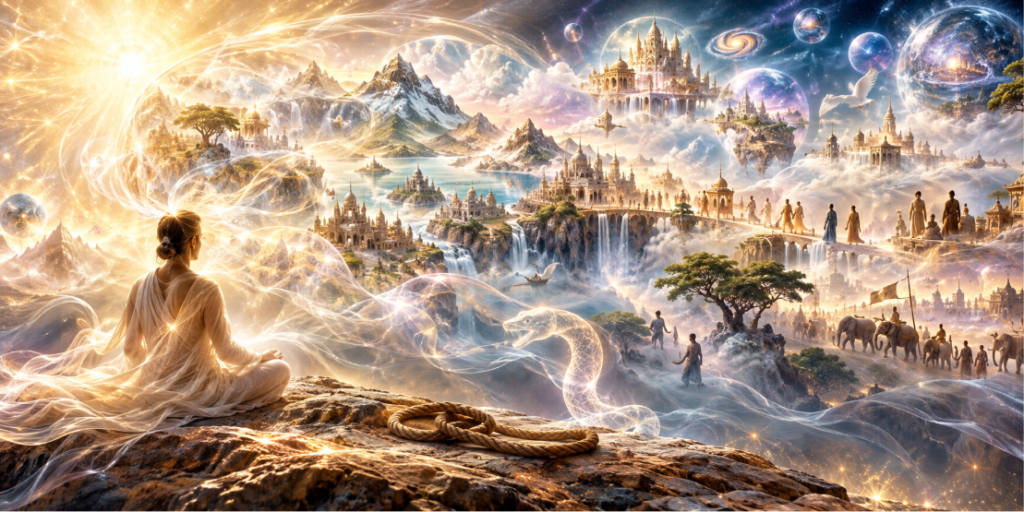
The jīva is, in truth, infinite consciousness. It has no size, no boundary, no location. But at some point, a thought arose within it: I am small. I am atomic. I am limited. And with that single thought — the jīva appeared to become exactly that. Limited. Contained. Bound.
But notice what Ṛṣi Vasiṣṭha says carefully: it only apparently became so. Nothing actually changed in the nature of the jīva. What changed was the imagination. And that imagination was false.
“This is the root of the entire story of bondage — not a real event, not a real fall — but a false thought, taken to be true.”
Ṛṣi Vasiṣṭha gives us an analogy. Even as a man may dream that he has died, and that he now inhabits another body — so too the jīva, whose true nature is an extremely subtle body of pure consciousness, begins to identify itself with grossness. And in identifying with it — it becomes gross.
“This is not a physical process. No material transformation has taken place. The jīva has not actually entered a body the way water enters a vessel. What has happened is subtler — and more dangerous. It has begun to think of itself as gross. As physical. As this particular body, in this particular place, with this particular name.”
And from that identification — the entire architecture of ordinary human experience is built.
Knowledge of the living state (personality), leads to that of Egoism which is the cause of intellection. This again introduces the sensations and finally the sensible body. (Ego is the subject of thoughts).
“Man is but a being of his own conception, and by getting rid of this concept, he is freed from his idea of the duality of the world (as a distinct existence); just as one with his shoes on, perceives the whole earth he treads upon, to be covered over with skin. Know the revolution of the visible world, to resemble the revolving wheel of a potter’s mill; which they turn about in play as the rotatory ball of a terrestrial globe.”
As the same gold is changed to the forms of bracelets and other things, and as the same gross matter appears in the different forms of wood and stone; so the uniform soul of God appears as multiform according to his various modes and attributes. (The soul modifies itself into many forms of activity and passivity).
Do not overlook the mist of error which overspreads this world of illusion, abounding with multitudes of mishaps and mischiefs.
In him resides entity and non-entity, in him there is unity, duality and plurality, and the beginning and end of all things. The density of the Intellect makes the mind, and the mind brings forth all the powers of thinking, willing or volition, and of acting or action. These it produces, accumulates, contains, shows and then absorbs in itself. There is that nature of Brahma, which you said to be beyond the perception of the mind and senses, and what are these perishable things, which you say to have proceeded from him. If your reasoning comes to this end, I cannot then rely upon it. The disciple is to be prepared and purified at first, with the precepts and practice of quietism and self-control (Sama and damā); and is then to be initiated in the creed that “All this is Brahma, and that thyself art that pure Spirit.”
The well discerning Sage should tell them, that are enlightened in their understandings, whose desire of sensual gratifications has abated, and who are freed from their worldly desires, that they are purged of the dirt of their ignorance, and are prepared to receive religious and spiritual instruction.”
The venerable Vasishtha, who was the chief of sages, and like the luminous sun on earth, having considered these things, spoke to Rāma as follows. Whatever takes place at any time or place and in any form, is but the variety of the One Self-existent reality. Why therefore, O Rāma! should you give vent to your sorrow or joy, or wonder at any change of time or place or nature and form of things, which are full of the spirit of God, and exhibit the endless aspects of the Infinitive Mood.
“He then formed from his thought (chitta) this creation, containing the fourteen worlds with all the bustle of living beings in them.”
You will understand the proper import of my phraseology, when the eyesight of your understanding becomes clearer, and when the light of reason will rise in your mind.
As the sea sparkles with the golden beams of the starry frame; so the translucent vast soul of God, shines with the light of its own intellectual sphere.
It is hard to have a wise man, whose mind is devoid of its firm reliance on the vanities of the world; and freed from its desire or disgust of something or others, as agreeable or disagreeable to its state. But the avaricious are not content with all they have, and like the body of this earth, is not full with all its hills and mountains and surrounding seas. The truly great and wise man, rests in that highest state of eminence; where the stations of the sun and moon, are seen as the nether regions.
Have you, Rāma! considered well the meanings of my words, and did you reflect at night the reasonings of yesterday in your mind? Know Rāma! the soul to be as unsullied by its outer covering of the body, as the sky is unsoiled by the clouds of dust which hide its face; and as the petals of the lotus are untainted by the dew-drops, falling upon them at night. By meditating on the Supreme Soul in yourself, and by contemplation of the intelligent Spirit in your own intellect, you will find the glory of the Supreme Spirit, shining brightly in your pure spirit.
The qualities of respectability and amiableness, of affability and friendliness, and of compassion and intelligence, attend upon these people like their attendants at home.
He then reflected in himself and said: The intellect being devoid of its option, there is nothing for me to desire; but the mind being fond of pleasures vainly pursues after them. I am not dead (because my soul is immortal); nor can I be living (because the soul is not connected with life).
“I am not a reality (as the body), nor an unreality (composed of spiritual essence only); nor I am a material or aerial body (being neither this body nor Vital air).”
Neither am I of this world or any other, but self-same ego—the Great. He saw the repeated flux and reflux of worldly enjoyments, and thence settled his mind in an utter indifference about them.
Therefore, O Victorious Rāma, forego the enjoyments of life, which are sure to be attended with a distaste and nausea at the end, and betake yourself to that state or true felicity, which never grows insipid at any time. Know your soul as a thread, passing through, and interwoven with every thing in existence; and like a string connecting all the links of creation, as so many gems of a necklace or the beads of a rosary. Know the desirables (or worldly enjoyments) to be your evils, and the undesirable (self-mortification) to be for your good. Therefore shun the former by your continued practice of the latter. You can not be said to have your right reasoning, so long as you do not come to the light and sight of the soul, both by your own exertion and grace of the Supreme Spirit. There are three causes of your coming to spiritual light. Firstly your want of the knowledge of a duality, and then the effulgence of your intellectual luminary (thy soul) by the grace of God and lastly the wide extent of your knowledge derived from my instructions.
He vanquished the Gods and Asuras, and reigned over the whole earth, as the elephant masters the lotus-bed, by expulsion of the drove of swans from it. Supported by his son on one hand, and possessed of his force and treasures on the other; he became puffed up with his pride, as the swollen elephant emitting his froth from his triangular mouth. The breath of his nostrils like a hurricane; drove everything before it; and the clapping of his arms (bahwasphota), beat as loud surges on the hollow shores. The surviving sons of the demon, who had fled from the burning of their city, were afterwards led back to it by Prahlāda; as the migrating fowls are made to return to the dry bed of a lake by a shower of rains. Woe unto us! that are so miserable in both our inward and outward circumstances; and happy are our enemies of light (Devas), that have their ascendency over us. O the terrors of darkness!
Ah! what is impossible to irresistible fate, that has so reduced the mighty demons; who were this while used to pluck the flowers from the mountain tops of Meru like big elephants, and are now come to the sad plight of the wandering Devas of yore. The beauteous ladies of the gods and Gandharvas, that were once detained as captives in the inner apartments of demons, are now snatched from us, and placed on Meru (the seat of the gods), as if they are transplanted there to grow as heavenly plants. This our great father, and these mighty demons under him, have been laid down to dust like the lofty hills, that were levelled with the ground by the blasts of heaven at the end of the Kalpa. I have thought of one expedient only to oppose the rage of Hari, beside which I find no other way for our safety. Obeisance to Nārāyana forms my faith and profession, for my success in all undertakings; and may this faith of mine ever abide in my heart, as the wind has its place in the midst of empty air. She is the brilliant glory of Hari, which was easily acquired by him, and is ever attendant on his person with undiminished lustre, and illuminates the three worlds as a radiant medicinal tree—mahaushadhi. I see there in the flaming fire, the flashing sword—nandaka of Vishnu, which like an axe hath cut down the gigantic bodies of Daityas like trees, while it gave great joy to the gods. I see the great Vishnu visibly manifest to my view, as shining under the cerulean vault of heaven, mounted on his eagle of mountain, and holding his conch-shell, discus, cudgel and the lotus in his hands. None of these hosts of gods or demigods that I see before me, is able to withstand the irresistible course of the destination of Vishnu. And all attempts to oppose it, will be as vain as for our weak-sighted eyes to shut out the light of the sun.
After Prahlāda had meditated on Vishnu, he made an image of him as Nārāyana himself, I will worship this image, said he, with all my adherents and dependants, with an abundance of grateful offerings. He hung hangings of leaves and leaflets of heavenly arbors, and chaplets and trimmings of various kinds of flowers, as vakas and kundas, kinkiratas and white, blue and red lotuses. The Devas were all astonished to learn, that the Daityas had accepted the Vaishnava faith; and even Indra marvelled with the body of Rudras about him, how the Daityas came to be so at once. Nothing is graceful without its proper place, as a rich jewel loses its value, when it is set with worthless pebbles.
“The Lord Hari said:—Don’t you marvel ye gods! at Prahlāda’s faith in me; as it is by virtue of the virtuous acts of his past lives, that pious prince is entitled to his final liberation in this his present life.”
Pleased at Prahlāda’s firm belief, the lord proceeded by the subterranean route to the place of his worship, and stood confessed before him at the holy altar.
I worship the god that dwells in the lotus-like hearts of his votaries, with his appearance of a swarm of sable bees; and holding a conch-shell as white as the bud of a lotus or lily, with the earrings ringing in his ears with the music of humming bees. I take my asylum under that Hari who is the destructive frost to the lotus-bed of demons; and the rising sun to the opening buds of the lotus-bed of the deities; who is the source of the lotus-born Brahmā, and receptacle of the lotiform seat (cranium) of our understanding.
A cursory rehearsal of his narration, wipes off the sins of men; while the deep consideration of its spiritual sense, leads one to his eternal salvation. The man who considers well the manner of Prahlāda’s gaining his proficiency, gets a remission of all the sins committed by him in his repeated previous states of life. Know Rāma, that there are two states of liberation attending on sinless persons, the one is the emancipation of one in his embodied state in this life, and the other is after his departure from here.
Lord! I have again wandered about the countries of the Bhotas and Kirs for these past six months, and found no discrepancy in the accounts, they gave of me lately from the former ones. The Lord said:—It often happens that many things are of simultaneous occurrence at the one and same time; as the kākatālīya sanyoga or the synchronous flying of the crow and the falling of the fruit upon him. Thus it was that the idea of the Chandāla was of contemporaneous growth in the minds of all the Bhotas and Kirs as of thyself: as there are many men that are prepossessed with the same opinion with others, however wrong it may be. Time according to its common reckoning by years, kalpas and yuga-ages, is classed among the categories of substance; but time far from being a substance, is the source of all substances. The lord said:—This world, O Brāhman! is a delusion, like the enchantment of the conjurer Sambara; all things here, are the wondrous productions of imagination, and proceed from forgetfulness of the self. This state of Kātanjaka entered into thy mind, when thou hadst been standing amidst the water in thy devotion; and the thoughts of the whole career of the Chandāla, had altogether engrossed thy mind. But that ‘I am all in all’ is the belief of the truly wise, which prevents them from falling into such mistakes; and keeps them from the wrong notions of individualities and particularities, from their belief in the generality of all persons and things. Gādhi then gradually gained his dispassionateness, by means of his discrimination; as the trees fade away for want of moisture, at the end of autumn.
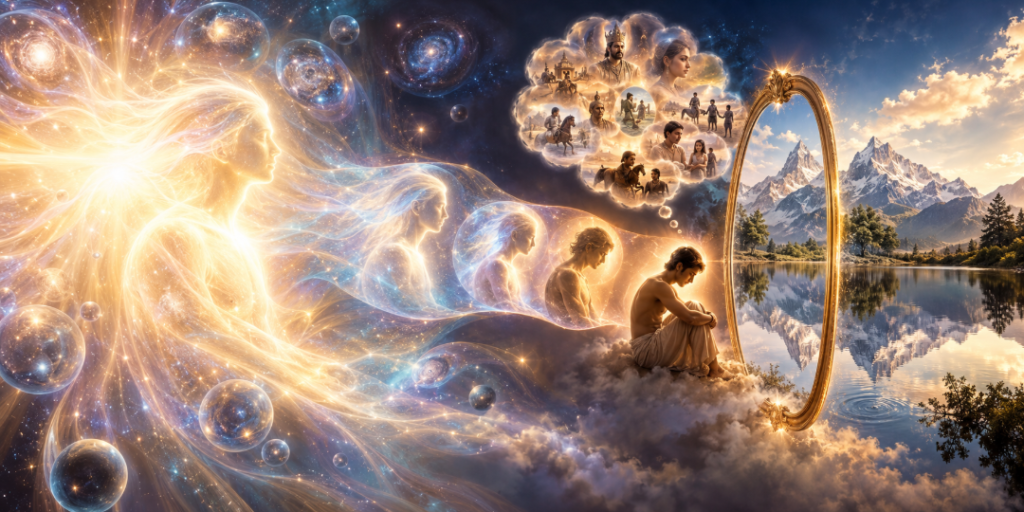
Then Ṛṣi Vasiṣṭha gives a second analogy. A mountain stands outside a mirror. But when it is reflected in the mirror — it appears as though the mountain is inside the mirror. The mirror has not become a mountain. The mountain has not entered the mirror. And yet — there it is, appearing to be within.
In the same way, the jīva reflects the external world — its objects, its activities, its movements — and begins to think: all of this is within me. I am the one doing these actions. I am the one having these experiences.
“The doer is born. The experiencer is born. Not as a reality — but as a reflection mistaken for reality.”
And so the jīva, whose true nature is pure witnessing consciousness, now lives as though it is a person — acting, suffering, enjoying, striving — inside a world that is, in truth, only its own reflection.