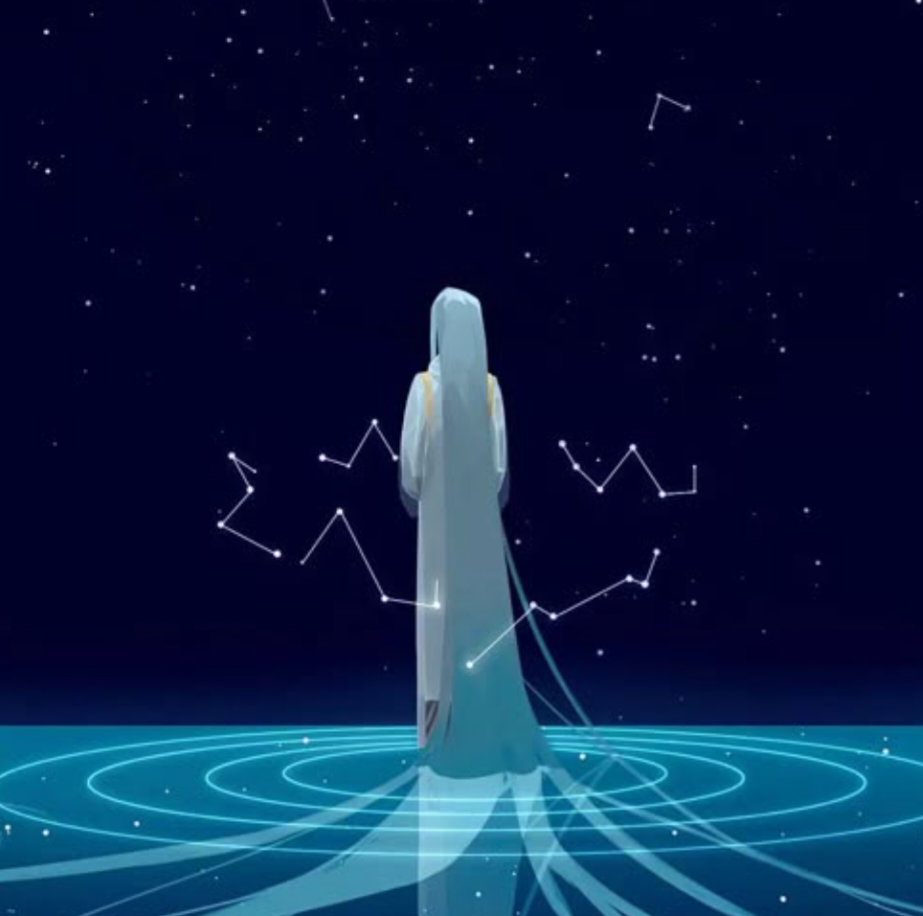
Step beyond transmigration into the peace of pure consciousness.
Pure Presence of Consciousness
Step beyond transmigration into the Absolute Reality.
Unfolding into Turya-Gati: A Lived Experience
The Sacred Crossing
A yatra is not measured in the distance covered. It is measured in what falls away.
The Yoga Vāsiṣṭha does not speak of liberation as something granted by a place. It speaks of seven stages by which the jīva moves from bondage to Brahman — subhecchā, the first stirring toward good; vichāranā, discretion born of right guidance; tanumānasā, the thinning of the mind; sattā-patti, the turn toward the Self as one’s only true refuge; asaṅga, the falling away of clinging; padārtha-bhāvanā, the dissolving of the very sense of “thing”; and turya-gati, the stage that opens into the fourth state itself. Our pilgrimage is built to walk the seeker through exactly this arc — not as a metaphor, but as a lived structure.
The setting out itself is subhecchā — the will to leave what is known, because staying has stopped feeling sufficient. What follows, in the presence of the master who has seen it all — who has already stood where truth stands, and returned to point the way — is vichāranā, the discretion the Sāstras say cannot arise alone, only in the company of one who knows. Here the inquiry begins in earnest: what is this world I have taken to be so solid? What is this “I” I have taken to be so real?
This inquiry is what thins the mind — tanumānasā. Not the wearing down of the body, but the direct recognition that the mind itself is not what it claims to be. Mind is only a movement of thought; when action comes to an end, mind comes to an end with it. The ego that seems to stand at the center of every experience — examined closely, it too dissolves, revealed as a name given to something that was never there to begin with. This is sattā-patti: the turn away from every borrowed refuge, toward the Self as the only ground that was ever real.
From here falls away what the mind was so sure it owned — asaṅga. Birth and death, held as the two great certainties of a life, are seen as events happening to a person who does not, on inquiry, exist. Memory, which strings moments into a story called “me,” is seen for what it is — recollection, not reality. Even knowledge, so long as it is held as something gathered and possessed, is recognised as another movement of the same unreal mind. And māyā — the appearance that made all of this look so convincing — is seen simply as appearance, nothing more. What remains, once the falling away is complete, is padārtha-bhāvanā: the point where the seeker, the seeking, and the sought are no longer three things standing apart.
This is where turīya opens. The Vāsiṣṭha calls it “deep sleep in wakefulness” — a state where the outward movement of thought has ceased, where all attachment has been snapped, and only peace remains. Not the peace of rest after effort, but the peace of the jīva that has stopped being jīva at all — freed from the pull toward objects, freed even from the memory of having sought. This is the sacredness a pilgrimage can offer that no ordinary journey can: not a teaching read about turīya, but a moment lived inside it.
And beyond turīya is what the pilgrimage was always moving toward — the direct experience of the Self, pure and infinite consciousness. That which is infinite does not travel from one place to another; movement is only possible where something exists outside oneself, and for the Self, nothing does. Everything that exists is already within consciousness. So where could the Self possibly go? It neither comes nor goes — for without consciousness, who would experience space, or measure time? This is Brahman, not approached from a distance, but recognised as what was never absent.
This is why we do not call it a yatra. We call it a sacred pilgrimage — a movement through the seven stages, undertaken in the body, so that what the Sāstras describe as a ladder of knowledge becomes, for a few days, a ladder you actually climb
If you feel drawn to this journey, write to us and we will plan it together.

Step into the supreme silence where the illusion of the world gently recedes.
The Field of Supreme Stillness
The Sacred Field
A pilgrimage moves through stages. A retreat does not move at all — and that is precisely its power.
The Yoga Vāsiṣṭha speaks of vāsanā — the deep-seated tendencies of the mind, the residue of countless movements of thought toward countless objects. These are not removed in a single crossing. As long as the seed of vāsanā remains, even a little, the state attained is like deep sleep — not perfection. It is only when vāsanā is destroyed at the root, and even its potential to arise again is gone, that the state matures into what the Vāsiṣṭha calls the fourth state, the transcendental turīya. This is not accomplished by a moment of insight. It asks for an uninterrupted dwelling — days given entirely to the wearing away of what has taken a lifetime to accumulate.
This is what a retreat is for. Not withdrawal from the world for its own sake, but sustained proximity to one’s own mind, without the daily movement outward that gives vāsanā fresh ground to take root in each day. Little by little, the pull toward objects weakens. The jīva — which the Vāsiṣṭha describes as tainted only by its own ignorant self-limitation — begins to see the vanity of what it has spent a lifetime reaching for. Attachments, held long enough in this stillness, are not overcome by force. They are simply seen through, and in being seen through, they snap.
What arises is “deep sleep in wakefulness” — a state of rest that is not unconsciousness, and a wakefulness that carries none of the mind’s usual movement. Held and matured over the days of a retreat, this state deepens into turīya itself: the pure and equanimous state, free of ego-sense and non-ego-sense, free of the real and the unreal as the mind normally divides them. Not the movement of waking or dreaming. Not the inertia of deep sleep. Something the Vāsiṣṭha calls the unbroken witness — present, aware, and utterly undisturbed.
And here lies the discipline the tradition insists on: even this experience, once touched, must not be seized and stored as memory, revived later as a desire to feel it again. That would only build a new vāsanā in place of the old. What a retreat asks of the seeker is subtler — to rest in equanimity even toward the experience of equanimity itself, so that when it comes unsought, it passes through without being clutched.
This is the sacredness of Sacred Stillness. Not a pause from life, and not a technique practiced for a fixed number of days. It is the uninterrupted dwelling in which vāsanā, held long enough in the light of attention, exhausts itself — until what remains is the mind at perfect equilibrium, the ego-sense abandoned, and turīya no longer read about, but lived.
If you feel drawn to this journey, write to us and we will plan it together.