Ego — the seeds of our endless transmigrations
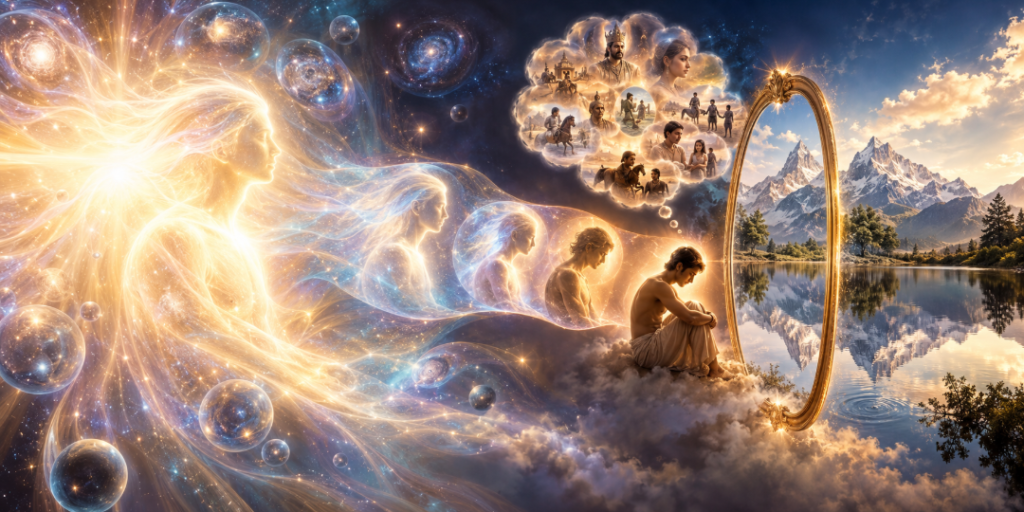
What has become of thy body, after it was rotten in a fortnight and evaporated in the air. Now when they will behold thee coming here in thy same body, they must be astonished to think thee as returned from the next world of the dead. When thou shalt appear before them in this thy purer and spiritual form, they must look upon thee with astonishment. For thou hast not thy former form at present, but it is changed to a purer one, agreeably to the tenor and temperament of thy mind. (Lit. according to the desire in thy heart).
For every body beholds every thing without him, according to his inward feelings; as for example the sight of shadowy ghosts is frequent to children, that have a fear of devils at heart. Thou art an adept in spiritualism, and hast a spiritual body on thee, and hast forgotten and forsaken thy former body, with all the desires connate with it.
The view of material bodies, is lost to the sight of spiritualists; and the intelligent view them in the light of autumnal clouds, which are void of substance (i. e., The flimsy clouds which are without rain-water in them). On attainment of the spiritual state, the material body becomes as an empty cloud, and as a flower without its odor. When a man of pure desire, is conscious of his attaining the spiritual state; he loses the remembrance of his material body, as a youth forgets his embryonic state.
Their dead bodies were devoured by the voracious beasts of the forest, or tossed about as some ripe fruits by the monkeys on the hills, (to be food for greedy vultures and hungry dogs). It was then thy dark night, and the previous creation slept as in their yoga-nidrā or hypnotic trance in thy sleeping self. Thus thou continuing in thy spirit, didst contain all things in thee in their spiritual forms.
Therefore do thy work as it comes to thee, with a cheerful heart, and calmness of mind; with a tranquil soul, as if it were in thy sleep, and devoid of desires which thou canst never reap. Whatever belief is deep-rooted in the minds of living beings, it is impossible to remove it by any body, except by its owner (by change of his mind or its forgetfulness).
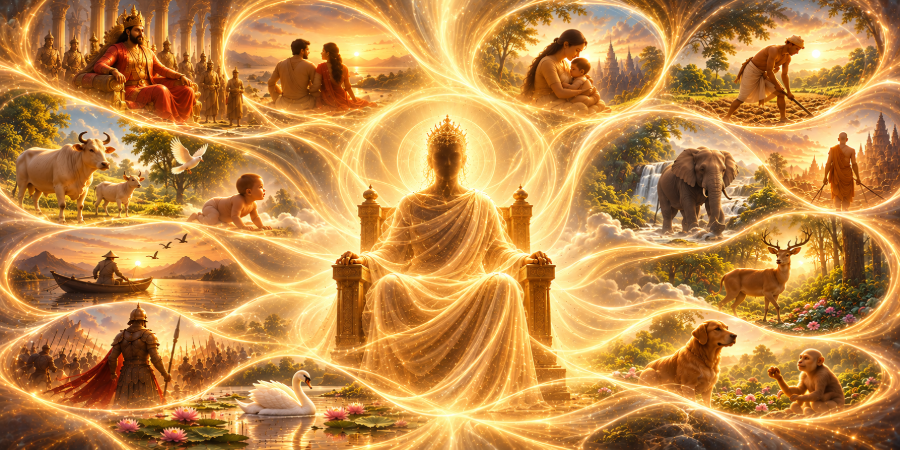
Thoughts are the seeds of action, and action is the soul of life. Past acts are productive of future consequence, but inaction is attended with no result. (Our lives are reckoned by our acts, and there is no vitality without activity). The living soul bears its vitality as the seed bears the germ in its bosom; and this sprouts forth in future acts, in the manner of the various forms of leaves, fruits and flowers of trees.
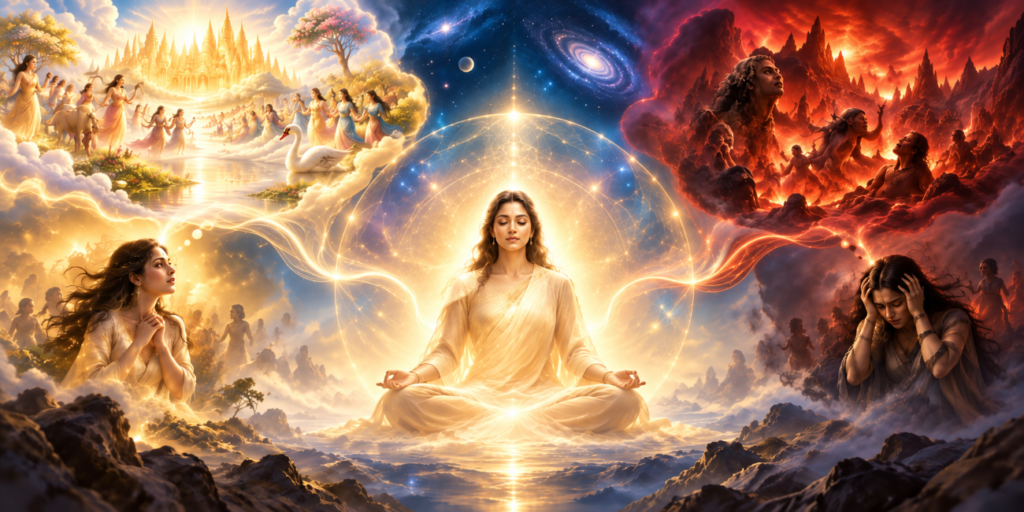
The personal acts of people are the causes of their repeated births and deaths in this or other worlds; and they ascend higher or sink lower by virtue of their good or bad deeds, which proceed from their hearts and the nature of their souls. Our actions are the efforts of our minds, and shape our good or bad destinies according to the merit or demerit of the acts. The fates and chances of all in the existing world, are the fruits and flowers of their past acts, and even of those done in prior Kalpas; and this is called their destiny.
“Sāstra: No act goes for naught even in a thousand Kalpas. Mā bhuktan kshiyate Karma, kalpa koti satai rapi.”
The ignorant have no notion of the spirit, beside that of matter, which they believe as the cause and effect (Kārya Kārana) of its own production.
“There is but One Being that is really existent, who is truth and consciousness himself, and of the nature of the vacuum and pure understanding. He is immaculate, all pervading, quiescent and without his rise or fall.”
Being then crushed to death in that marshy ground under the feet of buffaloes, they were transformed afterwards to the shapes of cranes, frequenting that lake of lotuses. The mind hangs in doubt between what is and what is not, and what is right and what is wrong.
“It forgets the past like the scent of a fleeting odor by its wilful negligence. (Unmindfulness is the cause of forgetfulness). What is true and real shines forth amidst all that is untrue and unreal; so does the subjective essence of the mind subsist amidst all its airy and fleeting dreams in sleep.”
The erroneous conception either of the reality or unreality of the outer world, does not spring in the mind, which is conscious of its operations only, and of no outward phenomena.
“This conception is like the deception of a magic show, and is concomitant with all sensuous minds. It is the long habit of thinking the unreal world as real, that makes it appear as such, to the unthinking, as a protracted sleep makes its visionary scenes appear as true to the dreaming soul.”
Placed between the unreality and reality of this and next life, you must have the good sense of sticking to the Truth, and neither wholly reject or stick to this or the next. You have said sir, of the birth of Brahmā in course of your lecture on the productions of the satva and rājasa qualities. I want you to tell me more on that subject. The splendours of worlds, are seen in the Supreme like waves in the sea, and as the mirage in the sandy desert; they abide in Him as flowers on the mango tree.
There are series of mundane worlds like the egg of Brahmā, which pass away by thousands like the hours in course of the year. All things are of the manner of sea waves, which vanish no sooner than they appear to view, and they are all of the nature of paintings, which are impressed in the mind.
“It is the intellect alone, which exhibits these appearances to our view; they are always situated in the intellect, though they appear without it like the beams in the inner disk.”
The gods and demigods appear again and again, and all people come and depart by turns, bondage and liberation are ever recurrent, and Indras and Somas ever reappear to view. Again the pushkara and āvartaka clouds, poured down their rain water, deluging the tops of the boundary mountains, and filling the face of the earth with foaming froth, swimming on the surface of one sheet of water.
He had for his father, the renowned sage Saraloman, residing in the same mountain, and resembling the great Brahmā in his abstract meditation. When the god of fire thought in himself that, as fire is the mouth whereby the gods receive their food, the offering of a Brāhman’s flesh to it, would wholly burn down their faces.
Remaining in the divine Intellect, the mind thinks of thinkables, as they are distinct from itself; and its longing after them is called its desire, which springs from it as a germ from its seed. All things are unsubstantial and unsubantiated by the unsubstantial mind; thus the world being but a creation of our fancy a desideratum, there is nothing substantial for you to think about. Desire is undoubtedly a curable disease, as long as it is a transient malady of the mind; but it becomes incurable, when it takes a deep root in it.
Decorated with flowers, the tree seemed to stand in its bridal attire; and resembled the bridegroom in mutual embrace with the twining brides. They beheld the beautiful antelopes, which slept in their leafy beds on the ground, below the stretching boughs of shady trees, as if they were the progeny of their native forest.
Now I have related to you, Rāma, this story of Dāsūra, that you may learn from his instance the unreality of the apparent world, and as it is but a shadow of the ideal one (in the Divine mind). Rub out the dirt of desire from your mind, and see the image of truth in it as in a mirror; you will thus attain to the highest state of knowledge, and be honoured in all worlds as a perfect being.
If you know the world to be a temporary existence, why then should you take any interest in what is so frail and unstable, rather than care for your immortal soul? When you have known this for certain, O Rāma by your own proficiency, and have well ascertained this truth by its clearest evidence:— The man that does not employ his mind to his actions, becomes indifferent (virāga) to the world; and he is freed from it, who is certain of his being no agent of his actions.
I now come to understand the nature of Brahma, and I am as pacified by thy speech, as the heated mountain is cooled by rain waters. I will fully expound to you the subject matter of your inquiry, at the conclusion of my argument; when you shall have arrived to a better knowledge of these things. Of all things that are observed in the world, there is nothing among them which may be truly desirable, and is to be sought after by the wise.
“It is hard to have a wise man, whose mind is devoid of its firm reliance on the vanities of the world; and freed from its desire or disgust of something or others, as agreeable or disagreeable to its state.”
The man of enlightened understanding, looks upon this globe of the earth, as the bulb of a Kadamba flower, round as an apple or a ball—teres atque rotundus; he neither gives nor receives nor wants of aught in this world. It views the body as a network of veins and arteries, pale and white as frost, and all cellular within. The fire, moon and the sun, appear as the fuel in a furnace, requiring to be lighted by the blaze of the intellect, as every opaque atom in nature. No worldly good can allure the heart of the wise, who have tested the vanity of temporal things; and no earthly evil can obscure their souls, which are as bright as the clear sky which no cloud can darken. The material world appears as a solid rock to the stolid ignorant; but it seems as the evanescent wave to the wise. The ignorant take a great pleasure in the transitory enjoyments of the world; but the wise take them to no account, as the swan disdains to look upon the moss of the lake.
As this son of the divine tutor, resided in a grove in some part of the mount Meru (the Altain chain—the homestead of the gods); he found the tranquillity of his spirit in the Supreme soul; by means of his holy devotion. The spirit is inside and outside of all bodies, it is above and below and on all sides of all. Here, there and every where is the same spirit, and there is no place where it is not.
The delusion of love and lust, makes one body to embrace another, both of which are composed of impure flesh and blood. Such are the acts, O Rāma! that delight the ignorant. Forsake therefore your desire of enjoyment, and seek to be united with your spiritual essence; because the thought of your materiality (or being a material body), has taken possession of your mind (and separated you from yourself and the spirit of God).
Then the sun sprung forth from that light, and shone as a globe of gold amidst his world encircling beams. Being so determined, he ceased from the toil of his creation, and reflected on the eternal spirit in his own spirit. (According to the Sruti:—the spirit is to be reflected in the spirit). He beholds the world as a vale of misery, with very little of happiness in it; and where the soul is fast bound to its alternate passions, and led by the changes of its hopes and fears. He is conversant with all states and properties of things, and is as full as the ocean without intermixture of any crude matter in him.
All beings are continually springing from the mind of Brahmā, like sparks of fire struck out of a red-hot iron; while many are flying to it as their common centre. Those who are born originally with their sātvika nature, are pure in their conduct and have never to be born again.
Blessed are the righteous, who are always even tempered, gentle and as handsome as the forest trees, beset by creepers with clusters of their blossoms.
“Consider well in your mind the frail acts, which are attended with various evils; and do those acts which are good for the three worlds, both in their beginning and end, and forever to eternity.”
You must look at the disjunction of all things in the world from you (i.e. the temporaneousness of worldly things); and seek to associate with the righteous, as the peacock yearns for the rainy clouds.
As it is the same air which fills the cavity of every pot on earth, so it is the one and the same intellect and spirit of God, which fills, enlivens and sustains all bodies in every place. Your liberal mindedness and self-reliance, combined with your cool-headedness and all other virtues, have set you above the reach of misery and all mental affliction; and also freed you from future transmigration, by your attainment of liberation in this life.
Enjoy the perfect peace and tranquillity of the righteous and wise, and avoid alike both the cunning of foxes and silly freaks of boys. The man who is habituated in the practice of the manners, and the modes of life of another person, is soon changed to that mode of life, though it be of a different nature, or of another species of being. It is ordained for the twice born classes to attend to the duties of their religion at midday; and therefore it does not behove us to swerve from discharging our noonday services at this time.
Those who conform with their customs of the country, and conduct themselves in the ordinary course of men in their outward demeanour, and cherish their inward sentiments in the close recesses of their bosoms, are reckoned as truly wise, and are sure to get over the ocean of the world on the floating raft of their wisdom. Men who imitate the purity of the manners and conduct of those, that are born with the property of goodness, acquire in process of time the purity of their lives also.
As there is no difference between the soul, intellect and life, so there is no duality in the living soul and intellect, nor in the body and its acts, which are inseparable from each other. Acts are the causes of bodies, and the body is not the mind; the mind is one with egoism, and the ego is the living soul. The living soul is one with the Divine Intellect and this soul is all and the lord God of all.
By knowing one’s self as nothing as it was before its coming to being, and by considering the falsity of his notions (of his reality), no one can have any cause of grief (at its loss). (The Sruti:—The knower of the true-self, is above all grief and sorrow). Man is but a being of his own conception, and by getting rid of this concept, he is freed from his idea of the duality of the world (as a distinct existence). As the plantain tree has no pith except its manifold coats, so there is no substantiality of the world beside our false conceptions of it.
Our births are followed by childhood, youth, old age and death one after the other, and then opens the prospect of a heaven or hell to our view, like passing phantoms before the flighty mind. As the clear eye sees bubbles of light in the empty sky, so the thoughtless mind views the firmament full of luminous bodies (which are but phantoms of the brain). When the intellect thinks of another thing (as matter) beside itself, it then falls into the error of dualism; but when it concentrates its thoughts in itself, it then loses the sense of the objective duality.
When the sound and consummate understanding, runs in one course towards its main reservoir of the supreme; it becomes divested of its knowledge of the knowables, and of its self-consciousness also in the presence of the one and no other. The perfected understanding finds the errors, to which it is exposed by its sensation of the sensibles; and comes to know, that birth and life and all the acts and sights of the living state, are as false as dreams.
The mind being repressed from its natural flight, can have no thought of any thing; and is lost in itself; as the natural heat of fire and motion of the wind being extinct, they are annihilated of themselves. It is not difficult to repress the action of the mind and rouse our consciousness; in order to heal our souls of the malady of their mistaken notion of the world. If you can succeed to suppress the desires of your restless mind at any time, you are sure to obtain your liberation even at the very moment and without fail.
If you will but turn to the side of your subjective consciousness only, you will get rid of the objective world, in the same manner as one is freed from his fear of snake in a rope, by his examination of the thing. If it is possible to get rid of the restless mind, which is the source of all our desires; it is no way impossible to attain to the chief end of liberation to any.
Remain unfettered by forsaking the desires of your greedy mind; for what is the good of getting sensible objects, which we are sure to lose (some time or other). It is the Spirit of God alone, that abides in everything in these phenomenal worlds, which rise to view like the waves of the waters of the great deluge.
“It is his knowledge that is attended with the summum bonum of liberation, and it is ignorance of that supreme Being, that binds the mind to the interminable bondage of the world.”
There are two causal principles combined with the living soul, namely: its predestination resulting from its prior acts and volitions; and its later free will which branch forth severally into the various causes of birth, death and subsistence of beings. The intellect (chit) is possest of its own nature of the properties of oscillation and rest, like the vacillation and stillness of the winds in the air. Its agitation is the cause of its action, otherwise it is calm and quiet as a dead lock—quietus itself. The varying intellect erroneously conceives its unreal egoism and meitatem as realities, from its ignorance of its unity with the unchangeable reality of God, and also from its felicity of enjoyments peculiar to its varied state. The intellect is as the water in the wide expanse of Brahma; its inflation raises the waving thoughts in the mind, resembling the bubbles of water, and produces the revolutions of living souls like eddies in the sea of this world.
Rāma said:—Oh how wonderful is this world, which presents its unreality as a reality in all its endless forms unto us; and though situated in the Divine self, appears to be quite apart from it. O how it makes its minuteness seem so very immense to us. Now tell me Sir, how the spiritual particles increase in bulk, and in what manner the body of the self born Brahmā was produced from Brahma. Say also in what manner do these objects in nature come to existence in their material forms.
O Rāma! This living spirit was a development of Brahma—the universal soul; it was holy and a commensurable and finite being, and having a personality of its own; it remained as an impersonal unreality in the essence of the self-existent God. Being separated afterwards from its source, it had a different appellation given to it. The wakeful living god (who had no twinkling of his eyes), whereby we measure time was yet conscious of its course by means of his thoughts; and had the notion of a brilliant icicle of the form of the future mundane egg in his mind. The living soul is thus the common receptacle of the sensations, and source of the senses, which it developes afterwards in the organs of sense in the body. It perceives the sensation of sensible objects through the perceptive holes, that convey their perceptions into the sensorium of the mind. The nature of this abstruse essence, is as undefinable as that of the spirit; it appears to be in motion, when it is really at rest, as in our idea of the soul. (Spiritual bodies are said to move and fly about, because the spirit is the motive, and life the animating principle as the soul is that of consciousness). As the notion of the spiritual, is distinct from that of all others which are material and corporeal; so the notion of Brahma is quite apart from every thing, except that of his self-consciousness.
Rāma said:—If consciousness is self-same with Brahma, and our consciousness of ourselves as Brahma, make us identic with Brahma Himself; then what is the use of devising a duality of the soul (as the divine and human souls), or of talking of the liberation and final absorption of the one in the other? Rāma, A word full of meaning, becomes meaningless out of its proper place; like the offering of flowers to gods and guests, out of their proper season. (So all intempestive acts, go mal a propos, unless they are done in proper time). There is a time for the introducing of a subject, and another to hold silence over it; so every thing becomes fruitful in its proper season. As the living Brahmā and other spiritual beings, are unreal in their nature; so also are the essences of other beings, from the big giant to the little emmet, but mere unrealities in their substance. It is the vitiated imagination of boys, that fancies the water and its waves as different things; and makes a false distinction between
them which are really the same things. (Hence whatever differences there appear in objects, they are all as the fallacy of a snake in the rope with the unknowing. There is no difference of antagonistic powers felt in the spirit of Brahma, who is equal in all, and to whom all things are equal; though there seems a constant opposition in the natures of things).
As she was thinking in this manner, the God discovered her sinister motives, contrary to the character of a yogi; and accosted her in a voice resembling the roaring of clouds. Moreover shalt thou molest the dwellers of unhealthy districts, and the practicers of malpractices; by entering their hearts with thy infectious breath, and by disturbing their sleep, and deranging the liver and other intestinal parts of the body.
The mantra runs thus:—”There lives Karkatī, the Rākshasī, in the north of the snowy mountain; her name is Visūchikā, and it is for repelling her power that I repeat this mantra; Om, I bow to hring, hrang and ring, rang—the powers of Vishnu, and invoke the Vaishnavi powers to remove, destroy, root out, drive away this choleric pain, far beyond the Himālayas, and afar to the orb of the moon. Om (amen) and swāhā (soho), be it so”.
तस्या मन्त्रः ।
ॐह्रींह्रांरींरां विष्णुशक्तये नमः ।
ॐनमो भगवति विष्णुशक्तिमेनां ॐहरहर नयनय पचपच मथमथ उत्सादय दूरेकुरु स्वाहा हिमवन्तं गच्छ जीव सः सः सः चन्द्रमण्डलगतोऽसि स्वाहा ।
Let these lines be held on the left arm as an amulet. Let the patient think the medicinal moon to be seated in his heart, and believe himself to be freed from death and disease; and his faith will save his life and heal his pain. The lord of the three worlds then disappeared in the air, after delivering this efficacious amulet to the Siddhas attending upon him. He went to his splendid seat in heaven, where he was received by the god Indra, who advanced to hail him with his hosannas.
Whatever reflextion is represented in the mind, the same is manifested in a visible form, and becomes compact and stands confest before it. The mind is identified with acts, done by the exercise of a power immanent in itself as the agent; and the result of the actions, whether physical or moral, good or bad, recurs to the mind in their effects.
How can you call one as connected with or separate from you, when you know the whole world together with yourself, to be contained in the all-containing universal soul.
“There are two kinds of egoisms growing out of the knowledge of truth, and both of these are good and pure in their natures, and productive of spirituality and liberation of men.”
The one is the ego of the form of a minute particle, transcending all things in its minuteness; and the other is the ego of one’s self. The first is that the one ego is all, and the second is the knowledge, that my or thy ego is the same one.
There is a third sort of egoism amounting to the non-ego, which takes the body for the ego, and thus becomes subject to misery, and finds no rest in this life nor in the next. Now leaving all these three kinds of subjective, objective and non egoisms; he who holds fast the fourth sort—non-ego, sees the sole intellect beyond these three.
All the sensations and vibrations that we have in our bodies, and all the thoughts we are conscious of in our minds, are all affections of the sovereign soul, which is beyond our vision and the visibles. (Invisible yet best seen in all its works and workings in us). If the soul is existent by the inherence of the Lord (Intellect) in it, it suffers no loss by the absence of the frail body from it.
As long as the pure light of the intellect, does not shines forth in the sphere of the mind, so long does it long for liberation as it’s chief good. Liberation or freedom from all feelings, is less meritorious than the knowledge of all things.