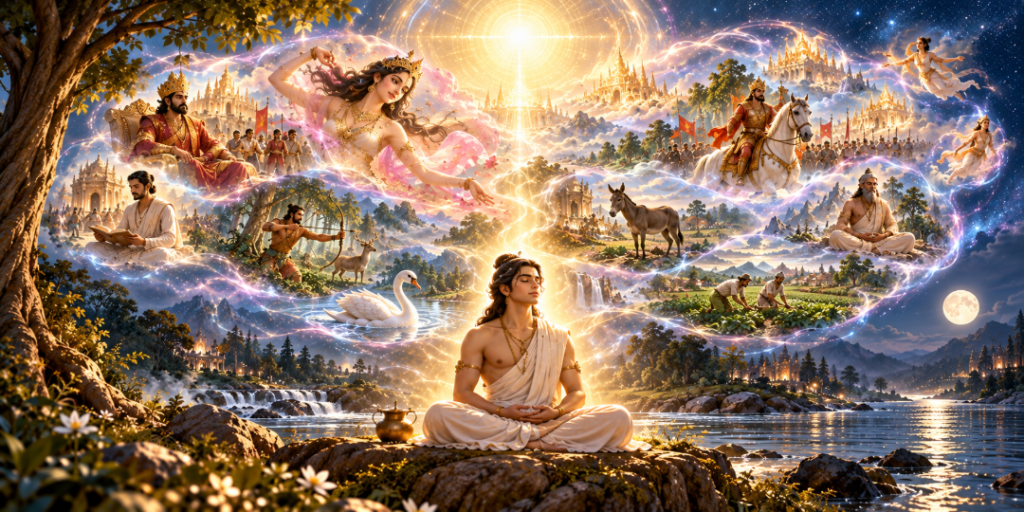
Enlightenment evades all difficulties
The Direct Path to Awakening
“One who enjoys the company of enlightened men does not suffer in this world, even as one who holds a candle in his hand does not see darkness anywhere.”
By merely listening to my words you will be enlightened; there is no doubt in this. Know that the universe has arisen from Brahman and it is Brahman alone. In the scriptures, words have been used in order to facilitate the imparting of instruction. Difference and non-difference, knowledge and ignorance, pain and pleasure — all these pairs have been invented for the instruction of the ignorant. They are not real in themselves.
As long as words are used to denote a truth, duality is inevitable; however, such duality is not the truth. All divisions are illusory.
The Encounter with the Rākshasī
Once I asked creator Brahmā to tell me how this universe was created, and he gave me the following reply:
It is the business of the brave to pounce at once like a lion upon his prey. Therefore leave off thy bragging and show us thy prowess at once.
She stood with her jet-black body like a rock of dark agate, and that, joined with her loud laugh, gave her the appearance of the all-subduing night of dissolution (Kālarātri — the night of universal doom, an attribute of Kālī, the goddess of destruction).
Lay aside this great ado for nothing, which does not become thee; because the wise pursue their business with coolness to crown it with success. The words, the face, and the eyes are expressive of the inward thoughts of the wise, and these go together like the salt and water of the sea, which are inseparable from one another.
मनस्येकं वचस्येकं कर्मण्ये कं महात्मनाम् ।
मनस्यन्यत् वचस्यन्यत् कर्मण्यन्यत् दुरात्मनाम् ॥
“The mind, the word, and the act of the wise all agree. But those of fools disagree in all three.”
I shall therefore ask them about something wherein I am doubtful; because they that fail to ask the wise what they know not must remain dunces throughout their lives.
The minister said:
“This is the king of the Kirātas, and I his councillor; we have come out tonight in our nightly round, for apprehending malicious beings like thyself.”
The Rākshasī replied:
“Prince! Thou hast a good minister, but a bad one unbecomes a prince; all good princes have wise counsellors, and they make the good prince. But kings must have spiritual knowledge also, because it is the highest of human knowledge. The king having this knowledge becomes the best of kings; and the minister who knows the soul can give the best counsel for the guidance of other souls.”
(For it is said: Nāndhenaiva nīyamānā yathāndhāh — the blind cannot lead the blind.)
There is but one expedient for you two lads to escape from my clutches; and it is by your solution of my intricate questions, according to your best wits and judgment.
- The Monad & Point: What is that monad which shines in darkness, and is that point which is and is not?
- The Imperceptible Jot: What is that iota which is imperceptible to all, and what is that jot which becomes an enormous mountain?
- The Universal Essence: Which, having no flavour in it, gives savour to all things; and whose presence being withdrawn from all substances reduces them to infinitesimal atoms?
- The Unmoved Cause: Whose glance is it that causes the production of the world, as from its seed; and who is it that creates the world without any motive or material?
- The Non-Dual Ground: Who is it that has nothing existent beside himself, and in whom all things exist, like the waves existing in the waters; and who is it whose will makes them appear as different things?
- The Changeless Source: What being is that which shows these phenomena without changing itself, such as in the shape of the seed of the world before it develops itself in creation, and sometimes in the form of a developed forest of created beings?
But if thou fail to lighten my heart of its doubts and set it at ease, then know for certain that thou shalt immediately be made fuel to the fire of my bowels at this very moment.
The Nature of the Atomic Intellect (Chit)
Underlying the atomic intellect is the minute seed which contains this universe; but whether it is a substantial or unsubstantial reality, nobody can say. It is called a reality from our notion of its being the soul of all by itself, and it is from that soul that all other existences have come into being. It is a void from its outward inanity, but it is no void as regards its intellect (which is a reality); it is said to be nothing from its imperceptibility, but it is a subtle something from its imperishableness.
All finite bodies are unreal; the immortal soul is real and identical with the Supreme Soul.
“The unlimited soul resides in all limited bodies, and the atomic intellect pervades the vast universe; it is in the same manner as the mind fills all bodies, in its purely subtle state unknown to the senses.”
This particle of the intellect is immovable, though it moves thousands of miles over; and we find in our consciousness many a mile to be composed in this particle.
The mind is firmly seated in the vacuous intellect, from which it never stirs, though it goes to all places where it is never located.
“That which hath its seat in the body can never go out of it; as a baby hanging on the breast of its mother cannot look to another place for its rest.”
One, though free to range over large tracts at will, will never start from his own abode where he has the liberty and power to do all he likes.
The All-Pervading Divine Soul
Wherever the mind may rove, it is never affected by the climate of that place; as a jar taken to a distant country with its mouth shut does not yield any passage to the light and air of that region into it.
The Divine Soul is of the essence of fire and never forsakes its igneous form. It inheres in all bodies without burning them, and is the enlightener and purifier of all substances. The intellect, which is the light of the soul and enlightener of the lights of the luminous sun, moon, and stars, is indestructible and never fades, although the light of the luminaries is lost on the last day of universal doom.
The eyeless vegetable creation is sensible of an inward light within them, causing their growth and giving them the capability of bearing their fruits and flowers. It is that Spirit which manifests itself in everything in all these worlds; but it shines as the brightest gem when all the worlds are compressed in it at the universal dissolution.
Anything appearing as a certain truth to the mind stamps the same impression in the soul, as the sense of some golden jewellery becomes more impressive in the soul than the idea of its gold (illustrating the fallacy of our perceptions, creating errors in the judgment of the understanding).
The intellect is the wonderful property of the Divine Spirit, in which it is present as its object (chetya). But how can a man have a view of it whose mind is fixed to the sight of the world, which is a shadow of the Intellect and moves as a tree which is shaken by the wind? As a mirage is the reflection of the dense light of the sun, so is the world a shadow of the solid light of the Divine Intellect. As the accumulation of sunbeams exhibits the formation of a gold mine in the sky, so the golden appearance of the world prevents the deluded from looking to the knowable object of the intellect.
Knowing it as such, men should consider everything by the light of reason and proceed to the knowledge of truth by their intellectual culture. There appears a difference in these rays both from the original light and also from one another in different beings by a curious design of Providence; but it is yet the same in all, like the forms of the trees growing out of the same kind of seed.
There is but one God, who is one and increate, calm and quiet, without beginning, middle, or end, and without a body and its parts. He has no duality and is one in many. He is of the form of pure light, and shines forever with everlasting and undiminished lustre.
The Vision of Lord Śiva and the Solar Wisdom
They passed in this manner the period of two ages before their devotion met with the approbation of the god who bears the crescent of the moon on his forehead. Then the god, rising to their view like the full moon and appearing in the midst of the heaven and earth, spoke smilingly unto them in a gentle and audible voice, the breath of which refreshed them like the breath of spring reviving the faded plants of the forest.
“The Brāhmanic couple then returned to their home with gladness in their hearts, and appeared as the reflections of the two divinities Śiva and Umā in their persons.”
In course of a short time, they attained their boyhood and became conversant in the language of the gods (Sanskrit), as the mute clouds become sonorous in the rainy season.
What avails the autocracy of the great Indra, which is lost in one moment (a moment’s time of Brahmā)?
What is that thing which endures a whole kalpa, and must be the best good as the most lasting? Do you but sit in your posture of padmāsana, and think yourselves as the bright Brahmā and full of his effulgence, possessing the powers of creation and annihilation in yourselves. I find every day among all sorts of beings some rising and falling, and others diving and floating, like the incessant waves of the sea (everything is changing in the changeful world).
Upon thy waking this day with thy desire of creation, all these things are exhibited to thy view as a copy of all that was in thy inmost mind or Spirit already. (So it is upon our waking from sleep; we come to see a facsimile of all that lay dormant in the sleeping mind).
“I am the one eldest among them, consecrated in this temple of the sky, and appointed by thee, O lord of all, to regulate the portions of time on earthly beings.”
This beautiful world that you behold, appearing to your view with all its wonderful structures spread out in the skies, serves at best as a snare to entrap your senses and delude your understanding, by taking the unrealities as realities in your mind.
Brahmā said:
“Tell me, thou sun, what need is there of my making any more worlds, after these ten orbs have come into existence?” (These ten orbs are the ten planetary bodies belonging to the solar system).
The sun said:
“Thou, O Lord of creatures, dost create all these for the sake of thy pleasure only, and so dost thou retract them all in thyself, as the sun gives and withdraws his light by turns.” (Creation and annihilation are the acts of expansion and subtraction of all things, from and in the Supreme Spirit).
“Do thy duty as it may present itself to thee, rather than remain inactive with doing nothing. The dull person who, like the dirty mirror, does not reflect the image, comes to no use at all. Therefore do thy work as it comes to thee, with a cheerful heart and calmness of mind, with a tranquil soul, as if it were in thy sleep, and devoid of desires which thou canst never reap. It is easy to destroy what is made by the hand, and to shut out the sensible objects from our perception; but who can annul or disregard what is ascertained by the mind?”
Whatever is habituated to confirmed belief in the mind, no curse can remove it from the mind, though it can kill the body.
The Story of Indra and Ahalyā: The Mastery of Mind
One thinking himself as composed of the body (i.e., a corporeal being) becomes subject to all the accidents of corporeality. But he who knows himself as bodiless (an incorporeal being) is freed from all evils which are accidental to the body. It is thus the mind that causes all our errors in this world, as it is evidenced in the instance of Indra and his consort Ahalyā.
Brahmā said:
“Tell me, my Lord Sol, who was this Indra, and who that Ahalyā, by the hearing of which my understanding may have its clear-sightedness.”
In that city there lived a libertine at the head of all the rakes; he was the intriguant son of a Brāhman, and was known by the same name of Indra. She lost her modesty with her self-possession, and repeated in her frenzy, “Here is Indra, and there he comes to me.” Then as the day passed on and the shade of night covered the face of nature, the lady made haste to the house of Indra, the Brāhman’s boy. She adorned herself with pastes and paints and wreaths of fragrant flowers, and conducted her lover to a private apartment, where they enjoyed their fill. For as long as she thought of her lover Indra, her face glowed as the full-blown lotus, blooming with the beams of her moon-like lover.
The king then ordered them to be taken out of the tank and told them to repent for their crimes; but the infatuated pair was far from doing so, and replied to the king in the following manner. They were tied to the feet of elephants to be trampled down by them, but they remained uninjured and said:
King, we feel our hearty joy at the remembrance of each other. This body is but an ideal form and presents a shadowy appearance to view; you can pour out your punishments upon it for a while, but it amounts to no more than striking a shadow with a stick. The mind is firm forever that is steadfast to its fixed purpose. Nay, it is identified with the object which it has constantly in its thoughts. (This is called mental metamorphosis or assimilation to the object of thought).
Know it for certain, O King, that neither these bodies about us, nor these bodies and sensations of ours are realities. They are but shows of truth, and not the movers of the mind; on the contrary, it is the mind which supplies the bodies and senses with their powers of action, as the water supplies the trees and branches with their vegetative juice.
The mind is generally believed to be a sensuous and passive principle, wholly actuated by the outward impressions of the senses; but in truth it is the mind which is the active and moving principle of the organs of action. Because all the senses become dormant in the absence of the action of the mind, the functions of the whole creation come to a stop without the activity of the Universal Mind (anima mundi).
“Deign, O great sage, to pronounce thy fulmination upon him without delay; because it is a breach of justice to spare the wicked, as it is to hurt the innocent.”
Bharata then pronounced his imprecation by saying:
“Do thou, O reprobate sinner, soon meet with thy perdition, together with this sinful woman that is so faithless to her husband.”
The inner principle of the soul can never be destroyed by anybody or anywhere, owing to its inscrutable, subtle, and intellectual nature. Being subjected to the torment of transmigration, they were both born as a pair of deer in mutual attachment, and then as a couple of turtle doves in their inseparable alliance.
“Therefore, wherever they come to be reborn in any shape, they always assume, by virtue of their delusion and reminiscence, the form of a male and female pair.”
The Omnipresence of Mind and the Aindava Sons
“What thing is there, O lord of lords, that is wanting in thee in this universe of so many worlds, that should make thy great soul to pine for the air-built worlds of Indu’s sons? Thou lord that hast made these creatures, remain firm in thy place and behold the infinite space which is spread out before thee, commensurate with the ample scope of thy understanding in the triple spheres of thy intellect and mind, and the vast vacuity of the firmament.”
Brahmā said:
“Well hast thou said, O sun, for I see the ample space of air lying open before me; I see also my spacious mind and the vast comprehension of my intellect. I will therefore go on with my work of creation forever. Therefore thou art at liberty to create ad libitum whatever thou likest, and think not that the sons of Indu have robbed thee of anything, when thou hast the power to create everything.”
Then this great luminary stood confessed with his bipartite body of light and heat, with the first of which he shone as the sun in the midst of heaven.
Thus have I related to you, O sagely Vasiṣṭha, all about the nature and acts of the mind, and the omnipotence of the great soul, which infuses its might in the mind in its acts of creation and production. As the living souls of the Aindavas were incorporated with Brahmā by their intense thought of him in them (or by their mental absorption of themselves in him), so also have we attained to Brahmāhood by means of our mental conception of that spiritual light and supreme intellect in ourselves.
As the Aindavas were Brahmās in their minds, so my mind makes me a Brahmā also; it is the mind that makes one such and such, according to the conception that he entertains of himself. (We are in reality nothing but what our minds inform us to be). The conception of phenomenals as real cannot make them real, any more than the appearance of a golden bracelet can make it gold, or the phenomenals appearing in Brahmā can identify themselves with Brahmā himself.
It is said that lifeless blocks are without intelligence and perception; but everything that bears a like relation to another has its perception also like the other (hence all things, being equally related to Brahmā, are equally sentient also in their natures).
There is no error in the unity of the intellect, nor is the soul liable to error unless it is deluded by its belief in pluralities. The intellect is as full as the ocean, with all its thoughts rising and setting in it as its endless waves. The term ego is inapplicable to the pure and simple internal soul, which, being vitiated by the gross idea of its concupiscence, takes the name of ego, as the thickened coldness is called by the name of frost.
“The mind, being cleansed of its darkness like the mirror of its dirt, shows the golden hue of spiritual light, which is replete with real felicity, and by far more blissful than what this earthly clod of body can ever yield.”
Whatever one thinks inwardly in himself, he is verily transformed to its likeness, as in the instance of the Aindava Brāhmans and of Indra and Ahalyā cited before.
The Primacy of Intellectual Effort
“Lord! You have spoken before of the irrevocable power of curses and imprecations; how is it then that their power is said to be frustrated again by men?”
The mind, which is the other part of the body of embodied beings, is ever free and unsubdued, though it is always under the subjection of all living beings in the three worlds. Mere bodily energy is never successful in any undertaking (any more than brute force); it is intellectual activity only that is sure of success in all attempts.
The head must guide the body.
Think of the sage who fell into the dark pit while his mind was employed in some sacrificial rite, and was taken up to heaven in reward for the merit of his mental sacrifice. Redemption is to be had by sacrifice of the soul, and not of the body.
Therefore let a man employ himself in the exercise of his own manly powers, and engage his mind and his mental energy in noble pursuits, in the paths of truth and holiness. The mind, O muni, is transmuted in a moment to its new model, as the inflated or aerated water rises high into waves and ebullitions, glaring with reflections of sunlight. (Common minds are wholly occupied with thoughts of the present, forgetful of the past and careless of the future).
Whatever the mind has in view, it succeeds soon in the accomplishment of the same. And as it does aught of good or evil, it reaps the reward of the same in the gladness or bitterness of its soul. It is our conception that makes us see a forest in the fog, or a tower in the clouds, appearing to the sight of the observer to be rising and falling by turns.
The Fourteen Grades of Existence
From the unspeakable Brahmā there sprang all things in their undefinable ideal state, and then the Spirit of God being condensed by His Will, it came to be produced of itself in the form of the Mind (the volitive and creative agency of God).
These living souls rise and move about in the vacuous sphere of the infinite Intellect (Chidākāśa). These are unfolded by the elementary particles of matter and pass in the open space surrounded by air. They then reside in the fourteen kinds of animated nature, according to the merit and demerit of their prior acts. They enter the bodies through the passage of their vital breath and become the seeds of moving and immovable beings. Many are brought down and bound to innumerable births in this earth by their ignorance of the Chit or Divine Intellect, and are subjected to interminable transmigrations in various births.
Some persons acquainted with spirituality have reached their state of perfection and have gone to heaven, like particles of sea-water carried into the air above by the blowing winds. These desires drive us to different countries, to distant hills and dales in search of gain (else man could live content with little and on his native plain).
Hear me now relate to you, Rāma, the several classes of higher, lower, and middling species of beings, and the various grades of their existence here and elsewhere in the scale of creation: Of these:
- The Pure Substantial (Śuddha-sattva): High spiritual beings aligned with truth.
- The Gentle (Rājasi): Born after prior births with gentleness, obtaining liberation after 100 transmigrations.
- The Noble Gentlemen (Rāja-sāttviki): Noble conduct, entitled to liberation after a few births.
- The Right Gentlemen (Rāja-rājasi): Actions conform with their title; liberation after 100 births.
- The Infatuated (Atyanta-tāmasi): Addicted to changing desires; reach truth after 1,000 lives in ignorance.
- The Baser Nature (Adhama-sattva): Possibility of liberation after 10,000 births in various forms.
The Doubtful (Sandigdha-mokṣa): Benighted men whose liberation remains uncertain due to repeating past vicious courses.
- The Blinded Gentry (Rāja-tāmasi): Act foolishly under infatuation; uncertain liberation even after 1,000 births.
- The Excessively Infatuated (Atyanta-rāja-tāmasi): Conduct corresponds with extreme infatuation; transmigrations do not easily cease.
- The Children of Darkness (Tāmasa): Demonic orders and Rākṣasas, traditionally described as deprived of liberation.
- The Mixed Darkness (Tāmasa-rāhasa): Combine darkness and enlightenment; liberated after 1,000 demoniac births and 100 progressive ones.
- The Darkest Darkness (Tāmas-tāmasi): Transmigrate for millions of years across births before potential liberation.
The Grossly Ignorant (Atyanta-tāmasi): Continue in gross ignorance indefinitely; liberation is doubtful.
The Universal Source: All other masses of living beings proceeding from the body of the great Brahmā, like moving waves from the ocean.
As the variegated arbour produces its leaves and flowers of various hues from itself, so the varieties of created beings spring from one Brahmā — the source of all. As the air in a pot and about a basin is the same with the surrounding air of heaven, so are all individual objects the same with the undivided spirit of the all-pervading Brahmā.
It is He from whom all things have risen; unto Him they return in their time, some after their transmigrations in a thousand births, and others after longer periods of their revolutions in various bodies.
Action, Mind, and the Manifestation of World
Wherefore it is not right on the part of the enlightened to say that such and such things are produced from Brahmā, when there is nothing that exists apart or separate from Him. An infinity of living beings will continue to spring from the same, like blades of grass sprouting from the earth below; and they will likewise be reduced to the same, like the seasonal plants of spring dying away in the hot weather of summer.
It is the act which makes the actor, and the actor who does the work. Thus they follow one another on the analogy of the seed and the tree which produce one another. This mutuality of both is seen in the practice of men and ordinances of the Veda.
“Cessation of mental operation is attended with desinence of thought, and quiescence of the mind is accompanied with discontinuance of actions. The liberated are free from both of these, but the unemancipated from neither.”
The mind, being ever restless in itself, becomes identified with the actions proceeding from its activity. The actions also, whether good or bad, become identified with the mind, which feels their just rewards and punishments. Hence you see, Rāma, the inseparable connection of the mind and acts in reciprocating their actions and reactions upon each other.
The nature of the mind is known to be composed of the property of Volition, which is an attribute of the infinite and almighty power of the Supreme Soul. The mind is of the nature of imagination (Kalpanā), which is ever busy in its operations; hence the inactivity of the mind is as impossible in this world as the insapience of the sapient man.
The Divine Mind is said to be distributed into all souls by mistake and without any reason, since the All is without any substance or substratum and indivisible in its nature. It is a mere fabrication of our desires and fancies to diversify it in different persons.
The Functional Names of Mind
“It is the movement of the mind which is said and perceived by us to be the source of our actions, and the actions of the mind are as various as the branches, leaves, and fruits of trees.”
Whatever is determined by the mind is readily brought into performance by the external organs of action (Karmendriya); thus, because the mind is the cause of action, it is identified with the effect.
The simultaneous collision of many sensations (like the Kākatālīya saṁyoga) diverts the mind from its clear sight of the object of its thought and causes it to turn about in many ways.
- Understanding (Buddhi): When man, after considering himself and other things, comes to understand them in their true light.
- Thought: Which passes from one object to another in quick succession, shifting without forming a right judgment.
- Fancy: Holding fast on fleeting fantasies by letting loose solid and certain truths.
- Imagination (Īhita Kalpanā): Giving various images to the objects of desire.
- Desire: The appetence residing in the mind for possession of past enjoyments and efforts for attainment.
- Kākatālīya Sanyoga: The accidental assemblage of fancied objects.
- Sensation: Because all its actions of hearing, feeling, seeing, smelling, thinking, and enjoying serve to delight the senses, which convey impressions back to the mind.
- Heart (Chitta): The intellect (Chit) situated in the bosom of sentient bodies with all its affections and feelings (āvilām), holding a nature between goodness and badness.
It is defined as the agglutinative and associative power to collect materials for imagination which builds up on them. The appetence which resides in the region of the mind, for possession of the objects of past enjoyment; as also the efforts of the mind for attainment of other things, are called its desires. The mind is called sensation, because all its actions of hearing and feeling, of seeing and smelling, thinking and enjoying, serve to delight the senses, which convey the impressions back to the mind. The sensible actions are seeing and hearing, feeling, tasting and smelling, of the outward organs of sense; but the mind is the cause both of these actions and their acts. Its abstract knowledge of general truths being shadowed by its percipience of concrete and particular gross bodies, it comes to the knowledge of numbers and parts, and is overwhelmed by the multiplicity of its thoughts and the objects of its desires.
It then has a nature between goodness and badness. As a man passes under many titles, according to his various occupations and professions; so the mind takes different appellations according to the various operations of its nature.
“They have attributed to the mind many designations, according to the views in which they designed to exhibit its nature; such as some calling it the intellect, another the understanding, the sensation and so forth.”
All these various doctrines, arising at different times and in distant countries, lead at last to the same Supreme Being, like many different ways leading passengers to the same imperial city. It is ignorance of this supreme truth or misunderstanding of discordant doctrines that causes the votaries of different systems and sects to carry on endless disputes among themselves with bitter acrimony.
The disputants maintain their particular positions by their respective dogmatism; just as passengers persist in their accustomed paths as the best suited to them. The mind receives its various names from its different functions, as a man is called a Snātaka (early bather) or a Dātā (donor) from his acts of sacred ablutions and religious gifts. A man without the heart has no feeling nor sensation.
The mind which is one with the Divine Intellect (i.e., sedately fixed in the one Brahman) perceives the world to be absorbed into itself; but being polluted with matter (like fresh water with soil), it falls into the error of taking the world for real. Know then, O Rāghava, that neither intelligence nor inertia is the cause of the world; it is the mind that is the cause of visible objects, as it is the light which unfolds them to the view.
Whatever varieties are mentioned of the mind, by the reasonings of different systems of philosophy, and sometimes by the advocates of an opinion, and at others by their adversaries:— As the spider lets out its thread from itself, it is in the same manner that the inert has sprung from the intellect, and matter has come into existence from the ever-active Spirit of Brahmā.
Non-Dual Reality, Soul, and the Mind
“The minds of the unenlightened are the causes of their error, as those not knowing the common property of water, find a difference in the waters of the waves and the sea.”
The omnipotence of Brahmā stretches to all ten sides of the universe; his power of annihilation is seen in the extinction of beings, and his punishment is evident in the sorrows of the miserable. The power called the living principle is a reflection of God, standing between the thinking mind and dull matter, derived directly from Brahmā.
That property in him which possesses the power of thinking is termed the mind, appearing to be something other than the Soul—much like erroneously seeing peacock’s feathers in the sky or foam in the eddies of water. It is our error that creates a division between the soul and mind, and between Brahma and Brahmā, because the properties belonging to the mind are identical with those of the self-existent soul. All properties of the living soul are contained in and derived from the universal soul of Brahmā, just as all properties of vegetation, blossoming, and fructification of trees are contained in the season of spring and dispensed among plants agreeably to their respective soil, climate, and circumstances.
As the earth produces its harvests according to its particular soil and season, so the heart and mind exhibit their thoughts and feelings of their own accord, uncaused by another. The intelligent soul sees these hosts of creation moving in the essence of Brahmā, beholding them like innumerable waves, billows, and surges rolling on the surface of the sea.
Freedom from Bondage and the Nature of Illusion
There is neither appetence, pleasure, desire, nor error in one who relies entirely upon the Supreme; for how can one who lives in the Supreme Self—which is devoid of these—harbor any desire or error? The mind ignorant of its Supreme origin is called the living soul (jīva), which, through its ignorance of the Supreme Soul, resembles a friend alienated from his true companion.
It is a wrong impression to speak of the bondage of the soul, which is ever free from bonds; likewise, it is untrue to seek the emancipation of a soul that is always emancipated. Imagining its bondage is a false conceit of the ignorant, and their imagination of its liberation is equally a false conception. The wise man knows neither bondage, liberation, nor error of any kind—all three exist solely in the conceptions of the ignorant.
The Allegory of the Three Princes and the Royal Illusion
There were once on a time, some three highminded and fortunate young princes; in a desolate country, who were noted for their virtues and valour. They shone in that vast desolate land resembling the spacious sky, like stars in the expanse of the waters below. Two of them were unbegotten and increate, and third was not born of the mother’s womb. (These three uncreated princes, were the principles of the soul and the mind, and the living soul—jīva, which is not procreated in the womb with the body). Their lotus like feet were singed by the burning sands of their desert path, and they cried aloud like some tender fawns, going astray from their herd saying:—”O Father save us”.
Having come out of that desert land, they set forth with their faces looking forward; and proceeded onward like the three planets Mercury, Venus and Jupiter in their conjunction. They were refreshed from the fatigue of their journey, under the shade of these trees; and they halted there like the three Deities Indra, Vāya and Yama, under the umbrage of the Pārijāta arbour of Paradise. (The three gods—Jupiter, Eolus and Pluto, were the regents of the three regions of heaven, sky and the infernal world:—swar, bhuvar and bhur, composing the three spheres of their circuit).
They encountered three channels: One of these was a dry channel and the other two were shallow and with little water in them; and they looked like the eyes of blind men with their blinded eye-balls (i. e. the channel of satva or temperance was almost dried up, and that of rajas or mediocrity had become shallow for want of righteous deeds; but the stream of tamas or excess was in full force, owing to the unrighteous conduct of men).
“These were the human bodies, standing and walking upright upon the earth, and decorated with crowns and coronets on their heads.”
They resumed their journey, and arrived at the end of the day and about sunset, to their future abode of a new-built city, standing afar as on the height of a hill. Here they saw three beautiful and goodly looking houses, with turrets of gold and gems shining afar, like peaks of mount Meru under the blazing sun. (These were the human bodies, standing and walking upright upon the earth, and decorated with crowns and coronets on their heads). They entered this house, and sat and walked about in it with joyous countenances; and chanced to get three pots as bright as gold therein. (These pots were the three sheaths of the soul, mind and of the vital principle, called the prānamāyā-kosha).
The mouthless Brāhman took a hundred dronas of the rice and eat it up, because he devoured the child and youth, and the princes took the remainder of the Brāhman’s food for their diet (which was nothing). I have told you this story, O Rāma! in connection with my lecture on the subject of the mind; and it will serve to explain to you, the fabrication of the mind of this imaginary being of the world.
“Nothing is really existent except the creations of our imagination, and it is our fancy which fashions all the objects in their peculiar fantastic forms.”
(Everything appears to us as we fancy it to be; whereby the same thing is viewed in a different light, not only by different persons; but by the same person in a different state of mind). The imaginative power manifests all things all around, as the moving waters, show the rise and fall of the waves in the sea. “It gives a shape of airy nothing”. “It is the power of apprehending ideas and combining them into new forms and assemblages”.. “It is the power of apprehending ideas and combining them into new forms and assemblages”.
The Fickle Nature and Agency of the Mind
The mind is so changeful by the influence of time, place, power and nature of acts and things, that it continually shuffles from one feeling to another, like an actor personating his many parts on the stage. The fickle mind gets every thing according to its own doing, and all the actions of our hands, feet and other members of the body, are regulated by the same. (The mind is the mover of bodily organs). Therefore the mind which is situated in the earthen dolls of human bodies, can do nothing of its own will, unless it is destined so by virtue of its former acts. (The mind that moves the body, is itself moved by the destiny derived from its prior acts).
“The mind alone is perceived to be in existence in the world; and its representations of the forests and all other things are but variations of itself!”
The perceptions of the quickness and slowness of motion, and of much or little in quantity, as also of swiftness or tardiness of time, belong to the mind and not to the dull material body. The mind alone is perceived to be in existence in the world; and its representations of the forests and all other things are but variations of itself! So the thinking man sees the substance of gold only, in all its various formations of bangles and bracelets, which are taken for naught.
King Lavaṇa and the Magician’s Spell
There was a range of tawny rocks on one side, and fields brown with ripened corn on another; while the warbling of cerulean doves—reechoed in the resonant groves about. His fair fame formed a white diadem to crown his head, and adorn his shoulders with its brightness; it whitened the hills in the form of so many Sivas, besmeared with the hoary ashes upon his tufted head and person. His greatest exertion was devoted to the supportance to respectable men; and his name was uttered like that of Hari by all his people. His uncommonly magnanimous and wonderous acts, which were free from the fault of niggardliness; were unlike to any thing that was ever heard or seen by any body.
Then as the royal party was seated in the court hall, beautiful songstresses, began to sing, and ravish the hearts of the hearers, with the music of lutes. The ministers were then employed in the public affairs pending before them; and the dextrous officers were engaged in relating the reports of the country to the king. There were the learned pandits reciting the holy legends from their books, and the courteous panegyrists chaunting their sacred eulogies on one side.
There appeared at this time a magician in his fantastic attire, and with his blustering vauntings before the Court; in the manner of a roaring cloud, threatening to deluge the earth with his showers of rain. He approached before the king, as a monkey advances to a shady and lofty tree, loaded with fruits and flowers. This horse of mine, O king of the earth! is the best of his kind, and a compeer of Uchcha Sravās; he is a personification of the wind in the swiftness of his flight. After he had ended his speech the magician spoke in a voice, as sweet as that of the swallow, after the roaring of the cloud is hushed to silence.
The king saw the horse brought before him as a figure drawn in painting, and gazed upon him with his fixed eyes and without closing his eye-lids, as he was himself turned to a painting. He continued for a couple of hours as if he was drowned in his meditation, and as insensible saints remain in the enjoyment of their internal and spiritual stupor. The Courtiers remained motionless at seeing his quiescence, as when the filaments of the lotus, remain unmoved, by their being besmeared in the mud. The people were struck with terror and dismay, at seeing this apoplexy of their prince who remained with his closed eyes, like closed lotuses shorn of their beauty.
As he was about to fall down from the horseback, he was held up by and supported upon the arms of his attendants; as the mount Meru is kept from falling, by the hills at its feet and sides. The Courtiers then respectfully asked the king, what was the matter with him; with a voice as sweet as the lotus utters to the sun when he is eclipsed by Rāhu. The moon-like face of the king was brightened by his full open eyes, as the vernal season is beautified by the blooming blossoms, after the winter frost has passed away.
“How wonderful are the captivating powers of spells, which they have derived from the Lord, and whose influence had overpowered on the strongest sense of my mind.”
The mind residing in the body, may be fraught with the highest knowledge, and yet the minds of the wisest of men, are liable to errors and illusion. I have seen so many passing scenes in one single moment under this wizard, as had been shown of old by Brahmā in his destruction of the theurgy of Indra.
King Lavana’s Narrative: The Delusion of Worldly Trials
The king said:—I beheld a region full with objects of various kinds, such as rivers and lakes, cities and mountains, with many boundary hills, and the ocean girding the earth around. My wife delivered of a daughter which is the cause of woe, as a danger is the spring of calamities. This daughter grew up as soon as the growth of the cares and sorrows of the ignorant. Being burthen with the cares of my family, and troubled by anxieties of my mind; I saw my increasing afflictions like a conflagration rising all about me.
I had to pass full many a live-long year, under the shade of dhavalī trees; with no other cloth or covering on me than an old tattered, dirty and stinking Kaupina, which was beset by flees and leeches. (Kaupina a piece of rag covering the lower secret parts of the body as that of Fakirs and Yogis). The many quarrels and bickerings, and the sorrows and wailings, to which I was often exposed at home and abroad, made my blood to gush out in tears from my weeping eyes.
Then vexed by the scolding of the termagant Chandālī, and the threats of the villainous Chandālas; my face became as pale as the waning moon under the shadow of Rāhu (the ascending node). I had to live upon the roots of withered vegetables. I dug them out plentifully from the woodland grounds and eat them with a zest, as a fortunate man has in tasting his dainty dishes of well cooked meat. I often repaired to the garden grounds of the Chandālas, with my spade and basket in the cool of the evening, in order to collect the raw flesh, which had been cast about in the dirt, for making any food of them. We passed the night in company with the sylvan apes, with our teeth clattering with cold; and the hairs of our bodies standing on their ends, like a thousand thorns through coldness.
The Vetālas of the woods fled before me, as they do from the furies of the forests; and I set my snares and nets in the woods, for catching the deer and birds of the air. We have cast off kindness from our hearts, as the snake leaves off his slough; and take a delight to let fly the hissing arrows of our malice, as the thunder storm betides all animals. But I underwent many a difficulty, which multiplied as thickly upon me, as the weeds growing in dales; and I moved about all the corners of that hellish spot, during my destined time.
I have caught and killed the innocent deer in the trap; to feed upon its flesh; and have killed the chowry kine, to lay my head on the hair hanging down their necks. I bore it on my back, as a bear bears the long bristles upon him even in the hot season; and suffered the heat of the wild fire, which burnt away many wild animals which perished in groups as in the last conflagration of the world. I raved sometimes in my rage, and wept at others in my bitter grief; I fared on coarse meals, and dwelt, alas! in the abodes of vulgar Chandālas. Thus I passed so many years of my misery at that place, as one fastened to the fetters of his insatiable desires, is doomed to toil and moil for naught until his death.
“My foolish mind kept fluttering like a bird, in the maze of my wishes and fancies; and my heart was perturbed by passions, like the sea by its raging waves.”
I forgot my royalty like a dead man, in that state of my wretchedness, and was confirmed in my belief of a Chandāla, and bound to that hilly spot like a wingless bird. The people were daubed with ashes all over their bodies, and were famishing for want of food and drink; because the land was without any article of food or even grass or water in it, and had turned to a dreary desert. The hungry mob, hurrying to browse the branches and herbs, yielded their lives in those acts; while others sharpened their teeth, in their acts of tearing and devouring one another.
Huge serpents were burnt in their caves, and the fumes rising from these burning bodies, served to grow the poisonous plants on the spot; while the flame stretching aloft with the winds, gave the sky an appearance of the glory of the setting sun. Men biting and tearing one another, were flying in all directions; when the splitting of the burning wood hit upon their breasts and bellies, and made them gory with blood gushing out of them. Thus beset by dangers and horrors, with no other shelter than the rugged hollows of rocks, this place presented a picture of this world, with its circumambient flames, burning as the twelve zodiacal suns on high.
The winds were blowing hot amidst the burning woods and rocks, and drying up all things; and the heat of the fire below and the sunbeams above, together with the domestic calamities caused by influence of the planet Saturn, made this place a counterpart of this woeful world. Some of these emigrants were devoured by tigers, as they went out of their houses; as unfledged birds are caught by falcons, as they come out of their nests. I separated myself from the connections of my father-in-law and others; and depending upon myself, I escaped narrowly from that distressed country, with my wife and children about me.
I halted here after my tiresome journey and lengthened troubles, as one who had fled from the confines of hell; and took my rest like the withering lotus, from the scorching sunbeams and heat of summer. Afterwards my younger son Prach’chhaka, who was as dear to us as he was the less intelligent, rose up and stood before me. The little boy repeatedly made the same request, and said with tears in his eyes, that he was dying of hunger. He agreed to it, and said ‘give it then’; because his hunger was so pressing and his vitality was so much exhausted, that he could not decline to crave my flesh for his food.
“These hundreds of worldly systems, display the multifarious powers of Omnipotence; which delude even the minds of the most wise, to believe in the reality of unrealities, as it were by the spell of magic.”
Like the ignorant, I was subject to a hundred changes of fortune. As the great and mighty King—Lavana, had been recapitulating and expostulating on the vicissitudes of fortune:— These hundreds of worldly systems, display the multifarious powers of Omnipotence; which delude even the minds of the most wise, to believe in the reality of unrealities, as it were by the spell of magic. This delusive magic was not spread over the mind, by any trick or art of the conjurer; who aimed at nothing more than his own gain, by the act of his sorcery.
Psychological Mechanics and Mind Mastery
The mental powers are ever busy to multiply the unrealities to infinity, as ignorant children are prone to create the false goblins of their fancy, only for their terror and trouble. The distracted mind, sees the fiery Saturn in the cooling moon; and the nectar being swallowed as poison, acts as poison itself. The minds of men being entangled in the net of avarice like poor stags, are rendered as helpless as these beasts of prey, in the forest of the world.
“Know therefore that it is mind that make, the man and not his body that is called as such: the body is dull matter, but the mind is neither a material nor immaterial substance (as the spirit).”
Whatever is done with the mind or voluntarily by any man, know Rāma, that act to be actually done by him (since an involuntary action is indifferent by itself); and whatsoever is shunned by it, know that to be kept out in actu. If the mind do not join a thing with its known properties and qualities; then the sun and the luminaries would appear to be without their light. So it becomes taste being connected with the tongue and palate, and takes many other names besides, according to its other faculties.
Thus the mind is the chief actor on the stage of the living animal body. It was by virtue of such a representation, that the dreaming mind of king Harish chandra, took the course of one night for the long period of a dozen of years. The mind that preserves its clear sightedness, and its equanimity and unalterableness in all places, and under all conditions; retains its even temper and nice discernment at all times, under the testimony of its consciousness, and approbation of its good conscience.
The mind is restless of its own nature, with all its vain thoughts and desires within itself; but the man is carried abroad as by its current; over hills and deserts and across rivers and seas, to far and remote cities and countries (in search of gain). Some minds with too much self reliance in themselves, and without considering the true nature of things; give them different forms and colours, according to their own conceptions and opinions, though they are far from truth. It vanishes in vacuity and extends in the space; it dwells in everything at its pleasure, and flies from everywhere at its will.
What is seen by the mind, is seen with the eyes, and what is unseen by it, is never seen by the visual organs; as things lying in the dark are not perceptible to the sight. Those great souls (philosophers), who have investigated into the manner of the connection between the two quite different substances of the body and mind, and those learned men who show us their mutual relations (the psychologists), are truly worthy of our veneration.
“The dispassionate Yogi that sits reclined in his abstract meditation in the forest, has no sense of his hands being bitten off by a voracious beast from his body; owing to the absence of his mind.”
The mind employed in some other thought and inattentive to the present discourse, finds it as a detached piece of wood dissevered by an axe. As the waters of the sea display themselves in huge surges, billows and waves, so the mind which is in the body, displays itself in the various sights exhibited in our dreams. As the king Lavana believed himself to be a chandāla for some time, so do we believe ourselves to be so and so, by the thoughts of our minds.
As the idea of man includes that of a woman also, and the idea of father comprises that of the son likewise; so the mind includes the wish, and the wish is accompanied by its action with every person. The mind is busy with its thoughts of long drawn wishes, which cause its repeated births and deaths, and their concomitants of hopes and fears, and pleasure and pain. As it is the greater or lighter pressure of the oil-mill, that thickens or thins the oil, so it is the deeper or lighter attention of the mind, that aggravates or lightens its sense of pleasure or pain.
“He whose mind does not wave to and fro like a brandished sword, but remains fixed as a post or pillar to its best intent and object, is the best of men on earth, all others (with fickle minds), are as insects continually moving in the mind.“
Steadiness of the mind is attended with the stillness of worldly commotions, as the suspension of the churning Mandara, was attended with the calmness of the ocean of milk. Foolish men that are infatuated by their giddiness and ignorance, revolve round the centre of their hearts, as the giddy bees flutter about the lotus-flower of the lake; till at last grown weary in their giddy circles, they fall down in the encompassing whirlpools, which hurl them in irreparable ruin.
“He who remains at rest by giving up the objects of his desire, is verily the conqueror of his mind; which is reduced under his subjection as an elephant wanting its tusks.”
Mould your heated imagination by cool reasoning, by precepts of the Sāstras, and by association with the dispassionate, as they do the heated iron by a cold hammer. Employ your mind to the acts of goodness by the light of your understanding; as you join your soul to the meditation of God by light of your spirit. He who can take the unpleasant for the pleasurable in his understanding; may with ease subdue his mind, as a giant overcomes a boy by his might.
No one can reach the best course of his life, without the tranquillity of his mind; which is to be acquired by means of his own exertion, in getting rid of the fond objects of his desire. All bodily pains of men are quite at an end, no sooner the mind is at rest, after the removal of mental anxieties by means of true knowledge.
Self-Effort, Reason, and the Way to Liberation
“Join yourself to your intellectual or abstract thoughts at first, and then to your spiritual speculations. Being then master of your mind, contemplate on the nature of the Supreme soul.”
Calmness of mind, produces the want of anxiety; and the man that has been able to subdue his mind, cares a fig for his subjection of the world under him. So no body is born here nor dies at any time; it is the mind that conceives its birth and death and migration in other bodies and worlds (i. e. its transmigration and apprehension of its rise or fall to heaven or hell).
I repeat the same lesson, that there is no other way, save by the government of the unruly mind, to come to the light of the truly real, clear and catholic knowledge of the Supreme. Hold fast the discus of reason, and cut off the bias of your mind; be sure that no disease will have the power to molest you, if you can have the good sense to despise the objects of pleasure, which are attended by pain. The mind is blown away by its destitution of egoism (Ahantā) and meitatism (mamatā), like a cloud by the winds. The man that is devoid of desires, cares for nothing, whether the winds may howl with the fury of storms; or the seas break their bounds, or the twelve suns (of the Zodiac) rise at once to burn the universe.
As coldness is the nature of frost, and blackness is that of ink; so is swiftness or momentum the nature of the mind, as stillness is that of the soul. This vacillating power of motion, which is implanted in the mind, is known to be of the same nature as that of the self-motive force of the Divine mind; which is the cause of the momentum and motion of those worlds. The monster of the mind, being roused from its rest, raises all our dangers and disasters; but its falling into rest and inaction, causes our happiness and perfect felicity.
“The mind is a thing that stands between the real and unreal and between intelligence and dull matter, and is moved to and fro by the contending powers on either side.”
It must be by the force of your intelligent mind, that you must lift up your deluded mind, which is drowned in the cares of this world. There is no other means that will help you to do so.
“Let your own mind cut the net of the mind, which is ensnared in this world; and extricate your soul, by this wise policy, which is the only means of your liberation.”
The unknown one of which we are unconscious by our knowledge, transcends all whatever is known to us by our consciousness. Our unconsciousness is our nirvāna or final extinction, while our consciousness is the cause of our woe.
The Dissolution of Ignorance (Avidyā) and Universal Unity
There exists nothing real or unreal any where, except the only true essence of God; as there is no substantiality in the continuity of the waves, besides the body of waters. If truth is delectable and untruth is odious, then remain firm to what is good; and be employed in your duties. If truth is delectable and untruth is odious, then remain firm to what is good; and be employed in your duties. Our love of the world, ceases soon without the objects of affection; as the lamp is extinguished without its oil, and as the vermilion mark, which is soon effaced.
It was delusion which made one minute, appear as many years to king Lavana; and the space of one night, seem as the long period of a dozen of years to Harish chandra. The delusion consists in the building of aerial castles in the mind, without their substance; and though these appear in hundreds and thousands of shapes, they have no substantiality in them. Men think much of their improvement, and of many other things on earth; but there is no improving in this decaying world; which is as a tempting cake with a coating of sweets, but full of deadly gall within. It is as an extinguishing lamp, whose flame is lost and fled we know not where. It is visible as a mist, but try to lay hold on it, and it proves to be nothing.
Men being long deluded by this error, which has fastly laid hold of their minds, imagine a long duration of the world, as they do of the scenes in their dreams.
“Our strong avarice riding on the vehicle of the desired object, chases the fleeting mind as bird-catchers do the flying birds in nets.”
But these delights serve only to poison us, while they seem to cool the worlds with their distillation; just as the crescent orb of the moon, injures us with too much of her moistening influence, while it appears to refresh us with her full bright beams. Look at the power of this unsubstantial ignorance, a negative thing, and still there is nothing which it can not alter to some thing else. It is strange that a thing sparkling in darkness, and vanishing in day light, and mope-eyed as the moping owl, should thus keep the world in darkness. It is wonderful that fallacy which is attended with incessant woe and peril, and which is devoid of sense and knowledge, should keep the world in darkness.
“Our desires are the offspring of our ignorance, and the annihilation of these constitutes what we call our liberation, because the man that is devoid of desires, is reckoned the perfect and consummate Siddha.”
That which is not the subject of thought, which is all-pervasive, and the thought of which is beyond expression and comprehension is the universal spirit. All this is verily Brahma, eternal and imperishable intelligence. To him no imagination of the mind can reach at any time. Which is one and one alone, all and all-pervading, and imperishable Unity; which is incomprehensible in thought, and is only of the form of Intellect, is the universal Spirit.
There resides also the impure mind, which is in its nature beyond all physical objects, and runs after its own desire; it is conceivable by the Intellect as sullied by its own activity. The exertion of human efforts, gives rise to the expectation of fruition, but want of desire, causes the cessation of exertions; and consequently puts a stop to the desire of employment, together with our ignorance causing the desire.
The goddess of ignorance—Avidyā, with her uplifted arms resembling the long stalks of lotus plants, laughs in exultation over her conquests, with the glaring light of shining moonbeams.
But they are freed from all affairs of this life, who know themselves as spiritual beings, and their spiritual part is neither subject to bondage nor labour. Ignorance (avidyā) is painted in the imagination of earthly men, to be as dark as the darkness which surrounds the highest pinnacle of Meru, blazing with the blue light of sapphire, or at the primeval darkness impenetrable by the solar light. There is neither the possibility of a body of darkness to abide in the sky, when the mundane egg is full of light (which has displaced the primeval darkness); and when the nature of light is the brightness which stretches over the extramundane regions.
The great ignorance that rises in the mind and raises the desires of thy heart, has spread the net of thy false hopes for thy ruin, causing thy death and decrepitude under them. Learn ye that are seekers of truth, that the words: I, mine and this and that, are all meaningless in their true sense; and that there is nothing that may be called real at any time, except the knowledge of the true self and essence of Brahma. It views a dry desert in the wide waters, beating with billows and undulating with the fragrance of the aqueous kalpa flowers; and imagines a dry mirage in the empty clouds of autumn.
If the mind is not filled and led away by worldly desires, there is no fear then of our falling into the dangers, which the day-dreams of our earthly affairs incessantly present before us. Therefore, Rāma! give up the earthly desires, that serve at best to bind down the (celestial) soul to this mortal earth and its mortifying cares; and remain as the pure and white crystal, with reflecting the hues of all things around in your stainless mind. Knowing everything with avidity in thy watchful mind, and performing all thy duties with due submission, and keeping from the common track with thy exalted mind, thou wilt raise thyself above comparison with any other person.
Creation as a Mental Projection of Brahmā
BRAHMĀ said: I had asked the lotus-born god once before, to tell me how these hosts of creation had come to being. Hear me tell you, said he, how I (the personified mind), awoke at first on the day of creation in a former kalpa, with my volition to create (expand) myself. The gods began to sport in the etherial air, and men moved about on the earth, and demons and serpents were confined in their abodes underneath the ground. Then were the sevenfold worlds and continents, the septuple oceans and the seven boundary mountains, brought to existence, and they continue to exist until their final dissolution at the end of a Kalpa period (which is determined by the Kalpa or will of God).
The earth covered over by the garniture of her verdure, resembles a lady sitting begirt by her robes; and having the produce of paddy for her victuals; and the busy buzz of the world for her music. Why is it that I do not see with my visual organs, all that I perceive, as a magic scene spread out in the sphere of my Mind? My child, it is only mind that appears as all this. In my mind I saw several seemingly independent universes. In them all I also saw my own counterparts — creators. In those universes I saw different kind of beings. Looking at all this I was puzzled: ‘How is it that I am seeing all these with my mind?’ I thought of the suns in one of the solar systems and asked him the question.
Motiveless Creation and the Infinite Soul
The SUN said: You have no wishes, nor any motives of your own. Naturally there is no need for you to do anything. What benefits do you derive from creating the universe? Creation of the universe is surely a motiveless pastime to you! Creation emerges from you who are free from the least desire or motive just as the sun, without intending to shine, is reflected in a pool of water without the water intending to so reflect it. If there be anything in the world beside the oneself, that may be thine or worth thy desiring, thou mayst long to have it; but all things being but parts of the universe, there is nothing particular for any one to have or seek. One may be very learned and well-informed in every thing, he may be a noble and great man also, but he is sure to be tied down by his avarice, as a lion is fettered by his chain.
“As the light residing in the waters of the sea or a pot of water, is not connected either with the water or pot, nor is it felt by us but by its reflexion; so the intangible soul abides unconnected in its receptacle of the body, and reflects itself to our knowledge only.”
As the all-pervading sky is not to be seen owing to its extreme tenuity; so the undivided nature of the all-pervasive intellect, is not to be perceived on account of its rarity. As the light residing in the waters of the sea or a pot of water, is not connected either with the water or pot, nor is it felt by us but by its reflexion; so the intangible soul abides unconnected in its receptacle of the body, and reflects itself to our knowledge only. It is clearer than the translucent air, and finer than it by a hundred times; it is known as an undivided whole by the learned; who view it as identic with the whole undivided world, which it comprehends within itself. It neither rises nor sets, nor gets up nor sits; it neither proceeds nor recedes to or fro, it is not here nor is it no where. It is led by its own error and of its own accord, to forget and forsake its state of infinitude; and then by assuming its individual personality of egoism (that I am), it is converted to an ignoramus. (So men of contracted views turn to be dunces). It gives fragrance to flowers, and grows by degrees their filaments and pistils; and it makes the moisture of the porous ground, to grow vegetables on earth.
The Willful Mind and the Dissolution of Desire
The Mind sometimes wishes to destroy its former frame and remove to another, and effects its purpose at will. Know the gods as offspring of the willful Mind; as the branches are the offshoots of the main tree, and the summits are projections of the principal mountain. The willful mind takes at its will its good, bad and moderate or sober forms; known under the names of satva, rajas and tamas. As the mind conceives a thing to be, so it perceives the same in actuality; therefore have no conception of anything, if you want to know the truth of it.
“Try to relinquish your desire, and you will evade all difficulties; and cease to think of anything, and your desire for it will disappear of itself.”
It is by mere chance, that we come to meet with the objects of our desire; as it is by an act of unavoidable chance also, that we are liable to lose them. They appear before us as secondary luminaries in the sky, and then fly away as the mirage vanishes from view. Try to relinquish your desire, and you will evade all difficulties; and cease to think of anything, and your desire for it will disappear of itself. The removal of reliance upon the world, removes our attachment to it; and consequently prevents our joy or sorrow at the gain or loss of any thing. Our desire like fire, is kindled by every straw; and it burns and blows out in its invisible form within the mind. He who has not been able to master over his vain desires, and hobby whims in this world, will find them vanish of themselves in course of time, as nothing false can last for ever.
The Immortal Soul and the External Vehicle
If you know it to be a temporary existence, why then should you take any interest in what is so frail and unstable, rather than care for your immortal soul? The quality of the inner soul or mind, manifests itself in the outer body, as the quality of the seed appears in the form and taste of its fruit.
“The body is the nest of the bird of the mind, and it is hole of the snake of lust; it is the cave of the goblin of greediness, and the den of the lion of life.”
The mind then dwells upon the thoughts of its actions, which have their display in the several organs, and members of the bodily actions, which are produced by the motions of the inner thoughts and acts, as the leaves and branches of trees are projected by the inner process and operations of the seed. The body is the nest of the bird of the mind, and it is hole of the snake of lust; it is the cave of the goblin of greediness, and the den of the lion of life.