The Cure for Seeing
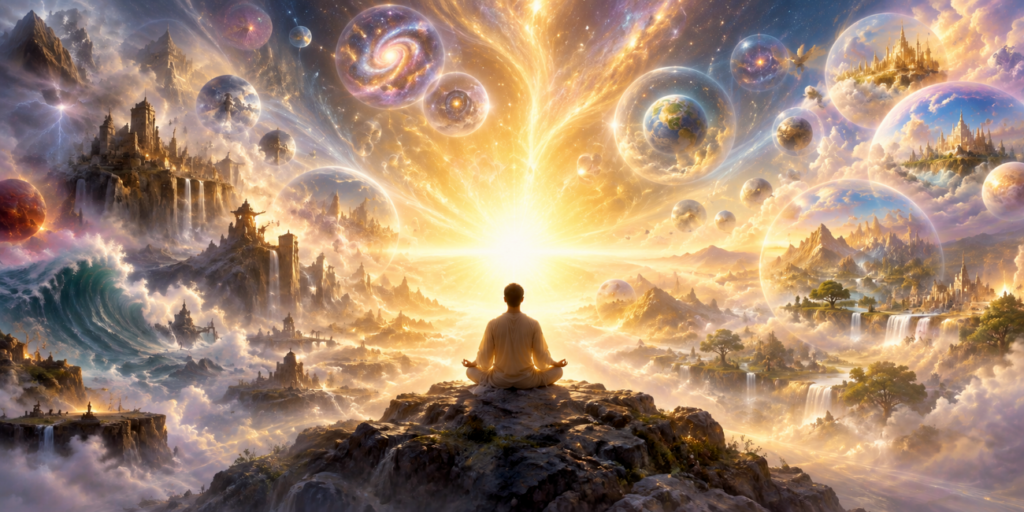
“The only way to cross this formidable ocean of world-appearance is the successful mastery of the senses. No other effort is of any use. When one is equipped with the wisdom gained by the study of the scriptures and the company of sages, and has his senses under control, he realises the utter non-existence of all objects of perception.”
The Nature of the Mind and Ego
The mind is of the nature of imagination (Kalpanā), which is ever busy in its operations: hence the inactivity of the mind is as impossible in this world as the insapience of the sapient man. If egoism is not granted to be a mental action, and the sensations be reckoned as actions of the body, yet its name of the living principle answers for all the acts of the body and mind.
“The mind, being fixed in the Supreme, becomes purified of its worldly desires and attachments; and then it perceives that soul in itself, which transcends all imaginations of the mind. (Kalpanās are imaginary attributes of God in the mind, who can only be seen in the heart).”
It is the province of the mind to secure the sedateness of the world in itself, and it lies in the power of the mind either to make its bondage or get its freedom.
The Allegory of the Heart: The Desert of Rāmātavī
On this subject there hangs a curious tale relating the legend of the heart, which was revealed to me of yore by Brahmā himself, and which I will now relate to you, if you will listen to it with attention.
There is a long, open, and dreary desert—Rāmātavī by name—which was quite still, solitary, and without an inhabitant in it, and so vast in its extent as to make a pace of a league of it. There stood a man of a terrific and gigantic figure in it, with a sorrowful visage. He held a club and maces in his arms, with which he was striking his own back and breast, and then running away in this direction and that. Thus striking, crying, and flying afar on all sides, he became tired and spent, and lank in his legs and arms. He fell flat with his languid limbs in a large blind pit.
After the lapse of a long time, he scrambled out of the pit with difficulty and again continued to run away and strike himself with his own hands as before. Having then gone a great way off from that place, he got to a grove of plantain arbour under the cooling moonbeams, where he sat for a while with a smiling countenance. Having then come out of the plantain grove, he went on running and beating himself in his usual way.
The Fall of the Demons and the Flight Across Realms
Being used to warfare for so long a period, they at last grew proud of their superior strength and repeated successes, and entertained the desire of their final victory. So when the desires of the demons Dāma and others became identified with their selves, their souls were degraded from their greatness and confined to the belief of the desired objects. They thought only how to become lords of the earth, and thus became lazy and enervated, as lotus-flowers without water.
“These cowards, wishing to preserve their bodies from the hands of death, became as powerless as to rest satisfied with having the feet of their enemies set up on their heads (i.e., they fell at the feet of their foes to spare their lives, as they say that cowards die many times before their death).”
Many fell in the cavities of the eddies of seas, in the abyss of the ocean, and in the running streams; some fell into far distant forests, and others dropped down amidst the burning woods of wild fire. Many fell in the polar regions, some alighting on the mountain tops and others sinking in the lakes below, while several of them were tossed over the countries of Āndhra, Dravida, Kashmir, and Persia. Many were lying with their broken armours and weapons, slashed by the superior power of the adversary, and with their robes and attires all dismantled and torn by their fall.
It happened on one occasion that Yama—the god of retributive justice—gave his call to that spot in order to survey the state of affairs in the doleful pits of hell.
Romance in the Enchanted Grove
He, like the moonstone, was soothed by her cooling beauty, beaming as moonlight in the sky; and she also, being beheld by him, was entirely subdued by her love to him. She was covered all over her person with the shafts of cupid, as when the lotus blossom is hid under a swarm of fleeting bees, and became as disordered as the leaves of the lotus are disturbed under a shower of raindrops.
She graced his person as the lotus-stalk graces the bosom of the elephant, and then spoke to him sweetly with her words mixed with tender affection. The loving pair fell into their trance of love in that happy grove, as a couple of playful bees creeps into the lotus cup under the fair filaments of the flower, shaking by the gentle breeze.
Transmigration and the Cycles of Existence
The parterres of Nandana gardens were trodden down under the feet of the fellow followers of Śiva, as when the ocean was churned by the Mandara mountain. The tender weeds and willows growing as golden shrubberies and tangled bushes in the beach of the river were trampled under the legs of heated elephants, as when they infest the lotus lakes on Meru.
“Associated by his sweetheart, he passed the moonlight nights in the forest groves of Kailāsa, attending to the songs and music of heavenly choristers.”
They with their emaciated bodies and sorrowful minds wandered about in the air, like birds without their nest. They grew the vegetables on earth. Some of these vegetables were concocted and then eaten by a Brāhman in the land of Dasārna or confluence of the ten streams.
“The substance of Śukra was changed to the semen of the Brāhman, and then conceived as a son by his wife. He constantly prayed for the long life, wealth, and learning of his darling, and thus forsook the constancy of his faith and reliance in Providence.”
Thus his falling off from the thought of heaven to those of the earthly aggrandizement of his son made his shortened life an easy prey to death, as the inhaling of air by the serpent.
He underwent repeated births and deaths in his wanderings in the world in search of its enjoyments, and seemed as something whirled about in a turning mill or wheel, till at last he found his rest in the cooling beach of the rivulet. It remembered how the wind instrument of its lungs breathed out the joyous music of its exemption from the pain of action to which all other men were subjected (this refers to the breathing of so-ham hamsah in yoga, which is the sweet music of salvation).
He did not find his son lowly bending down his head before him—the son who was the leader of the army of virtues and who was the personified figure of all merits. The dry and white skeleton of the body resembled the desire of fruition, which bends it to the earth to undergo all the favourable and unfavourable accidents of life.
“The face, standing erect on the protruded shoulders on both sides, was looking forward in the womb of the vacuous sky whither the vital breath had fled from the body.”
Thinking it no other than the dead body of his son, he became sore angry upon the god of death.
Yama’s Discourse on Destiny and Illusion
Yama said:
“We are appointed as devourers of all beings; and you are destined to be devoured by us. This is ordained by destiny herself, and not by any act of our own will. Know this form of mine to be that of the Supreme Being, whose universal spirit acts in various forms, all over the universe. As the motion of the moon is caused by no casual cause, though they falsely attribute a causality to it, such is the course of death in the world of its own spontaneous nature.
Knowing that the course of our conduct is subject to the destiny appointed by the Divine will, the wise never allow themselves to be subjected under the darkness of pride or passion at our doings. But the ignorant mind which is prone to evil destroys the goodly body, as little children break their dolls of clay in sport.”
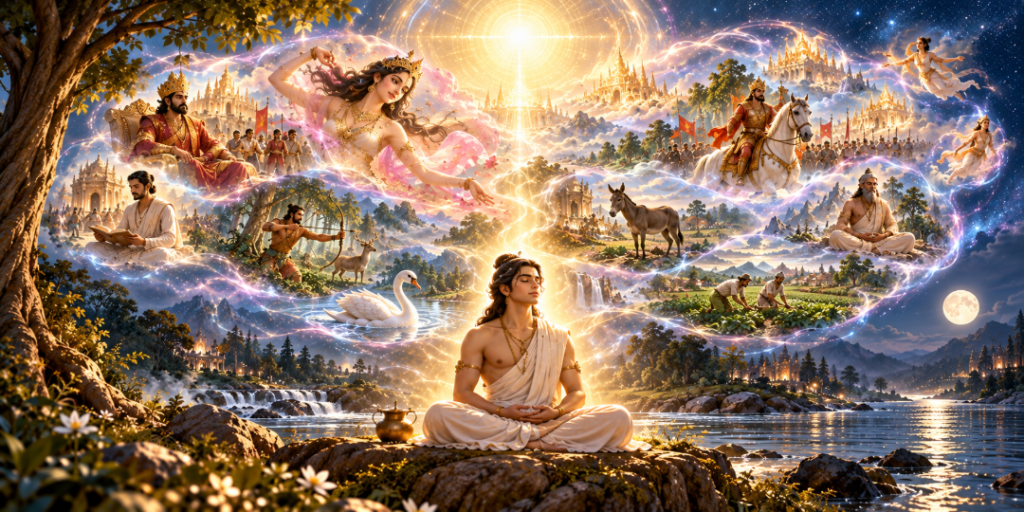
There he thought he passed a revolution of eight cycles of the four yugas in company with Viswāchī, a beauteous Apsara damsel unto whom he clung as the hexaped bee clings to the blooming lotus. He had become a Brāhman in the land of Dasārnā, and then a king of the city of Kosala. He became a hunter in a great forest, and then a swan on the bank of Ganges. He became a king of the solar race, and then a rāja of the Pundras, and afterwards a missionary among the Sauras and Sālwas. He next became a Vidyādhara, and lastly the son of a sage or muni. He had repeatedly been a Kirāta huntsman in the Vindhyā hills and at Kaikatav. He was a chieftain in Sauvīra, and had become an ass at Trigarta.
This son of yours had been skilled in incantations (mantras) and propagated them in the land of Vidyādharas. He became a favourite of females, as the sun is dear to lotus-flowers; and being as handsome as Kāma (Cupid) in his person, he became a favourite amongst Vidyādhara damsels in the land of Gandharvas.
“If you wish, O venerable sage, to know the reveries in his mind, you shall have to open your intellectual eye in order to pry into the thoughts of others.”
Awakening from Illusion: The Vision of Bhrigu and Śukra
Having seen the mind of his son in his own mind, the muni returned from the bank of Samangā to his own body on mount Mandara, where it was left in its sitting posture in the presence of Yama.
I knew very well that my son is not subject to death, and therefore I was struck with wonder to behold him lying as a dead body. I am now made to be acquainted by thee regarding the thoughts of my son, and am enabled also to see the whole scene on the bank of Samangā.
Yama replied:
As the huge waves of the wide and billowy ocean rise but to subside in its calm and undisturbed waters below, they sink in the Supreme Spirit—resembling one vast body of pure and transparent, cold and sweet water, and like a vast mine of brilliant gems of unfailing effulgence. He rests in peace who thinks himself to be situated in the cooling orb of the moon; otherwise the body is consumed with cares, as a tree on the bank is burnt down by a conflagration.
“Brahmā was produced in Brahma as the billow is produced in the water, and the male and female are produced from the neuter Brahma, changed to and forming both of them. The mind forgets its spiritual nature of its own will and makes for itself a strong prison house of its earthly possessions, as the silkworm weaves its own coating.”
“All those that appear as Brahmā, Vishnu, and Rudras, as also they that have become as gods and those that are called men and male creatures: some that are subjected to penury and poverty have little to effect in their lives, and always torment themselves with the thoughts that they are poor, miserable, weak, and ignorant.”
Remaining within the depth of the Divine Spirit and yet thinking ourselves to live without it is the cause of keeping us in darkness on the surface of the earth. Some having a little understanding have gone down the depth of holy knowledge without ever reaching the bottom or finding its either shore. But those that are awakened to sense have the rich mine of the śāstras, framed by the enlightened for the guidance of their souls. The study of good works destroys the errors of the mind, as the course of the sun in the sky destroys the darkness of the night.
All living bodies are subject to pain and pleasure, but it is the mind which constitutes the body, and not the flesh. He (Śukra), having tasted the pleasure and pain of all these states at a moment’s thought of his mind, is now seated as a devotee on the bank of Samangā under the spreading beams of the moon. The suffering of hell torments, the enjoyment of heavenly bliss, and the thoughts of birth and death are all fabrications of the mind, which labours under these thoughts.
With their luminous bodies, they arrived at the spot of Samangā and shone on high above the tamāla trees below. Their simultaneous rising in the clear firmament made them appear as the sun rising with the full-moon over the cloudy horizon.
“They saw the mountain bulls (Bos guavus) dozing in their giddiness, sitting as ebriety in person, while their bodies were reddened by the red dust of flowers and their tails flushed with the crimson farina blown by the breeze. They saw the Siddhas to be hit by the celestial damsels with blossoms of mandara flowers and clad with vests of the tawny clouds by which they were shrouded. They walked about here and there, and looked at and admired the grandeur of the mountain, till at last they alighted on the nether earth, decorated with its cities and human habitations.”
He thought upon the course of the currents of the world, which are continually gliding with successive joy and sorrow to man, who gets rid of them after his long trial.
“After their mutual salutations, they were seated on a slab of stone and appeared as the venerable gods Vishnu and Śiva seated on the pinnacle of Meru. Bhrigu made him acquainted with the state of his former birth, and he remembered it instantly by the clairvoyance of his inward sight.”
The Resuscitation of Bhārgava’s Body
There Śukra saw on a cliff of that mountain the dried body of his former birth, lying covered under the dark and dewy leaves of trees.
Ah, my pitiable body! How dost thou rest here in peace, forgetful of thy former delights in the different stages of life, and insensible of the thoughts of thy past enjoyments and amusements of yore! Behold the stags of the forest flying with fear at the sight of the wide open jaws and withered skin of my carcass, which with its horrid mouth frightens the timid fawns in the woods.
The other bodies of Śukra were merely the creations of his imagination; but that of Bhārgava (as the son of Bhrigu) was the actual one, as produced by the merit of his pristine acts. They who are acquainted with the course of nature, as also those that are ignorant of it as brutes and beasts, are all subject to the course of the world, as if they are bound in the net of fate and liable to grief and sorrow. The shadow of the sun is seen to shake in the water, but not so the fixed sun himself; so the wise are moved in worldly matters, though they are firm in their faith in God.
“Remain true to thyself by giving up thy concerns in the world; but continue to discharge all thy duties in this world by the acts of thy body. If you can rescue yourself from the great gloom of egotism and arrive at the state of pure indifference to all objects, you will certainly become great in your mind and soul, and be the object of universal veneration.”
His Brāhmanical body fell down immediately on the ground, staggering as when a tree is felled or falls down with its uprooted trunk; and it became disfigured in a moment in its face and limbs. The veins, arteries, and all the cells and cavities of the dead body were again supplied with their circulating blood, as the dry beds of rivers are filled again with floods of water in the rainy weather.
Śukra then rose up from the ground, breathing the breath of life like the cloud ascending to the sky by force of the winds. He bowed down to his father standing in his holy figure before him, as the rising cloud clings to and kisses the foot of the lofty mountain. Bhrigu looked with affection on the new-risen old body of his son, and smiled to see the resuscitation of the body that was begotten by him. Thus the son and sire graced each other by their company, as the sun and lotus-lake rejoice to see one another after the shade of night.
Thus the son of Bhrigu, who was born as Śukra at first, was gradually led away from his holy state by his thought of the heavenly nymph and subjected to various states of life to which he was prone.
Philosophical Reflections: Intellect, Creation, and Wisdom
As the sights in our dream and the images of our imagination are never apart from our minds, and as they cannot show themselves to the view of others, such is our erroneous conception of the world. Thus have we all become like the dreaming son of Bhrigu: to understand the false creations of our imagination as sober realities.
Considering in a philosophical light (tatwadarsana), it will be found that it is the will or desire of everybody which is productive of the objects of his desire. The pure mind has the true notions of things, as the gem polished from its dross receives the right reflection of everything (or reflects the true image of everything). But the sullied mind cannot easily unite with the object of its thought, as a dirty and cold piece of iron cannot join with a pure red-hot one unless it is heated and purified from its dross.
The tanmātras of the living soul and its proclivities run in one channel to the reservoir of life, and are thickened into one living being by their mutual coalition. The world, consisting of thousands of orbs like gunja fruits, contains the assemblage of atoms on atoms; and these, unconnected with one another, form the great garden of God.
As the looker on the clear sky does not see every part of it, and as the eye that looks on all others does not see itself, so we see everything about us besides ourselves.
“As the pure Spirit, taking the form of the vital breath, performs the functions of the body; so the mind, being reborn in a new body, is employed in all the functions of the same body.”
The living soul, having attained its intellectual state and the rest of the conditions of sound sleep (susupti), is awakened to the knowledge of itself and is released from its rebirth, while the ignorant soul is subjected to be born again.
Among these repeated births, the subordinate regenerations resemble the many-folded coatings of a plantain tree; and the spirit of Brahmā is contiguous to and pervades the whole, like the lofty leaves of the same tree. The seed casts off its seedy form and assumes the shape of the fruit; but Brahmā (the seed of all) contains the fruit (of the universe) in his bosom, without laying aside the seed.
The viewer viewing the view is unable to see himself (his inward soul) because his consciousness, being engrossed by external objects, is disabled from looking into itself. As the looker on the clear sky does not see every part of it, and as the eye that looks on all others does not see itself, so we see everything about us besides ourselves. But the all-seeing God, being permeated in the visibles, there can be no beholding of Him as a personal God, nor of them as distinct things. Because whatever the Almighty King proposes to do, He instantly forms their notions and becomes the same Himself.
Everyone’s intellect perceives the existence of the world in the same manner as his living soul happens to meet with everything as present before it by virtue of its former acts and their reminiscence stamped in it. When the mind becomes perfect, it comes to be the living being; and the intellect being purified becomes all-pervasive. Hence is the union of the intellect with the living spirit. The atom of the intellect contains the particles of all our notions, as the seed-vessel contains the farinaceous atoms of the future fruits, flowers, branches, and leaves.
Others look on outward objects as receptacles of the intellect, from the belief that the all-pervasive, inseparable, and imperishable intellect (soul) must abide in all and every one of them. God that shines is the living soul of everybody, resides also in the soul of that soul, as also in all the living souls and mind which are contained within the body of another.
By reverting the cognition of visibles to the recognition of their essence (tanmātra) in the invisible plenum, we get rid of our error of the reality of the formal world, as we do of the ornament in the material gold. He who is discursive in his words and not discerning in his mind is like a blazing fire in a picture. No one can be wise until he gets rid of his false wit. Wisdom serves at first to weaken our passions and enmity, and then uproot them at once; and at last it lessens our desires and endeavours, and gives an appearance of holiness to its possessor.
The Layers of Life and the Nature of Mind
All living beings composed of the dense intellect and soul, contain other living animals under one another, like the manifold crusts of the plantain tree, and the insects contained in the womb of earth. The worshippers of gods, get to the region of gods, and those of Yakshas meet at the place of Yakshas, and the adorers of Brahmā ascend to Brahmaloka. Resort therefore to what is best and the greatest refuge.
The States of Consciousness and Vitality
The waking state is that wherein we have a sure reliance; and that is called dreaming, in which we place no certain reliance and believe to be untrue. The state of waking dream is again of longer or shorter duration, in both of which the visions appear the same at all places and times. As long as one knows anything to be lasting before him, so long he believes himself to be waking, but no sooner is it lost to him, than he thinks himself to have been dreaming of it.
When the body has its activity with the powers of the mind, speech and the other members of action, it is to be understood, that its vital element is put to motion by the vital breath which it breathes. The internal actions of the body and mind being quieted, and the motion of the heart being at rest, the living principle becomes as still, as the flame of a lamp unshaken by the wind. The mind circulates about the outer world, through the passages of sight and other organs; and sees within itself the forms of many mutable shapes and figures.
When the body is weary with action of its limbs, mind or speech, the living element then becomes still, and remains in its composure, with the calm and quiet soul residing within the body. Life lies latent in the inner heart, as the liquid oil resides in the sesamum seed; it lies as dormant in the interior part, as frigidity within the frost, and fluidity in the clarified butter. This principle of life and thought, sees the multitudinous worlds situated with all their vicissitudes within itself, as the large tree and all its parts and productions, are observed to be contained within the seed.
When it is full of blood, it perceives a fiery redness in itself, like that of a rubicund rock, or as the crimson red of the setting sun in the sky. When the organs are not besieged by external objects, which disturb the inward senses of the mind; it indulges itself in the reflexion of many things, which is called its dreaming state. Now O great-minded Rāma! you have learnt the inward process of your mind; but there is no reality in them nor in this existent world, which is subject to the evils of death, desire and destruction.
Dialogue with Rāma and the Allegory of Dāma
Rāma said:—Why sir, all that is existent is ever present before us as our own bodies, and all things beside ourselves; but you are speaking of Dāma and the demons.
“Yes Rāma, being perfect quietude and void, he seems as nothing existent; and all these creations subsist in that vacuity as particles of its own splendour. What we call the world, is the representation of things to us as in our dream; it is a hollow body as a bubble rising in the empty ocean of the Intellect, and appearing as the water in the mirage.”
That Dāma and others would obtain their liberation, upon their release from their demoniac bodies by death. Being then crushed to death in that marshy ground under the feet of buffaloes, they were transformed afterwards to the shapes of cranes, frequenting that lake of lotuses. Thus I have related to you the whole of the story of the demon Dāma, which will fully convince you of the vanity of the world.
Overcoming Egoism and the Illusion of Worldly Attachment
He who abides by the dictates of the true śāstras, and associates with the best of men, are never subject to the darkness of error. Those who are renowned for their virtues, have the power to bring their destiny under their command, convert all their evils to good, and render their prosperity perpetual. Abiding patiently by the Śāstra, without hastening for success; and perfecting one’s self by long practice, produce the ripe fruits of consummation. Now wake and shake off the dullness of your long, deep and death-like sleep, like the torpor of the old tortoise lying in the bog.
See how he became victorious over death itself, by his adoration of Mahādeva by the side of a lake. So men having full knowledge of the spirit, and exerting their utmost devotion, are enabled to root out their destiny of transmigration, which is fraught with so much pain and pleasure (both of which are equally hurtful to the soul). The notion of the sphere of the world, is derived from the rays of the central intellect, stretching to the circumference of the understanding, and there being no difference between the radiating point and the radiated circle, acknowledge the identity of the radiator, the radii and the periphery (i.e. of the intellect, its intelligence and the world).
It is for want of the knowledge of the one Ego, that we think ourselves as I, thou, this or the other; and it is by shutting out our view of the only soul, that we see the incessant revolutions of this world and that. The man that is debased by this kind of egoism, can never come to his right sense; but becomes subject to all the evils of life, under the thrall of the powerful enemy. The man that forsakes the feeling of his egoism (or personality) from his mind, is not debased nor goes to perdition by either his indifference to or management of worldly affairs (i.e. the doing or refraining from bodily or worldly actions, is equally indifferent to the philosophic mind).
The celestial army being harassed on all sides by Bhīma, Bhāsa, and Dridha, fled precipitately from the height of heaven, as the Ganges runs down from Himālayan height. The whole world is full with the spirit of God, whatever otherwise one may think of it at any time; there can be no other thought of it except that it is a nihility, and this forms our perfect knowledge of it.
Purification of Mind and the Cleansing Mirror
The goodly disposed mind ever teems with virtues, that are opposed to wrong acts and vice, as the ground of a good quality, grows only the good and useful trees in spite of weeds and bushes. Thus prepared, the mind becomes devoid of its desires and enmity, and is freed from all troubles and anxieties.
“It becomes obtuse to the feelings of grief and joy, and of pain and pleasure also, and all its restlessness dies in itself.”
The mind makes the world its own, and ranges all about it; it raises the mountains and mounts over them; it is as the infinite vacuum, and comprehends all vacuity in itself; and it makes gods of friends and foes of others unto us.
“The understanding being soiled by doubts, and forgetting the true nature of the intellect, takes upon it the name of the mind, when it is full of all its worldly desires.”
The world is a magical city, and as a mirage appearing to sight; it is of the nature of the delusive panorama, showing many moons of the one, whose unity admits of no duality. So the one Brahma is represented as many by delusion.
The mirror of the mind being cleansed by the knowledge of the śāstras, and dispassionateness of the understanding, it receives the reflexion of Brahma, as the clear crystal reflects the images of things. The mind being composed of vain desires, is an unreality in itself; say therefore, O Rāma! why should you sorrow for something which in reality is nothing. When the rains of our desires are over, and the calmness of the mind is restored; when the shuddering coldness of dullness has fled, and when the mud of worldliness is dried up:— It is then that the mist of error vanishes from view, like the shadow of night on the approach of dawn.
Agency, Action, and the Optionless Soul
As the all-pervading sky is not to be seen owing to its extreme tenuity; so the undivided nature of the all-pervasive intellect, is not to be perceived on account of its rarity. It neither rises nor sets, nor gets up nor sits; it neither proceeds nor recedes to or fro, it is not here nor is it no where. (Omniscience is present everywhere and is ever the same). It falls from its knowledge of generals to that of particulars, by its act of specialization; and comes to the discrimination of the positive, and negative, and of inclusion and exclusion (or admission or rejection).
It made the universe teem with fourteen kinds of beings in its as many worlds of the chaturdasa-bhuvanas; and these are as different in their modes of life as in their forms and figures. Therefore the will to do this or that, or try for one thing or other, does not relate to the soul but to the mind. Thus the optionless soul, having no will of its own, does nothing except cogitating on what is in itself. It is no active agent, owing to the union of all agency, instrumentality and objectivity in itself. It abides nowhere, being both the recipient and content, or the container and the contained of everything in itself.
Neither is the will-less soul actionless likewise, when the acts of creation are palpable in itself (karmaprasidhi). Nor is it possible that there is any other cause of them. (Nanyakartā dvītiryakam. Sruti). For what is it that is called an action, but the exertion of mental and voluntary energies, with a fixed determination and desire of performing some physical acts, which they call the actions of a person. (But the apathetic minds of the wise, being insensible both of the purposes and their ends, there is no imputation of agency which can ever attach to them).
Whatever the mind intends, comes verily to pass, and nothing is achieved without the application of the mind; whereupon the agency belongeth to the mind and not to the body. (An involuntary action is not a deed). The thinking mind sees the outward objects, as reflexions of his pure intellect cast without him. (The spiritualist regards the outward as images of his inward ideas, in opposition to the materialist, who considers the internal ideas to be but reflexions derived from external impressions).
Psychological Healing and Freedom
“Mind alone is all this: and when that is healed this jugglery of world-appearances is also healed. This mind alone, by its thinking faculty, conjures up what is known as the body: no body is seen where the mind does not function! Hence, the treatment of the psychological illness known as perception of objects is the best of all treatments in this world. The mind creates delusion, the mind produces ideas of birth and death; as a result of its own thoughts, it is bound and it is liberated.”
They who are established in the state of liberation, as pointed out by the scriptures, surely cross this ocean of world-appearance as their consciousness flows towards the self.
Cosmic Development and Self-Realization
As the gem has its brilliancy in it, whether it is moved or unmoved by any body, so the unreal world has its potential existence in the Divine Spirit, both in its states of action and inactivity. Thus the intellect which is self-manifest and omnipresent of its own nature, developes and envelopes the world by its own manifestation and occultation, and by its acts of integration and segregation (sānhāra and nirhāra); or the acts of accretion and secretion.
It falls from its knowledge of generals to that of particulars, by its act of specialization; and comes to the discrimination of the positive, and negative, and of inclusion and exclusion.
“It strives and struggles within the confines of the sensuous body (owing to its degradation from spirituality); and it multiplies in these bodies like the weeds sprouting out of the bosom of the earth.”
It gives fragrance to flowers, and grows by degrees their filaments and pistils; and it makes the moisture of the porous ground, to grow vegetables on earth. It renovates the forest with its gifts of various hues, and dyes them with the variety of colours in the rainbow of Indra. It made the universe teem with fourteen kinds of beings in its as many worlds of the chaturdasa-bhuvanas; and these are as different in their modes of life as in their forms and figures.
They are human asses, who dote on the beauty of female bodies, which are no better than lumps of flesh, blood and bones. Being freed from his selfishness and egoism, he felt that perfect tranquillity which the soul receives by resting in itself, and which likens the calmness of the sea by its subsidence in itself. He remains some times entirely devoid of all his desires; and at others he takes upon him his cares for mankind from his great kindness to them. Every creature is born in the shape of its inherent nature, and then it is either elevated or degraded, according to the nature of its associations. It lays also the foundation of its future state of bondage to birth or liberation, by its acts, commenced in the present life.