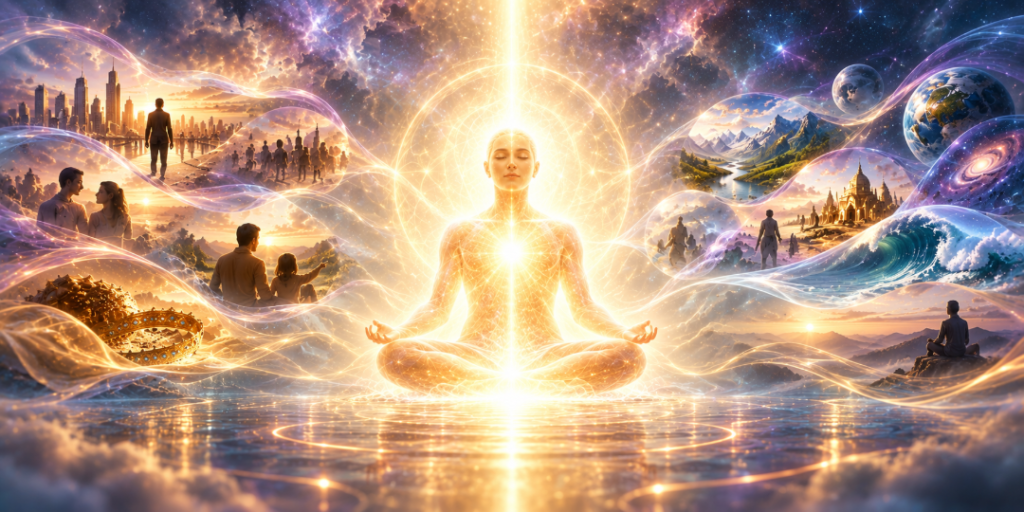
Appearance of Infinite Consciousness as ‘I am this’
“All things are equally indwelt by intelligence, so at all times in every way the uncreated is all, the self of all… Just as there is no division between a bracelet and gold, there is no division between the universe and the infinite consciousness.”
The Nature of Perception & Reality
Whatever one thinks within oneself in his own intelligence, that alone is expressed by him. To a suffering person a night is an epoch; and a night of revelry passes like a moment. In a dream a moment is non-different from an epoch. But to the sage whose consciousness has overcome limitations, there is neither day nor night.
All things are equally indwelt by intelligence, so at all times in every way the uncreated is all, the self of all. We use the expression ‘all things’: it is only a figure of speech, for only the infinite consciousness or Brahman exists. Just as there is no division between a bracelet and gold, there is no division between the universe and the infinite consciousness. The latter alone is the universe: the universe as such is not the infinite consciousness, just as the bracelet is made of gold but gold is not made of bracelet.
The Unfolding of Creation & Illusion
In that infinite consciousness there is an inherent non-recognition of its infinite nature: That appears to manifest as ‘I’ and ‘the world’. Just as there is an image in a marble slab even if it has not been carved, even so this notion of ‘I’ and ‘the world’ exists in the infinite consciousness. That is known as its creation.
“The word ‘creation’ has no other connotation. No creation takes place in the supreme being or the infinite consciousness; and the infinite consciousness is not involved in the creation. They do not stand in a divided relationship to each other.”
As she was thinking in this manner, the God discovered her sinister motives, contrary to the character of a yogi; and accosted her in a voice resembling the roaring of clouds. She was thus reduced to the thinness of a needle, fit only to sew a silken robe; and became as lean as the filament of the lotus flower by her own desire; which can change a hill to a grain of sand. Having subdued the organs of her senses and their powers, she remained as one without her organic frame, and identified with her living soul; and resembled the intelligent principle of the Bauddhas and Tārkikas, which is unseen by others (i. e. in her spiritual form only).
“An arduous attempt to accomplish the desired object, is often attended by a different result; and even success on one hand, becomes a failure on another; just as the mirror is soiled by the breath, while it shows the face to the looker.”
Sometimes she enters in the body of some lean person, as also in those of healthy and wise people; and appearing at first as a choleraic pain, becomes a real cholera at last. The iron needle growing old in its business of stitching, was at last lost by itself; like the rotten plank of a boat, bearing the burthensome ballast of stones in it. At last Sūchī came to find on a sudden, the fault of her wrong choice of the puny body (of the needle); which was to be filled with her scanty fare of a bit of thread, and then she began to repent for her folly. The colic caused by vitiation of the Vyāna air, produces many diseases, and affects all the members of the body with a watery fluid. When it comes by breathing of the lungs, it causes the Vāya sūla or pulmonary colic of lungs, and is attended by disfigurement of the body, and insanity or hysteria known as the hysteric colic.
The infinite consciousness regards its own intelligence in its own heart, as it were, though it is non-different from it, even as wind is non-different from its own movement. At that very moment, when there is unreal division, there arises in that consciousness the notion of space, which, on account of the power of the consciousness, appears as the element known as space. That itself latter believes itself to be air and then fire. From this notion there arises the appearance of fire and light. That itself further entertains the notion of water with its inherent faculty of taste; Thus, the water element appeared to manifest itself.
The words, the face and eyes, are expressive of the inward thoughts of the wise, and these go together like the salt and water of the sea (which are inseparable from one another) —
manasyekam vacasyekam karmanyekam mahātmanām |
manasyanyat vacasyanat karmanyanyat dusātmanām ||
The mind, the word and act of the wise all agree. But those of fools disagree in all the three.
Inquiry into the Cosmic Atom
What is that atomic minim which is one yet many, and as vast as the ocean, and which contains innumerable worlds like the bubbles of the sea? What is it that moveth unmoved and unmoving, and standeth without stopping; what is it that is intelligent yet as dull as a stone; and what is it that presents its variety in the vacuity of the understanding? Who is the maker of heavens, and who is the author of the natures of things; who is the source of this gemming world, and whose treasure are all the gems contained in it? (Man foolishly owns them for a time, but leaves at last to their true possessor and maker). Both time and space are equally infinite and indivisible, as the essence of God wherein they subsist, why then do we try to differentiate and separate them like the water from its fluidity? I shall then fill this big belly of mine with all the people of thy realm; but shouldst thou answer rightly, thou shalt reign in peace; or else thou shalt meet thy end like the ignorant, who are surfeited with the enjoyments of life.
This minutial is the transcendental vacuum, and is imperceptible owing to its minuteness; and though it is situated in all things, yet it is unperceived by the mind and external senses. The cogitation and incogitancy of the intellect, being both perceived in our minds, it is said to be both intellection as well as dullness of the intellect. The Divine Soul is of the essence of fire, and never forsakes its igneous form. It inheres in all bodies without burning them, and is the enlightener and purifier of all substances. There is an inextinguishable light (glory), known as ineffably transcendental, which the eye cannot behold, but is perceptible to the mind as its inward illumination, and presenting all things to its view. The atomic spirit is the casket of the bright gem of the world, without changing its minuteness. The divine spirit is its measure and measurer, beside which there is no separate world of itself.
Sometimes a twinkling—instant represents a Kalpa, when it is fraught with the acts and thoughts of an age; as an extensive country of many leagues, is pictured in miniature or in a grain of the brain. All things or objects which are perceptible to the senses, are called to be evident or apparent; and those which lie beyond them, are said to be imperceptible or unapparent. But visual sensation is not self-evident, except the vision of the intellect, which is the real essence.
Brahma is viewed as Sat or reality, when He is considered as pervading all things; and He is said to be Asat or unreal, because He is not the object of vision. So is the Intellect said to be a reality from its faculty of intellection, otherwise it is a stolid or dull matter. As a mirage is the reflexion of the dense light of the sun, so is the world a shadow of the solid light of the Divine intellect. Like the appearance of a visionary city in dream, the sight of this world is neither a reality nor altogether unreal; because it is a reflexion of the intellect, as the dream is that of images in the memory. It is but a continued medley of error. But all these living beings have no room in the empty sphere of Divine Intellect. They live and shine like the solar rays, proceeding imperceptibly from that luminous orb. As the tree which is yet undeveloped in the seed, is not in esse without development of its parts; so the world in the womb of Brahmā, was discernible only to the Divine Intellect.
Mind, Destiny, and the World-Illusion
The omnipotence of Brahmā, is seen to stretch itself to all the ten sides of the universe; his power of annihilation is seen in the extinction of beings; and his punishment is evident, in the sorrows of the miserable. The intelligent soul sees these hosts of creation to be moving in the essence of Brahmā, as he beholds the innumerable waves, billows and surges of the sea, rolling on the surface of the waters. The living soul although it is a particle of the Supreme soul, shows itself in this world as no soul at all (but a form of mere physical vitality). So the purblind see two moons in the sky, and are unable to distinguish the true moon from the false one.
“Nothing is really existent except the creations of our imagination, and it is our fancy which fashions all the objects in their peculiar fantastic forms.”
As the princes, the rivers and the future city, were mere creations of the nurse’s imagination, so the existence of the visible world, is but a production of the imaginative power of man. Whether the body lasts or falls, it is of no matter to us (since the soul survives its loss); as the flower being destroyed, deposits its fragrance in the air. The mind by its restless desires, hastens itself to a painful death; which reasonable are trying to avoid; by their government of the mind.
As the child makes a variety of his toy dolls at home from clay, so the mind is the maker of all its good and bad chances, according to the merit or demerit of its past actions. Therefore the mind which is situated in the earthen dolls of human bodies, can do nothing of its own will, unless it is destined so by virtue of its former acts. (The mind that moves the body, is itself moved by the destiny derived from its prior acts).
“The mind is the cause of all its feelings, as water is the cause of the sea, and the heat of fire. Hence the mind is the source of all things, and intimately connected with whatever is existent in the world.”
The Forest Hermitage & Royal Meditation
The forests were deep and dense, and there dwell in the fastness of these woods a number of holy hermits; while the Vidyādhara damsels had wrought there many a bower of swinging creepers (for their amusement). Groves of Karanja plants were decorated with bundles of blossoms, to the utmost boundaries of the jungle; and the firmament resounded with the rustling noise, emitted by the leafy date trees in the villages around. The birds, Siddhas and seers were sitting and singing outside their homes of mountain caverns; and made the valley symphonious with their celestial strains of holy hymns.
After he was seated there as gladly as the moon in the firmament, his chieftains and legions appeared before the throne with their salutations (and presenting of arms). The ministers were then employed in the public affairs pending before them; and the dextrous officers were engaged in relating the reports of the country to the king. He bowed down to the ruler of the earth, and lowly bent his capped head and neck before the court; as a tree hangs down its loads of fruits, at the foot of a mountain. He was followed by his swift and beautiful courser, as the Uchcha Sravā horse of Indra follows his master in the celestial regions. He continued for a couple of hours as if he was drowned in his meditation, and as insensible saints remain in the enjoyment of their internal and spiritual stupor. The noise of the people in the Courtyard, was all hushed and quiet; as the roaring of the clouds is stopped at the end of the rains.
As he was about to fall down from the horseback, he was held up by and supported upon the arms of his attendants; as the mount Meru is kept from falling, by the hills at its feet and sides. The Courtiers then respectfully asked the king, what was the matter with him; with a voice as sweet as the lotus utters to the sun when he is eclipsed by Rāhu.
“The minds of fools are fascinated by the trivial and tawdry trifles of common people; but they are of no value to the high minded as one like yourself.”
The moon-like face of the king was brightened by his full open eyes, as the vernal season is beautified by the blooming blossoms, after the winter frost has passed away. You trickster, said he, what was this snare which thou didst entrap me in, and how was it that thou didst perturb my tranquil soul by thy wily trick, as a gale disturbs the calm of the sea.
The Realization of Uddālaka & Absolute Bliss
When the phenomenas are all ingulphed of themselves, in the one common spirit; and there remains nothing as different from it, it is then called the one common entity. This common view of all existence, is entertained by all great and liberated beings; as it is the same moisture and air, that is spread through the whole earth and vacuum. He compressed the vital airs in his body, and kept his head erect on his neck; and then by fixing the tip of his tongue to the roof of his palate, he sat with his blooming countenance turned upwards to heaven. His habitual consciousness of intellection, taught him the community of the intellect; and it was by his constant communion with the intellect, that he perceived a flood of internal bliss stirring in himself.
The Brahman then attained to that state of his summum bonum which in unmeasurable, and pervades through all space of the measureless vacuum; and which fills the universe and is felt by the enraptured yogi alone. It is what is called the supreme and infinite bliss, having neither its beginning nor end, and being a reality, without any property assignable to itself.
After a long time had elapsed in this manner, the daughter of the mountain king—Pārvatī, came to that spot, accompanied by the Mātris, and shining like flames of fire with the grey locks of hair on their heads, as if to confer the boon of his austere devotion. Whoever plants this plant of the life and conduct of Uddālaka in the garden of his heart, will find it always flourishing with the flowers of knowledge and the fruit of divine bliss within himself. And whoso walks under the shadow of this growing arbor, he is never to be subject to death, but will reap the fruit of his higher progress in the path of liberation.
Instructions on the Self & Renunciation
Think yourself as the light of sun, and vacuum with all its ten sides and the upper and lower regions of space; and that your soul is the soul of gods and demigods, and the light of all luminous bodies. Know yourself as darkness and the clouds, the earth and seas; and the air and fire and dust of the earth, and as the whole world, to be combined in thee.
“Being certain of this truth, you will see the innumerable worlds situated in thy internal soul; and by this means you will escape from being subjected to, or overcome by the joys and sorrows of life.”
There is a third sort of egoism amounting to the non-ego, which takes the body for the ego, and thus becomes subject to misery, and finds no rest in this life nor in the next.
“All the sensations and vibrations that we have in our bodies, and all the thoughts we are conscious of in our minds, are all affections of the sovereign soul, which is beyond our vision and the visibles.”
The soul is not born nor does it die, it neither receiveth nor desireth anything; it is not restrained nor liberated; but it is the soul of all at all times. The soul is awakened by its enlightenment, or else the soul is supposed in what is no soul for our misery only; as the supposition of a snake in a rope, leads to our error and fear.
The thought of getting liberation, growing big in the mind, disturbs its peace and rest, and injures the body also. But untruth being detected from truth, it flies from the mind, as a chandāla woman when once known she comes to be as such, flies afar from the society of Brahmans. The self contented man, neither gives to nor receives anything from anybody; he neither praises nor dispraises any one, nor does he rejoice or grieve at anything, nor is he ever elated nor depressed at any occurrence.
“The best of men that are devoid of desire, laughs to scorn at the busy affairs of the world, and at men taking from one and giving to another, or storing or squandering their riches.”
Rāma! you have nothing to desire in this world, nor are you led away by worldly desires, like one who is borne in a car, and thinks that his side-views are receding back from him. Though beset by anxious cares, he remains without the anxiety of his mind; and stands steadfast with his confidence in the supreme soul, like Brahmā in his hurry of the creation of the world. Who that knows what error is, will be so great a fool as to fall to it again? as none that has known a body of men to be the pariah chandalas, will ever like to mix in their company. Even learned Brahmans may fall into the error, of drinking some liquor for pure water; until they come to detect their mistake of the same. The sable locks and crimson lips of the fairy, are portrayed as in black and red in a picture; so their is no difference of the figure in its living form or in painting. Has still the comfort of thinking on her sweet heart, and dissipate her sorrows with the thought of her favourite lover; such is the mystic love of spiritualists.
I will now cease to think concerning the existence and inexistence of substances, and will recline solely (with my steady posture on that Being to whom the being and not being of things is truly known like that of a mountain peak). But it is their union, that serves to produce the same effect, as the wood that grows in the forest, the rope that is made of flax or hide, the axe made of iron, and the carpenter that works for wages, do all combine in the building of a house.
“Seeing the natures of things in their true light, he avoided all that presented a false appearance; and for fear of being misled by appearances, he resorted to the shelter of meditation.“
Then sitting in his erect posture, he said to himself; “Be passionless, O my impassioned heart, and rest at peace my intolerant spirit.” And I bid my last farewell to thee, O thou deity of piety and pious deeds! that I may no more engage myself to the performance of acts. I bow to thee my holy cell, that art my associate in this devout devotion; and art the only refuge of this weak body of mine, after its weary journey in the rugged paths of the world. I thank thee also, O my aged body! that art the prop of my life, even in this old age of thine; when thou art reduced to thy ribs, covering thy bloodless entrails, and thy shrivelled veins and arteries. Let this light which is visible to sight, reenter in the sun whence it proceeds, and let these sweet scents which come to my smelling, mix with the flowers from which they are breathed and blown. Here I sit devoid of all actions, and removed from the sight of all living beings; I am freed from the thoughts of worldly things, and am resting in the peace of my soul, which is seated in my cranium.
The Incorruptible Spirit & Mastery Over Mind
Knowing the soul to be inaccessible by pain and pleasure at all times, and as everlasting and ubiquitous in all places; no one, O mighty prince! has any cause to be sorry for it. All things are accomplished by application of their proper means, and what is thus ordained to take place, can not be undone even by the three-eyed God Siva himself. (It is believed that some mantras and gems are possessed of the power, of lifting living bodies in the air). It is not impossible or hard, to effect the acquisition of supernatural powers; should one persist in the course of practicing and applying the proper means to those ends.
Rāma said: Sir I have yet another question for your explanation and it is this, why did not the ravenous beasts of the desert, devour the deadlike body of the devoted sage, and why did it not moulder under the earth, by which it was covered?
Whenever the mind is occupied with the thought of any thing, it is immediately assimilated into the nature of that object, and assumes the same form on itself. The spiritualised body of the Yogi, is seen to move about on earth, like the shadow of something floating on the water. Therefore the spiritual body of the sage, which was rarefied above the elemental bodies by virtue of his spiritual knowledge, became quite incorruptible in its nature. He who has lost the pulsations of his heart and vital breaths, has lost also both his vitality and mortality, and become as stones (which are neither dead nor alive). So the want of fluctuation, is seen to cause the steadiness of all things in the world; and hence the bodies of sages are known to be as quiet, as the blocks of wood stroke of wood and stone. They are then perfect masters of themselves, whose minds are well governed by their right understanding; and are not affected by the influence of their destiny or the acts of their past lives, nor moved by their desires of any kind.
Ignorance vs. Divine Knowledge
But the Sapient man who knows the bodiless soul and relies therein, has all his senses under the subjection of his soul; and they do not overthrow him, as obstinate horses do their riders. How can the body be deemed an intelligent thing, when the knowledge of the one (i.e., the soul) as intelligence, proves the other (i.e., the body) to be but a dull mass. The presence of the one, nullifies the existence of the opposite other; as in the cases of day and night, of darkness and light, and of knowledge and ignorance.
Knowing your soul to be no part of your body, rest quietly in it to eternity; but believing yourself as the body, be subject to repeated transmigrations of it in endless forms. This bodily frame is the product of the Divine soul, as the wave is produced of the water of the sea; and though the bodies are seen to move about as waves, yet their receptacle the soul is ever as steady as the sea;—the reservoir of the moving waves.
The unintelligent body and limbs, are actuated to perform and display their several acts, by action of the vital breath; as the vacillation of the insensible trees and leaves, is caused by the motion of the breeze; and both of them cease to move, no sooner the current airs cease to agitate them. Talking with the ignorant, is as calling the dogs from a distance (which is neither heard nor heeded by them). Ignorance is the seat of evils, which never betide the sensible and the wise. The ignorant fool can never get rid of his misery, so long as he is fast bound to the belief of taking his body as his soul, and knowing no spiritual soul besides. The seeing man or looker on sights, that regales his eyes with the sight of unrealities; is at last deluded by them, as a man is moonstruck by fixing his eyes on the moon, and becomes giddy with the profuse fragrance of flowers. The ignorant foster their hopes of heaven on the death of their bodies; as the farmer expects a plenteous harvest, from his well cultivated fields.
These beauties with their glancing eyes, resembling the fluttering bees of summer, and with lips blooming as the new blown leaves of flowers; are flaunting to catch hold of ignorant men; as poisonous plants are displayed, to lay hold on ignorant flies. Enmity is like a wild fire, it consumes the arbour of the body, and lets out the smoke through the orifice of the mouth in the desert land of the heart, and exhibits the rose of the heath as the burning cinders. The ignorant man that is subjected to repeated births, and is rising and falling as waves in the tumultuous ocean of this world, is exposed also to repeated deaths: and the burning fire which engulphs his dead body, is as in the submarine fire of this sea.
This world which is a plane pavement and but narrow hole (lit., a cow foot-cave) to the wise, by their unconsciousness of it; appears as a boundless and unfathomable sea to the ignorant, owing to their great concern about it. (The wise think lightly of the world; but the worldly take it heavily upon themselves). The revolution of repeated births, is like the constant rotation of the wheel of a chariot; and there is no body that is able to stop their motion, by restraining his earthly desires; which are ever turning as the spokes affixed to nave of the heart. How flourishing is the arbour of this delusion, which is fraught with the endless objects of our erroneous imagination; and hath stretched out these innumerable worlds from our ignorance of them. It is under the influence of the cooling moon-light of ignorance; that our minds foster the fond desire of worldly enjoyments; and like the chakora birds of night, drink their fill of delight as ambrosial moon-beams. (The ignorant are fond of pleasures, and where ignorance is bliss, it is foolish to be wise).
The Delusion of Form and Mortality
The sidelong looks of the beautiful eyes in their faces, look like a cluster of black bees, sitting on the pericarp of a full blown lotus. Their swollen breasts which are compared with lotus-buds, ripe pomegranates and cups of gold, are viewed by the wise as a lump of flesh and blood and nauseous liquor. Their thick thighs are likened to the stems of lumpish plantain trees, and the decorations of their protuberant breasts, are resembled to the strings of flowers, hung upon the turrets of temples.
“All the world is as a ripe fruit in the mouth of death, whose voracious belly is never filled with all its ravages, for millions and millions of kalpa ages. (The womb of death is never full).”
Poverty branches out like the thorny Sālmali tree, in a thousand branches of misery, distress, sorrow, sickness, and all kinds of woe to human beings. (Poverty is the root of all evils in life).
The accumulation of unsubstantial materials, which causes the formation of the stupendous world, is taken for real substantiality by the unwise; as the foaming froths and ice-bergs in the sea, are thought to be solid rocks by the ignorant sailor. (So all potential existences of the vedantist, are sober realities of the positive philosophy). The great edifice of the world, is supported by the pillars of its mountains, under its root of the great vault of heaven; and the sun and moon are the great gateways to this pavilion. (The sun and moon are believed by some as the doors leading the pious souls to heaven). All worldly things are undergoing incessant changes, by their appearance and disappearance by turns; and the vicissitudes of our states and circumstances, from these of pleasure and prosperity to the state of pain and misery and vice versa, in endless succession. (Pain and pleasure succeed one another).
The animal creations and the vegetable world, are standing as passive spectators, to witness and meditate in themselves the marvelous acts of time, in sparing them from among his destruction of others. The trees however are not affected by any of these accidents, because they stand firm on their roots, and though suffering under heat and cold and the blasts of heaven, yet they yield their sweet fruits and flowers for the supportance and delight of all living creatures. (So the Yogis stand firm on their legs, and while they suffer the food and rest privations of life and the inclemencies of weather, they impart the fruits of divine knowledge to the rest of mankind, who would otherwise perish like the insects of the earth, without their knowledge of truth and hope of future bliss).
The Nature of Ignorance & Universal Manifestation
It is the energy of the Divine intellect, which is the mātrikā-mater or mother (mater or materia of all, and assumes the forms of density and tenuity and also of motion and mobility; the clusters of stars are the rows of her teeth, and the morning and evening twilights, are the redness of her two lips). The Jambūdwīpa or Asia forms her naval or midmost spot, and the woods and forests form the hairs of her body. She appears in many shapes and again disappears from view, and plays her part as the most veteran sorceress in all the three worlds. Such is Brahma the lord of gods, under whom these endless acts of evolutions and involutions are for ever taking place, in the infinite space of his eternal Intellect and omnipotent will.
Ignorance produces greater ignorance, and brings on unconsciousness as its effect: so knowledge leads on to higher knowledge, and produces self-consciousness as its result. All its joints are full of the reptiles of diseases, and its stem is perforated by the cormorants of destruction; yet it yields the luscious juice of delight to those that are bereft of their reason and good sense. Ignorance blossoms every day in the clusters of the bright planetary bodies, that shine with the sun and moon by day and night; and the winds playing in the air, bear their light like perfumes to us. (i.e. It is the spirit that glows in the stars, and breathes in the air, but ignorance attributes these to the planets and breezes, and worships them as the navagrahas and marut ganas, both in the vedas and the popular Puranic creeds).
The beams of the sun and moon, and the flames of fire, which are scattered about us like the crimson dust of flowers; resemble the red paint on the fair body of ignorance, with which this delusive lady attracts our minds to her. It stretches with its head to the blue vault of the sky, forming as a canopy of black arbour of black Tamala trees over it. The earth supports its trunk, and sky overtops its top; and it makes a garden of the universe (with its out stretched arms). It shoots out with buds of mistakes, and is beset by the briars of error; it grows luxuriant in hilly districts, with exuberance of its leafy branches. (Meaning that the hill people are most ignorant). Sometimes it resides in the infernal regions, and at others it dwells in the heavens above; sometimes it is exalted to the dignity of gods, and some where it remains in the state of mean insects and worms.
“Whatever appears as great and glorious, and all that is seen as mean and ignoble in their form, from the biggest and bright sun down to the most contemptible grass and straw; are all pervaded by the universal spirit: it is ignorance that dwells upon the external forms; but knowledge that looks into the inner soul, obtains its sight up the present state.”
Liberation, Desire, and the Inner Soul
I would not have my heart to be enticed and deceived by the false attachments and affections of this world; all which are as delusive, as our misconception of a snake in a rope. (All our earthly relations with our relatives and properties, are deception that are soon detected by our good sense and reason, and they vanish as soon as our mistake of the snake in rope. Therefore let no worldly tie bind down thy heart to this earth).
The understanding only is the embodied soul purusha, which is lost upon the loss of the understanding; but the soul is said to last as long as there is understanding in the body, like the ghatambare or air in the pot lasts with the lasting of the pot, and vanishes upon the loss or breaking of the vessel. (The soul lasts with the intellect in the body, but flies away upon the intellect’s desertion of it. This is maintained by sruti). Rāma! we call that to be the perpetual liberation of the soul, which follows persuasion of one common entity, after its rational investigation into the natures of all other things and their false appearances. (or else the blind torpidity of the irrational yogi, amounts rather to his bondage to ignorance than the liberation of his soul from it).
One is then said to recline in Brahma who is inclined to his spiritual Contemplation, after his investigation of divine knowledge in the sāstras, and his discussion on the subject in the company of the learned doctors in divinity. The heart that contains the fruitful seed of desire in it, can never have its rest or consummation even in its dormant state; but this seed being burnt and fried to its unproductiveness (by means of divine knowledge), it becomes productive of sanctity, though it may be in its full activity. The heart that preserves the slightest remnant of any desire in it, it again filled with its full growth to luxuriance; as the little remainder of fire or the enemy, and of a debt and disease, and also of love and hatred, is enough to involve one in his ruin as a single drop of poison kills a man.
The intellectual power which enveloped by the seed of mental desire, supplies it with moisture for its germinating both in the forms of animals and vegetables every where. Again when a man betakes himself to ponder well the properties of the object before him, his ignorance flies away from before his face, as darkness flies at the approach of light. As the great mass of thick darkness, disappears into nothing at the advance of light; it is in the same manner that the substantiality of gross ignorance, is dissolved into unsubstantiality at the advancement of knowledge. He who stoops to consider whether the flesh or blood or bones of his bodily frame, constitutes his personality, will at once perceive that he is none of these, and all these are distinct from himself. Thus ignorance being got over there remains nothing whatever, except the one eternal soul which is the adorable Brahma and substantial whole. There is no ignorance nor inexistence except the intelligence and existence of God, who pervade over all visible and invisible natures, which are attributed with the appellations of existence and inexistence.
Realization of the All-Pervading Brahman
This truth was well known to the host of Sages, including Narada and Pulastya, Angira and Pracheta, and Bhrigu Krutu, Atri and Suka, as it is known to me also. All these spacious worlds, that you behold to be spread all about you, they are all that One or on, and are situated in the immensity of Brahma. Our bodies being the abodes of Brahma, it is as false to think to our bodily pains, as also of our pleasure in bodily enjoyments, as to take a rope for a serpent. (Hence we can have no sense of our pleasure or pain, as long we know ourselves to be situated in Brahma and He in us).
The mind, understanding, egoism, and the elemental atoms, and the organs of sense, are all the various forms of Brahma; wherefore there is cause of our joy or grief. Brahma being known as Brahma, becomes manifested such in a moment; just as gold when known as such, is taken in due esteem.
“God being known as the tout ensemble or comprising the whole plenum, we come to believe the same as Brahma; and losing our egoism and tuism in the same, we come to the knowledge of that entity only comprising the entire universe.”
The unity of Brahma is a certain truth, and it is the ego which is manifest in the seas and mountains and all living beings; and in the qualities of reception and emission, and of extension and contraction in all material bodies.
He that is known as only soul of all, and who is ascertained as the supreme spirit, and who is designated by the appellations of the intellectual soul, Brahma the great, the only entity and reality, the Truth and Intelligence, apart from all other names. Give up the thought of thy difference from Brahma by knowing thyself as the reflexion of the intelligent soul; which is the cause of the causes of the existence of the world. Such as vacuum and others, which are causes of sound and are caused by vacuous spirit of God. The soul that has known the truth, knows himself as the supreme Intellect, as the pilgrim on the way sees only his saint before him, and no intermediate object besides. I am the undecaying intellect of Brahma, and deem my gain and loss in equal light of indifference; while I view this earth and sky, and the sun and moon displayed before my eyes in all their glory.
“I am that intellect of Brahma, which like the sunshine pervades equally in the form of transparent light in and above all created beings.”
The Spiritual Light and the Nature of Siva
“There is a little resemblance of this spiritual light, with the intellectual light of philosophers, whose minds are enlightened by the cooling moon-beams of philosophy, as those of the inspired saints are illumed with spiritual light.”
There are three pairs of lotus like organs formed of soft flesh and bones, and these stretch up and down perpendicularly in the body, and are attached to one stalk like artery connecting them with one another. These then receive different appellations, according to their course through the several, and are denominated as the five fold vital airs of prāna, apāna, samāna, udāna, and vyāna; by them that are skilled in science of pneumatic. (The prāna-vāyu is the breathing of the nostrils, the apāna is the wind in ano, samāna is the air circulating through the whole body, udāna is the air of speech, and the vyāna is the air let out through the pores of the whole body). These vital powers are employed in passing in and out, in taking in and letting out, in rising and falling, and also in moving throughout the body.
What more shall I say, than that it is our lord—the air, that moves the whole machine of the body, as a mechanic models everything by means of his machinery. Thus by watching the motion of those airs (i.e. of the prāna and apāna—inspiration and expiration for the whole of my lifetime); I find the course of my life to be as interminable, as that of the continuity of my breathings.
“What are the powers of that Siva, my lord! who are they and where are they situated; what is number, and how are they employed and who is their witness.”
“The god Siva is the benignant, incomprehensible and tranquil supreme soul; He is gracious and formless and of the nature of the pure intellect only.”
His essences are volition, vacuity, duration and destiny; and also the qualities of infinity and fulness. Beside these he has the properties of intelligence and action, as also of causality and quietude; and there are many other powers in the spirit of Siva, of which there is no reckoning nor end.
The god Siva who is intellect only of himself, has endless forms also (according to his endless attributes), and the powers that I have said to belong to him, are little and no way different essentiality. (The properties that are predicated of god, belong to his intrinsical nature and not derived from without). It is the discrimination of the powers of intelligence, action, passion, vision and others; that the powers of God are said to be many and different from one another, like the waves of the sea. Thus do those different powers act their several parts for ever, in the grand stage of the universe; as the ages, years, months and weeks and days, play their parts under direction of time—the manager of the stage.
“That power which appears as the one or another, is called the divine powers of destiny; and is distinguished by the several appellations of action, energy or will of God, or the dispensation of his Time.”
That power which determines the states of gods, and those of the great Rudras as so and so, and what regulates the conduct of all things from a mean straw to the great Brahmā, is called the predominant doom or destiny. This destiny continues to dance about the great arena of the universe, until the mind is cleared of her bugbear and freed from anxiety by the knowledge of truth (that it is the Divine will which destines the destiny).
“The play of destiny is very pleasing to behold, owing to the variety of its characters and contrivances, and the quick changes of the scenes, and the repeated entrances and exits of its players and actors.”
It is conducted all along with the music of the drums and trumpets of the roaring clouds of cosmic dissolution, swallowing countless eons (Kalpas) in mere moments. The vault of heaven is the canopy over this stage, the season flowers are its decorations, and the showers of rain serve for the sprinkling of rose waters in it. The dark clouds hung about the heavens are, the blue hanging screens around this stage, and the sexcentenary as of the earth with the shining gems in their bosom, serve for the ornamented pits and galleries of this playhouse.
The shining sky with its sight of the days and watches, and its eyes of the twinkling stars; is witnessing the continual rise and fall of all being, and the plunging and up heaving of mountaintops at the great deluge. The revolving luminaries of the sun and moon, and the rolling currents of the Ganges, appear as the pearly jewels on the person of this actress, and the lustre of the twilight seems as the red red-dye of her palms. The incessant motion of the upper and nether worlds, with the continued gingling of their peoples; resemble the footsteps of this dancing destiny, with the ringing trinkets and anklets fastened to her feet. The sunshine and moonbeams, represent the lustre of her smiling face; and the twinkling stars in the sky, resemble the drops of sweat trickling on her face. The changing scenes, that are always seen to take place in the play of destiny, at the great stage of this world; are continually witnessed by the great God himself, who is neither distant, or distinct from this, nor is this so from that.
This god who is the supreme Lord, is the adorable one of the wise; in the form of the intellect and conscious soul, and as all pervading and support of all. He is situated alike in the pot and painting, in the tree and hut, in the vehicle and in all men and brute animals; under the several names of Siva, Hara, and Hari, as also of Brahmā, Indra, Agni, and Yama.
“His worship consists in his inward meditation only, and in no other mode of outward worshipping, therefore apply your mind in the adoration of the universal soul, in its meditation in your soul only.”
He is in the inside and outside of all as the universal soul, and always dwells in spirit and in the soul of every wise person. This Lord is worshipped in various forms by different people in the many modes as described below. He contains this mundane sphere, together with all the worlds with their mountains and all other contents in himself; and the all powerful time which hurls them ever onward, is the warder at the doorway of his eternity.
Now hear me tell you, that are best acquainted with Brahma, of the mode of worshipping him in spirit; which consists only in adoring him in the conscious soul, and not in presenting offerings unto him. It is only by effusion of the nectareous juice of the understanding, that the god is worshipped; and this is styled the best kind of meditation and adoration of deity by the wise.
“By constantly talking on the subject, and resuming the inquiry after leaving it off, one becomes fully conscious of himself; and then he should worship his lord the self-same soul in his meditation of it.”
The ignorant man that meditates on the Lord, for a hundred twinklings of the eye; obtains in reward thereof, the merit of making the gift of a milch-cow to a Brahman. The man who worships the Lord in his soul, for half an hour in this manner; reaps the reward of making a horse sacrifice. He who meditates on the Lord in spirit and in his own spirit, and presents the offering of his reflections unto him, is entitled to the merit of making a thousand horse sacrifices. Whoso worships the Lord in this manner for a full hour, receives the reward of making the Raj sacrifice; and by worshipping him in this form in the midday; he obtains the merit of making many thousands sacrifices of such kind.
“Worshiping the Brahma continuously in this manner throughout the day, a person abides in the Supreme Consciousness. This indeed is the Supreme Meditation; this is the highest spiritual practice. This is in truth the most excellent adoration of the Soul”
Parables of Illusion, Virtue, and the Atomic Intellect
The embodied and living soul is led by its desire, as the young of a beast is carried about tied by a rope on its neck; and it dwells in the recess of the body, like a bird in the cage. The soul comes to find all these forms and bodies, to be as unreal as those it has left behind; and so must you reckon all bodies after they are destroyed, unless you be so profoundly asleep as to see and know nothing. Ignorance is the source of our desires, as it is the main spring of our error of taking the unself for the true self; it is the knowledge of the self therefore combined with right understanding, that can dispel the error of our desires.
He never killed a human being without some cause or harm, although he roved through the city, pinched by hunger and thirst. He walked in the ways of the honest and equitable men in the place.
That which displays the boisterous waves of seas, is the sprightly and sportive soul, heaving as the clear waters of the ocean. That which bears thousands of such Great Gods Mahādevas, in the manner of the hairs on his person; is the supreme Lord God of all.
As the stem (stambha) of plantain tree, is a folding of its pellicles plaited over one another, and having its pith hidden in the inside; so everything in the world presents its exterior coats to the view, while its substance of Brahma is deeply hid in the interior.
The world residing in the cell of the atomic intellect, ceases to subsist by itself upon right reasoning; so the body of a ghost exists in the fancy of boys only, and there remains nothing at last except the everlasting one. He overcame by his resolute perseverance, all his manifold obstacles and troubles, in his alternate propitiations of the god Brahmā and Siva and the sage Jahnu, for their discharging the course of the stream. Tell me lord, how can an end be brought to all sufferings—which take the forms of old age, death, delusion, and the like, and which drive the cycle of worldly existence (samsāra), to which I am so fast enchained. O Lord of Sages, I realize that Pure Consciousness alone exists—attribute-less, tranquil, stainless, and changeless; and neither the embodied spirit, nor the animal soul, nor the indwelling principle of material bodies, nor anything else is distinct or separate from It. Tell me, O reverend sir, how is it possible for any body to get rid of his egoism, which is deep rooted in our constitution, and has grown as big with our bodies as lofty trees on mountain tops. All egoistic feelings subside of themselves under the abandonment of worldly desires, which is to be done by the very great efforts of fortitude, in our exercise of the virtues of self-abnegation and self-command, and by the expansion of our souls to universal benevolence.
King Lavaṇa’s Vision & The Folly of Delusion
The king Lavana, having at the end of his dream, perceived the falsehood of his vision, resolved on the following day to visit that great forest himself. He said to himself: ah! when shall I revisit the Vindhyan region, which is inscribed in my mind; and where I remember to have undergone a great many hardships in my forester’s life. Roving in this region he beheld everything, he had seen before in his dream; he then inquired into the former circumstances, and wandered to learn their conformity with the occurrences of his vision. They cried, O ye sons and daughters, that lie dead with your emaciated bodies for want of food for these three days; say where fled your dear lives, stricken as they were by the steel of famine from the armour of your bodies.
Pressed by extreme scarcity, all our village people were scattered far abroad, and they perished in famine and never returned. A creature whose intellect is deluded views itself as a mere sheep; yet that very sheep, driven helplessly by the force of its latent mental impressions (vāsanās), assumes the majestic nature of a lion. Nothing has its entity or non-entity, nor can anything be said to exist or not to be, unless we have a positive idea of the existent, and a negative notion of the in-existent. Drive your dullness, and remain always in the company of your sound intellect as a solid rock; and whether in joy or grief, commit your soul to your Maker.
The Mechanics of Time & Unbroken Consciousness
“At the same time, the same infinite consciousness held in itself the notion of a unit of time equal to one-millionth of the twinkling of an eye: and from this evolved the time-scale right up to an epoch consisting of several revolutions of the four ages, which is the life-span of one cosmic creation.”
The infinite consciousness itself is uninvolved in these: for it is devoid of rising and setting (which are essential to all time-scales), and it is devoid of a beginning, middle and end.
The infinite consciousness alone is the reality, ever awake and enlightened: and with creation also it is the same. That infinite consciousness alone is the unenlightened appearance of this creation: and even after this creation it is the same always. It is ever the same. When one realises in the self by the self that consciousness is the absolute Brahman, then he experiences it as all — even as the one energy dwelling in all limbs.
One can say that this world-appearance is real only so far as it is the manifestation of consciousness and because of direct experience; and it is unreal when it is grasped with the mind and the sense-organs. Wind is perceived as real in its motion, and it appears to be non-existent when there in no-motion: even so this world-appearance can be regarded as both real and unreal. The mirage-like appearance of the three worlds exists as non-different from the absolute Brahman.
Karkatī, Sūchī, and the Power of Moral Excellence
The woodland gods and demigods, continued to fill its mouth with the dust; of blown and unblown flowers in the woods. The holy hermit who is devoted to his purpose, loses in time the motion of his external organs; but obtains by the exercise of his reason, the light of true knowledge in his soul. She came to know the truly knowable, in her own understanding; and she felt true bliss in her soul, after the removal of her sins by devotion. The god of air was so overawed by the blaze of her person, that he durst not ask her anything, such as:—”O saintly Sūchī! why dost thou undertake thyself to these austerities”?
Karkatī beheld them roving in the forest with the weapons of their valour and fortitude, and searching the Vetālas infesting the neighbourhood. I should rather suffer my body to perish with hunger, than destroy the intelligent for its supportance; because the soul derives more satisfaction from the counsels of the wise, than bare life without knowledge, can possibly afford.
Tell me what thou dost want of us, and whether thou dost terrify us by thy vain vauntings, or utterest these words from thy own fear of us. The darkness of her appearance, cast into shade, the deep dark waters of the deep at the universal deluge; which hid the flame of the submarine fire under them; and her voice was as hoarse as the growling of clouds on the high heads of hills. Hearing these words, the Rākshasī pondered in her mind and said:—O the serene composure of these lion-like men and the affability of their conduct with others? My intention is already known to them, as is theirs also to me: they cannot be destroyed by me when they are indestructible themselves by their moral excellence. (So the Sāstra:—The virtuous may endure or live for ever—chiranjīvati dharmātmā.)
As for Karkatī, you must know that there was a Rākshasa by name of Karkata, from his exact resemblance to a cancer. These float (before our eyes) like the waves upon waters, which are apparently of different forms, and yet essentially the same with the element, on which they seem to move. So the creations whether present, past or future, are all situated in the Supreme Spirit. By paying your attention to the drift of my preachings, you will be able to find out of your own reasoning, a mite of the medicine, for curing all the maladies of your deluded mind.
The Supremacy of Mind and Universal Peace
Brahmā said:— Well hast thou said, O sun, for I see the ample space of air lying open before me; I see also my spacious mind and the vast comprehension of my intellect, I will therefore go on with my work of creation forever. Now produce all things as thou wilt, and according to my behest, at which the refulgent sun readily complied to my request. And here he produced all things as I bade him do, in the course of the revolutions of his seasons. Whatever reflexion is represented in the mind, the same is manifested in a visible form, and becomes compact and stands confest before it. There is nothing as real or unreal, nor a personality as I or thou or any other; the real and unreal are both alike, unless it be the conception which makes something appear as a reality which has otherwise no reality of itself. There is no error of egoism or personality in the transcendental category of the divine soul; because it is the integrity of all consciousness, as the sea is the aggregate of all its waves and waters. Whatever is represented in the mirror of the mind, the same appears in the figure of the body also. But as neither this body nor the egoism of any one, is lasting for ever, it is right to forsake our desires.
Tell me, my lord! how the mind is unaffected by the power of imprecations and menace, which subdue the senses and say whether they are both overpowered by these, being the one and same thing. He who can control his mind by continued patience on one hand, and by incessant vigilance on the other, is the man of an unimpeachable character, and unapproachable by calamity.
“The more a man employs the mental part of his body to its proper employment, the more successful he is in obtaining the object he has in view.”
Intensity of bodily efforts overcomes all impediments, but it is mental exertion alone which leads to ultimate success in every undertaking (for without the right application of bodily efforts under guidance of reason, there can be no expectation of prospering in any attempt). Think of the sage who fell in the dark pit, while his mind was employed in some sacrificial rite, and was taken up to heaven in reward of the merit of his mental sacrifice. (Redemption is to be had by sacrifice of the soul, and not of the body). No pain or sickness, no fulmination nor threat, no malicious beast or evil spirit, can break down the resolute mind, any more than the striking of a lean lotus-leaf, can split the breast of a hard stone. Whatever the mind has in view, it succeeds soon in the accomplishment of the same. And as it does aught of good or evil, it reaps the reward of the same, in the gladness or bitterness of his soul. In this manner whatever shape the imagination gives to a thing, it appears in the same visionary form before the sight of the mind; therefore knowing this world of your imagination, as neither a reality nor unreality, forbear to view it and its various shapes and colours, as they appear to view.
The creation exists in Brahman just as the sprout exists in the seed, liquidity in water, sweetness in milk, and pungency in capsicum; but in ignorance it appears to be different from and independent of Brahman. There is no cause for the world’s existence as a pure reflection in the absolute Brahman. When there is a notion of creation, the creation seems to be; and when through self-effort there is an understanding of non-creation, there is no world.
“Nothing has ever been created anywhere at any time; and nothing comes to an end either. The absolute Brahman is all, the supreme peace, unborn, pure consciousness and permanent. Worlds within worlds appear in every atom.”
As and when one turns away from the notions of ‘I’ and ‘the world’, one is liberated: the notion of ‘I am this’ is the sole bondage here. They who know the infinite consciousness as the nameless, formless, substratum of the universe, gain victory over Saṃsāra (repetitive history).