Tracing the nature of the mind from mental projection
and reincarnative cycles to absolute dominion over the inner realm.
From Transmigration to Awakening: The Nature of Mind and the Pure Spirit
Nature of the Mind
How the single, all-pervasive Spirit manifests across distinct realms of intelligence and embodied form.
Degrees of Awareness Across Waking, Dreaming, Deep Sleep, and Turiya
Nature of the Mind
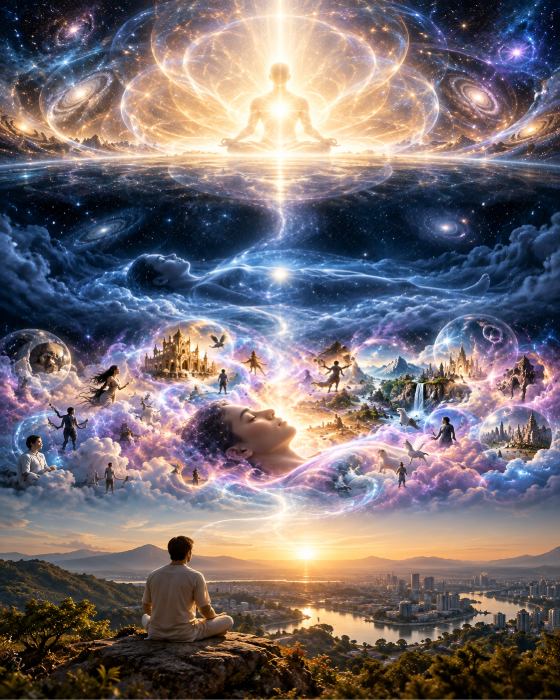
Nature of the Mind
The Nature of the Mind
The wandering journey of Bhrigu’s son illustrates the foundational nature of the mind: driven by latent desires (vāsanās), it projects whole worlds of experience, experiences celestial fall, and orchestrates continuous reincarnative cycles independent of the physical body.
Falling from the Skies
The son of Bhrigu, roved about the ideal lake of heaven (Mānas Sarovara), filled with golden lotuses, and frequented by the giddy swans and gabbling geese or hansas of heaven; and roamed beside the bank of the celestial river (Mandākinī), in company with the choristers (chāranas, and Kinnaras of paradise). He drank the sweet nectarious juice beaming as moonbeams in company with the gods; and reposed under the arbours of the groves, formed by the shaking branches of pārijāta plants. The parterres of Nandana gardens were trodden down under the feet of the fellow followers of Siva, as when the ocean was churned by the Mandara mountain.
He thought he remained in a celestial abode beside the marshy lands of Mandara, for a period of full sixty years; and passed his time in the company of the fawns of the place. He next thought to live in a garden at the city of the Gandharvas, where he believed to have lived for an immeasurable period like the genius of Time himself, who is the producer of an infinity of worlds. He was again translated to the celestial seat of Indra, where he believed to have resided for many cycles of the quadruple yuga ages with his mistress.
It was at the end of the merit of their acts that they were doomed to return on earth, shorn of their heavenly beauty and the fine features of their persons. His great grief at his fall from heaven to earth, broke his frame as it were into a hundred fragments; like a waterfall falling on the stony ground, and breaking into a hundred rills below.
Afterwards their disembodied minds entered into the network of lunar beams, and then in the form of molten frost or rain water, they grew the vegetables on earth. Revealing the fickle nature of the mind, he constantly prayed for the long life, wealth and learning of his darling, and thus forsook the constancy of his faith and reliance in Providence.
| Mode of Life | Core Characteristics |
| Civil Life (Worldly Blessings) | Longevity, prosperity, and capacity for learning |
| Ascetic Life (Spiritual Path) | Austerity, purity, and self-resignation of painful asceticism |
Transmigrating Jīva
His worldly thoughts having vitiated his understanding, caused him to be reborn as the son of the Madra king, and succeed to him in the kingdom of the Madras. The king of Madras, was released of his kingly person by his desire of asceticism; whereby he became the son of an anchorite in next-birth, in order to perform his austerities. He retired to the bank of the meandering river of the Ganges, and there betook himself to his devotion; being devoid of all his worldly anxieties and cares.
Thus the son of Bhrigu, having passed in various forms in his successive births according to his desires, demonstrated the projective nature of the mind as he remained at last as a fixed arbour on the bank of a running stream.
Decay of the Body
Then, after a vast passage of time, his body—decayed and weathered by the relentless winds and the scorching heat of the sun. The body is compared to a tree whose roots have been severed. Time, wind, and the sun gradually wear down the physical form until it can no longer remain standing. While Śukra’s physical body sat motionless in deep tapas on Mount Mandara, his subtle body (citta / mind) projected and experienced centuries of diverse lifetimes—illustrating that heaven, hell, rebirth, and time itself are purely mental projections within Consciousness (Chidākāśa).
Meanwhile, that physical body of the wise Śukra, remaining motionless on the slope of Mount Mandara, became completely desiccated by exposure to the scorching elements—reduced to nothing more than skin and bones. While Śukra’s subtle mind (Citta) was wandering through centuries of cosmic lifetimes—living as a king, a celestial Vidyādhara, a hunter, and a bee—his physical body sat forgotten on Mount Mandara.
The movements of the body, expressed through the hissing sounds of wind passing through its openings, seemed to sing like a faint melody, arising from the joy of the cessation of suffering. It refers to the breathing of so-ham hamsah in yoga, which is the sweet music of salvation.
With its sunken eye-sockets resembling an old, abandoned well in the dense wilderness of its face, that desiccated body unfeignedly revealed the ultimate voidness of the entire world. Comparing the hollow facial features (mukha-āraṇya) and vacant eyes to an ancient, dried-up well in a wilderness underscores the complete withdrawal of the life-force (prāṇa) and sense-energies (indriyas). While the physical frame is being gently swayed or harshly battered across the seasons, Śukra’s subtle consciousness (Citta) remains entirely detached, absorbed in its internal dream projections of successive lifetimes—underscoring that pleasure and pain belong solely to mental identification (ahaṅkāra), not to the inert physical body (sthūla-śarīra).
With its dry, withered intestines strung like the tight strings of a lute—producing a hollow, eerie echo as the wind blew through—the empty, skin-draped belly resembled the wild goddess of famine, howling like an innocent child stripped of her beauty. Yet the holy person of the hermit was unhurt by envious animals, owing to its freedom from passions and feelings, and its fervent devotion; and was not devoured by rapacious beasts and birds.
Nature for the Mind: The Grief
He did not find his son lowly bending down his head before him, the son who was the leader of the army of virtues, and who was the personified figure of all merits. He only beheld his body, lying as a skeleton before him, as it was wretchedness or poverty personified in that shape.
The crown of the head had become as white and smooth, as the phallus of Siva anointed with camphor, at the Indu-varcha ceremony in honor of the moon. The nose was shriveled to a dry stalk, for want of its flesh; and the nose-bone stood as a post, dividing the two halves of the face. The two legs, thighs, knees and the two arms (forming the eight angas or members of the body), had been doubled in their length (for their long etherial course); and lay slackened with fatigue of the long journey. He then began to dubitate in his mind, at the sight of the dead body, as to whether it could be the lifeless carcass of his son or any other. Thinking it no other than the dead body of his son, he became sore angry upon the god of death.
At this Yama—the regent of death, and devourer of living beings, assumed his figurative form of a material body, and appeared in an instant before the enraged father.
| Outer Beauty | Splendour of Yama |
| Radiance | Rays of light radiating from his body gave it the appearance of a hill filled with heaps of crimson kinsuka flowers. |
| Breath | The breath of his host hurled down mountain ridges like swinging cradles on earth. |
The rays of the living fire flashing from his trident, gave it the glare of golden ringlets, fastened to the ears of all the sides of the sky. Having appeared before the great sage, who was enraged as the raging sea, he soothed him to calmness as after a storm, by the gentle breath of his speech:
“You sages are observers of the multifarious rules of religions austerities, and we are observant of the endless and immutable laws of destiny; we honour you therefore for your holiness, and not from any other desire (of being blessed by you or exempted from your curse).”
Universal Laws & Agency
“We have destroyed the spheres of the universe and devoured legions of Rudras, millions of Brahmās and myriads of Vishnus; what is it therefore that we cannot do? We are appointed as devourers of all beings; and you are destined to be devoured by us. This is ordained by destiny herself, and not by any act of our own will.
Know this form of mine to be that of the Supreme Being, whose universal spirit acts in various forms, all over the universe. As flowers grow upon trees, so are animals born on earth; their growth and birth, as also their fall and death, are of their own spontaneity, and miscalled as their causality. The mind is falsely said to be the agent of all its enjoyments in life; though it is no agent of itself. It is a misbelief like the false conception of a serpent in the rope, where there is no serpent at all. Yet such is the elusive nature of the mind, which projects its own agency where none exists.
We were not actuated by desire of fame, nor influenced by pride or passion to any act; but are ourselves subject to the destiny, which predominates over all our actions. Knowing that the course of our conduct, is subject to the destiny appointed by the Divine will, the wise never allow themselves to be subjected under the darkness of pride or passion, at our doings.
Where is that enlightened sight, that gravity and that patience of yours, that you grovel in this manner in the dark like the blind, and slide from the broad and beaten path laid open for every body?
You know that all living beings have two bodies here, of which one is known as the intellectual or spiritual body or mind. The other is the inert or corporeal frame, which is fragile and perishable. But the minute thing of the mind which lasts until its liberation, is what leads all to their good or evil desires. As the skilful charioteer guides his chariot with care, so is this body conducted by the intelligent mind, with equal attention and fondness. That is called the mind which thinks in itself, ‘this is my body which is so situated here, and these are the members of my body and this my head.’ It has the name of the heart from the affections of the body, and so it takes many other names at will. But the earthly bodies are all perishable.”
Projections of the Thoughts
“Thus the mind of your son, wandered from your presence, as you sat absorbed in meditation, to regions far and wide in the ways of its various desires. This mind got into the city of the tutelar gods, and remained in a part of the garden of Eden (Nandana), in the happy groves of Mandara, and under the bower of pārijāta flowers.
There he thought he passed a revolution of eight cycles of the four yugas in company with Viswāchī, a beauteous Apsara damsel.
Faded and fell like ripened fruit. Being bereft of his aerial and celestial body, he passed through the atmospheric air, and was born again on earth in a human figure. He became a king of the solar race, and then a rāja of the Pundras, and afterwards a missionary among the Sauras and Sālwas. He next became a Vidyādhara, and lastly the son of a sage or muni. He became a ruler in Madras, then the son of a devotee named Vāsudeva living on the bank of Samangā. Your son has also passed many other births, which he was led to by his desire; and he had likewise to undergo some itara-janma heterogeneous births in lower animals. He became a favourite of females, as the sun is dear to lotus-flowers; and being as handsome as Kāma (Cupid) in his person, he become a favourite amongst Vidyādhara damsels in the land of Gandharvas.
Finding no other world nor body where he could enter, his spirit roved about in the empty air, as a bird soars on high without its nest. Demonstrating the unceasing, projective nature of the mind, the roving spirit of your son was led by its desire, as if it was propelled by a gust of wind, to become a Brāhman again, and to be reborn as such on this earth. It is in this kalpa age that he has become a Vidyādhara again, and betaken himself to the performance of his devotion on the bank of Samangā, where he is sitting still in his yoga meditation.
Thus his desire for the varieties of worldly appearances, has led him to various births, amidst the woods and forests in the womb of this earth, covered with jungles of the thorny khadira, karanja and other bushes and brambles.”
Nature of the Mind: Power
Your son has been sitting still in his firm devotion, with matted braids of hair on his head; and beads of rudrāksha seeds in his hand; and controlling the members of his body from their going astray. If you wish, O venerable sage! to know the reveries in his mind, you shall have to open your intellectual eye, in order to pry into the thoughts of others.
The sage immediately saw by his percipience, all the excogitations of his son’s mind; as if they were reflected in the mirror of his own mind. Having seen the mind of his son in his own mind, the muni returned from the bank of Samangā to his own body on mount Mandara, where it was left in its sitting posture, in the presence of Yama.
The knowledge of the existence of the world, whether it is a real entity or not, is the source of all errors of the wisest of men, by its varying forms and fluctuations. Thinking the imperishable soul of my son, to be snatched by death; I was led to the vile desire, of cursing thee on his untimely demise. So long do we labour under the sense of what is our duty, and what we must refrain from, as we are subject to the error of the reality of the world; but deliverance from this error, removes all such responsibilities from us. When we fret at death, without understanding its intention; we are of course blamable for it. I am now made to be acquainted by thee, regarding the thoughts of my son; and am enabled also to see the whole scene on the bank of Samangā.
| Aspect of Self | Role & Function in Existence |
| The Outer Body | Secondary material frame; perishable and dependent. |
| The Mind | The ubiquitous leader and true body; reflects consciousness and shapes reality. |
Of the two bodies of men, the mind alone is ubiquitous, and leader of the outer body of animated beings. It belongs to the essential nature of the mind to act as the true body, reflecting and making us conscious of the existence of ourselves, as also of the exterior world. It frames a form and gives a feature to the person that it had not before, and destroys one in existence in a moment.
It is the imagination that gives an image to airy nothing, as children see ghosts before them in the dark.
Its power to create apparent realities out of absolute unreality, is well known to every body, in his dream and delirium, in his misconceptions and fallacies and all kinds of error; as the sight of magic cities and talismans.
It is from reliance in visual sight, that men consider it as the principal body, and conceive the mind as a secondary or supplementary part. It was the mind, that formed the world from its thought; wherefore the phenomenal is neither a substance by itself; nor is it nothing. It is therefore undefinable—anirvachanīya.
Nature of the Mind: Worldly Attachments
The mind is part of the body, and spreads itself in its thoughts and desires into many forms; as the branch of a tree shoots forth in its blossoms and leaves. And as we see two moons by optical deception, so does one mind appear as many in many individuals. It is from the variety of its desires, that the mind perceives and produces varieties of things, as pots and pictures and the like—ghatapatādi.
All things springing from Brahma, sink at last in him; as the huge waves of the wide and billowy ocean, rise but to subside in its calm and undisturbed waters below. But one believing himself as a large wave, enlarges his spirit to greatness.
Self-Perception → Mindset Outcome
├── Thinker of Low Estate   → Reborn upon earth in the form taken as pattern
├── Thinker of Greatness    → Becomes as big as a hill, shining with lustre of gemstones
└── Thinker of Cool Peace   → Rests in peace (situated in the cooling orb of the moon)
He who thinks himself as a little being, and fallen from above to suffer in the nether world; is born upon earth in the form he took for his pattern. But he who thinks himself to be born to greatness, and rises betimes by his energy; becomes as big as a hill, and shines with the lustre of rich gems growing upon it. He rests in peace, who thinks himself to be situated in the cooling orb of the moon; otherwise the body is consumed with cares; as a tree on the bank is burnt down by a conflagration. Those who think themselves to be surrounded by worldly affairs; are as wide-stretching trees, awaiting their fall by impending blasts of wind.
But the waves are not of one kind, nor are they altogether entities or nullities in nature; they are neither small or large nor high or low, nor do these qualities abide in them. The dead are undying, and the living are not living. Thus is the law of their mutual succession which nothing can forefend or alter.
Nature of the Mind and Intellect
As water is universally the same and transparent in its nature, so is the all pervading spirit of God, pure and holy in every place. The many wonderful powers that it contains, are all active in their various ways. The several powers productive of several ends, are all contained in that same body. All the natural and material forces, have the Divine spirit for their focus. Brahmā was produced in Brahma as the billow is produced in the water, and the male and female are produced from the neuter Brahma, changed to and forming both of them. Verily this plenitude is Brahma, and the world is no other than Brahma himself. Think intently upon this truth and shun all other false beliefs (of the creator and created, and the like). Both the inert and active (matter and life), proceed from the same; and the mind proceeds from the intellect—chit of God.
The various desires are evolved by the power of the mind, from their exact prototypes in the Supreme soul. From the active agent, proceed the inert matter and inactivity without a secondary cause; as the active spider produces the passive thread, and the living man brings upon him, his dull torpor in sleep. The long sought power when acquired, becomes as familiar to the soul, as the dark clouds are attendant upon the sky in the rainy-season. There is no bondage nor liberation of human soul, nor of the Divine Spirit. We cannot account for the use of these words among mankind. All other bondages which bind the embodied soul to earth, are the works of the mind, which is the root of all worldly ties and affections.
All human affections and attachments to the visible world, are born in and remain in the mind; although they are as distinct from it, as the waves of the sea or as the beams of the moon; are produced from and contained in their receptacles. It is the Supreme spirit, which is stretched out as one universal ocean, agitated into myriads of its waves and billows. The Intellect itself is spread out as the water of the universal ocean, containing everything that is aqueous and terrene in its infinite bosom.
All those that appear as Brahmā, Vishnu and Rudras, as also they that have become as gods, and those that are called men and male creatures:— Are all as the waves of the sea, raised spontaneously by the underlying spirit; and so are Yama, Indra, the sun, fire, Cuvera and the other deities. They rise and fall as waves on every side, though some continue for a longer duration, as the lotus-born Brahmā and others.
| Level of Consciousness | Beings Represented |
| Pure & Enlightened Souls | Gods like Hari, Hara, and major deities |
| Somewhat Darkened Understanding | Men and inferior demigods |
| Greater Darkness | Worms, insects, gnats, flies, and serpents |
| Utter Darkness | Trees, vegetables, grass, weeds, and dull stones |
Worms and insects, gnats and flies and serpents and huge snakes, rise in the great ocean of the Divine Spirit, like drops of water scattered about by waves of the sea.
Some think of their stability in this world of dreams, and others are betrayed by their false hope of the stability of worldly affairs, which are quite unstable.
Some are born as trees, and others have become as gods and demigods; and while some are furnished with moving bodies, others are dissolved as water in the sea. Some are no less durable than many kalpas; and others return to the Supreme Spirit, by the moonlike purity of their souls. All things have risen from the oceanlike Spirit of Brahma, like its moving undulations. It is the intellectual consciousness of every body that is termed his mind.
Nature of the Mind: Errors and Individual Consciousness
Remaining within the depth of the Divine Spirit, and yet thinking ourselves to live without it, is the cause of keeping us in darkness on the surface of the earth. Our consciousness of ourselves as Brahmā, being vitiated by the various thoughts in our minds, becomes the root of our activities; while the pure consciousness of ego sum—I am, is free from all actions and energies. Those living bodies, that lie scattered as pebbles on earth; are seen to roll about or lie down with their temporary joy and grief in continued succession, owing to their ignorance of themselves.
There are some of pure and enlightened souls, as the gods Hari, Hara and others; and some of somewhat darkened understandings, as men and the inferior demigods. Some are placed in greater darkness, as the worms and insects; and others are situated in utter darkness, as the trees and vegetables. Some grow afar from the great ocean of the Divine Spirit; as the grass and weeds of the earth, which are ever degraded, owing to their being the emblems of sin; and others are barred from elevation as dull stones and heinous snakes.
Some have come to being only with their bodies; and they know not that death has been undermining the fabric of their bodies, as a mouse burrows a house. Some having a little understanding, have gone down the depth of holy knowledge, without ever reaching the bottom, or finding its either shore. Some beings that have undergone many births, and have yet to pass through many more, have ever remained abortive and benighted without the light of truth. Some are tossed up and down, like fruits flung from the hand: those flying upward have gone higher still; and those going down have fallen still lower and lower.
There are some persons among the Yakshas, Gandharvas and Kinnaras, who have overcome the errors of their minds, and have well considered every thing before and after them; that have become perfect in their lives, and passing as the living liberated persons in this world. Others there are among the moving and unmoving, that are as unconscious of themselves as wood and stone; and many that are worn out with error, and are incapable of judging for themselves. Those who are awakened to sense, and whose sins are washed off; have their understandings purified by the light of the sāstras.
Those who have not succeeded to dispel the errors of their minds, have darkened their understandings by a mist of ignorance; like the frosty sky of winter, and they find the phantoms of their error, dancing as demons before their eyes. The body that is seen to be composed of flesh and bones and the five elemental parts, is a creation of the imagination of the mind, and has no substantiality in it.
Such is the deceptive nature of the mind, that the suffering of hell torments and enjoyment of heavenly bliss, and the thoughts of birth and death; are all fabrications of the mind; which labours under these thoughts.
What need I to tell more in the manner of verbose writers, than go together at once, to the place where your son is situated. Sukra having tasted the pleasure and pain of all these states at a moment’s thought of his mind, is now seated as a devotee on the bank of Samangā, under the spreading beams of the moon.
Saying so, the lord of death smiled to think of the course of nature, and taking hold of Bhrigu’s hand in his own, they both departed as the sun and moon together. With their luminous bodies, they arrived at the spot of Samangā, and shone on high above the tamāla trees below. Their simultaneous rising in the clear firmament, made them appear as the sun rising with the full-moon over the cloudy horizon.
Descending from the Skies
They beheld upon their descending from the mountain, a great light below; proceeding from the bodies of the celestials, sleeping in the arbours of aureate creepers. They beheld the Siddhas, sitting on their stony seats upon the elevated rocks; with their bodies full of vigour, and their eyes looking on the spheres with defiance. There were the brisk and beautiful chowry deer serving as flappers of the mountain king, and dousing in the pools filled with falling flowers. They saw the Kinnara lads sitting on the tops of straight and stately date trees, and sporting with pelting the date fruits upon one another, which stuck to the reeds below as their fruits. They beheld big monkeys, jumping about with their hideous reddish cheeks, and hiding themselves in the coverts of widespreading creepers.
They saw the Siddhas, to be hit by the celestial damsels with blossoms of mandara flowers, and clad with vests of the tawny clouds by which they were shrouded. The uninhabited skirts of the mountain, were as the solitary walks of Buddhist vagrants; and the rivulets at its foot, were gliding with their currents covered under the kunda and mandara flowers, as if they were running to meet the sea, mantled in their yellow vests of the spring season. They walked about here and there, and looked at and admired the grandeur of the mountain, till at last they alighted on the nether earth, decorated with its cities and human habitations.
Enlightenment
His limbs were stiff, and his sense at a stand still, as he sat with his mind fixed on steady meditation. He seemed to be long at rest, in order to get his rest from the turmoils of the world. He became motionless as a wheel, after its long-winded motion; and found his rest after his prolonged whirling, in the whirlpool of the ocean of the world. He sat in a state of uniform meditation, without a shadow of duplicity in it; and was smiling with a cold apathy at all the pursuits of mankind. His soul was at rest, in the everlasting rest of God; as the pure crystal catches the colour of the gem, which is contiguous to it.
Upon opening and lifting up his eyes, he beheld the god standing with his father on one side, who being pleased at his sight, glowed in their countenances like the disks of the sun and moon. The Brāhman boy, having ended the muttering of his mantras on the bank of Samangā, accosted them with a voice distilling as the sweet nectarine juice of ambrosia amrita or water of life: “The darkness, which reigned in my mind, and which no light of the sāstras or spiritual or temporal knowledge, nor even my austerities could remove, is dispelled today by the light of your presence. Tell me who are you, whose feet have sanctified this place; as the glorious orbs of the day and night, enlighten the firmament. Blessed is the law of the Supreme Being, which is without its beginning or end, and is known as destiny here below; and by whose power the world is revolving as a curricle.”
“I see my countless and unknown births, and the innumerable accidents to which they were subject, for the period of a whole kalpa or duration of the world from first to last. I wandered about the Mandara groves, filled with flowering creepers like gold, and under the shade of the kalpa arbors of Meru, and in the flowery plains above and about it.”
“Now rise, O father! and let us go to see that body, lying on the Mandara mount, and which is now dried as a withered plant. I will follow you, with my firm belief in the one adored Deity of the learned. Let that be the desirable object of my mind, and I will act exactly in conformity with my belief.”
The Dried Skeleton
There is that body of mine, which was so fondly anointed with camphor, agallochum and sandal paste, by my wet-nurse before. This is that body of mine, which was used to repose on the cooling beds, made with heaps of mandara flowers, in the airy spots of Meru.
Ah my pitiable body! how dost thou rest here in peace, forgetful of thy former delights in the different stages of life; and insensible of the thoughts of thy past enjoyments and amusements of yore. I take fright to look upon this body, in which I had taken so much pleasure before, and which is now reduced to a skeleton.
Behold the stags of the forest flying with fear, at the sight of the wide open jaws, and withered skin of my carcass; which with its horrid mouth, frightens the timid fawns in the woods.
This dried body of mine, lying flat on the mountain stone, resembles the mind of the wise, abased at the sense of its own unworthiness.
It is freed from the demon of the mind, and is resting in its felicity without any apprehension of the vicissitudes of fate and fortune, or fear of fall.
See how happily this body is sleeping in this forest, by being freed from all its doubts and desires in the world; and by its being liberated from the network of its fancies. This body being set free from the impulses of the mischievous mind, is sleeping in its highest and perfect felicity, and is quite released from the jarring broils of the world, clashing like the mingled roarings of lions and elephants in their mutual conflict. Every desire is a fever in the bosom, and the group of our errors is as the mist of autumn; and there is no release of mankind from these, save by the impassionateness of their minds.
The Nature of the Mind: Attachment to the Flesh
They have gone over the bounds of worldly enjoyments, who have had the high-mindedness, to lay hold on the tranquillity of their minds. It is by my good fortune, that I came to find this body of mine, resting in these woods without its troublesome mind; and freed from all its tribulations and feverish anxieties.
Venerable Sir, that art versed in all knowledge, you have already related of Sukra’s passing through many births in different shapes; and feeling all their casualties of good and evil. How was it then that he regretted so much for his body begotten by Bhrigu; in disregard of all his other bodies; and the pains and pleasures which attended upon them?
Rāma! the other bodies of Sukra were merely the creations of his imagination; but that of Bhārgava or as the son of Bhrigu, was the actual one, as produced by the merit of his pristine acts.
The person of Sukra, received the Brāhmanical sacraments, and became an associate of the father; till at last it was reduced to the form of a skeleton in course of a long time. Because this was the first body which Sukra had obtained from Brahmā the creator, it was on this account that he lamented so much for it.
It belongs to the inherent nature of the mind to cling to primary physical form, so that even those born of flesh sorrow according to the natural conditioning of embodiment. They who are acquainted with the course of nature, as also those that are ignorant of it as brutes and beasts; are all subject to the course of the world, as if they are bound in the net of fate and liable to grief and sorrow.
Even great souls are seen to feel happy in pleasure and become sorrowful in matters of pain; and show themselves as the wise in their outward circumstances. The shadow of the sun, is seen to shake in the water, but not so the fixed sun himself; so the wise are moved in worldly matters, though they are firm in their faith in God. As the unmoved and fixed sun, seems to move in his shadow on the wave, so the wise man who has got rid of his worldly concerns, still behaves himself like the unwise in it. The causes of happiness and misery as also those of liberty and bondage, are the feelings of the mind; as the sun-beams and flame of fire, are the causes of light.
Remain true to thyself, by giving up thy concerns in the world; but continue to discharge all thy duties in this world by the acts of thy body. If you can rescue yourself from the great gloom of egotism, and arrive at the state of pure indifference to all objects; you will certainly become great in your mind and soul, and be the object of universal veneration.
Revivification of the dead
“Thou shalt perform austere devotion with this thy first born body, and obtain by virtue of that, the preceptorship of the Daitya tribe. Having attained the state of living liberation, by merit of thy prior acts; thou shalt continue in the preceptorship of the leader of the great Asuras for ever.”
Revivification:
1. Life Springs  → Śukra enters the withered corpse (like spring entering a faded plant).
2. Worthy Sire   → Halted after all their toils and troubles were at an end.
3. Enlightenment → Living liberated Brhamā guiding men, by their knowledge.
4. Reunion       → Śukra was led away by his thoughts to the life he was prone.
Sukra entered into his withered corpse, as the season of spring enters into a faded plant, in order to adorn it again with its vernal bloom, and its re-springing blossoms. The old sage Bhrigu finding the revivification of the dead body of his son, sanctified it with propitiatory mantras and sprinkling of water, from his sacerdotal water pot (kamandalu).
The body being filled with blood, gave the limbs to bloom; like the growth of lotuses in rainy lakes, and the bursting of new shoots and buds in vernal plants. The father then embraced the revived body of his son, and shed a flood of his affectionate tears upon him; as the high risen cloud washes the mountain top with showers.
They rejoiced at their reunion, like the loving pair of swans at the end of the night of their separation; and as the joyous couple of peacocks, at the approach of the rainy clouds.
The worthy sire and son, sat awhile on the spot, to halt after all their toils and troubles were at an end, and then they rose up to discharge the duties that were then at hand. They both continued as the living liberated guides of men, by their knowledge of all that was to be known; and preserving the equanimity of their minds, and the steadiness of their dispositions, amidst all the vicissitudes of time and place. Thus the son of Bhrigu, who was born as Sukra at first, was gradually led away from his holy state by his thought of the heavenly nymph, and subjected to various states of life to which he was prone.
Nature of the Mind: Mind of desirers
As the errors of various wanderings, occurred to the mind of Sukra; so it is with every body, as it is instanced in the case of Bhrigu’s son. So also are the ghosts and goblins, demons and devils, but imaginary figures of the mind; born in the shallow brain of men, to terrify them with their hideous shapes. So the creation of the world, and all created things, are situated in the mind of Brahmā; and make their repeated appearance, as the phantoms of a phantasmagoria before him.
All things appearing unto us, are as false as these phantoms; and they proceed from the mind of Brahmā, as the varieties of trees and shrubs, are produced from the same sap of the vernal season.
It is in its ideality, that anything appears as existent, which in reality is inexistent, though it is apparent to sight. The existence of the world, is as that of a lengthened dream; and the visible world is a wide spread snare of the mind, like fetters at the feet of an elephant.
Revealing the dual nature of the mind, the pure mind has the true notions of things, as the gem polished from its dross, receives the right reflection of every thing (or) reflects the true image of every thing. As the gilding of gold or any brilliant colour, cannot stand on base metal or on a piece of dirty cloth, so it is impossible for the vitiated mind, to apply itself intensely to any one particular object.
Purified and United
Rāma asked:— Will you tell me sir, in what manner the mind of Sukra, received the reflexion of the shadowy world, and its temporaneous movement in itself, and how these fluctuations rose and remained in his mind?
It is also naturally situated in the embryo of the mind, of every species of living being, and is gradually evolved from it, in the manner of the shoots and sprouts, and leaves and flowers of trees, growing out of the seed. But the sullied mind cannot easily unite with the object of its thought, as a dirty and cold piece of iron, cannot join with a pure red-hot one, unless it is heated and purified from its dross. The pure mind and its pure thoughts, are readily united with one another, as the pure waters mix together into one body of the same kind, which the muddied water cannot do. Want of desire constitutes the purity of the mind, which is readily united with immaterial things of the same nature like itself. The purity of the mind conduces to its enlightenment, and these being united in one, leads it to the Supreme.
Nature for the Mind: The Flaw in Viewing
Some of them are situated apart from one another, and are dissolved also separately; and some are joined together, and are born as two gunja fruits growing together. The souls of all living beings are subject to the three states of waking, dreaming, and sound sleep, which are caused by the mind and not by the body. Thus the soul passing under the triple condition in its living state, does not give rise to the body, as the sea-water gives rise to the waves. (The body is caused by the mind, and not by the soul which has no connection with it).
| Entity / Concept | Material Seed | Brahmā (Universal Seed) |
| Form | Material, visible | Formless, invisible (beyond comparison) |
| Transformation | Casts off seedy form to become fruit | Contains fruit within while retaining the seed |
The ubiquity of the intellect, makes it pass into the mind in its next birth; and exhibit itself in different forms in all its succeeding and subordinate regenerations (stages of life). The influence of the Divine spirit, is as cool as the cooling shade of a plantain arbour. It is of its own nature; and is as unchangeable as the pith of the plantain tree, notwithstanding the changes in all its outer coats and coverings. So the productive seed proceeding from Brahmā, displays itself in the form of the world. But as no body can say what is the cause of the sap in the seed, so no one can tell why the spirit of God, teems with productive seed (of Brahmā) in it.
The seed casts off its seedy form, and assumes the shape of the fruit; but Brahmā (the seed of all) contains the fruit (of the universe) in his bosom, without laying aside the seed. The seed of the fruit bears a material form, but Brahmā—the universal seed, has no form at all; therefore it is improper to compare the visible seed, with the invisible Brahmā; who is beyond all comparison. Brahmā evolves himself in his creation and does not produce the world like the fruit from the seed; therefore know the world as the vacuous heart of Brahmā, and is neither born nor unborn of itself.
The viewer viewing the view, is unable to see himself because his consciousness being engrossed by external objects, is disabled from looking into itself. Such is the deceptive nature of the mind, that as a looker on the clear sky does not see what is above the skies, so we see ourselves and others as material beings; but cannot see the inward part of the immaterial soul, as the wise men do.
We see the outward sight because we cannot see the beholder of the sight. The beholder is only the existent being, and the visibles are all nothing.
External Rove
As the moisture of the ground and of the vernal season, becomes incorporated in vegetable life, bringing forth the fruits and flowers; so the energy of the Divine Intellect, turns itself into the living spirit; which shortly appears in a corporeal form. The ideas of self and others, are as granules in the mind, and are like the grains of salt, which are produced in the briny grounds from moisture of the earth. So the multitudes of thoughts in the mind, are exactly as the globules of salt or sand on the seashore (almost infinite in their number).
You must observe with your keensightedness and well discerning mind, in order to look into the different states and thoughts of others. When the mind becomes perfect, it comes to be the living being; and the intellect being purified, becomes all pervasive. Hence is the union of the intellect with the living spirit.
Some beings pass into successive states of existence, as a man passes from one dream to another; and they think themselves to be firmly established in them, as one supposes to be settled in some house, appearing to him in his dream. The atom of the intellect, contains the particles of all our notions; as the seed-vessel contains the farinaceous atoms of the future fruits and flowers, and branches and leaves.
So the intellect conceives within itself and of its own particles, many other atomic germs, under the influence of particular times and places and actions and circumstances; which cannot be extraneous from itself.
All that is displayed in this world, is in reality nothing at all; and yet do these living beings, though possessing the particles of intellect in them, erroneously conceive the duality of an extraneous existence. These rove from one error to another, as a man sees one dream after another; and roll about in the pit of their delusion, as a stone when hurled from a hill downward.
Some persons rely on the union of the body and soul, and others relying in the soul alone, are placed beyond the reach of error; while there are many, who rely on their consciousness alone, and shine thereby as rational beings.
God being the all-pervading spirit of nature, is verily seen in the spirit of every body; and as he is ubiquitous, his omnipresence is present in every thing in all places. One living being is born in another, and that again within another, like the coatings of plantain trees, which grow one under the other over the inmost pith. (So God is the inmost marrow of all external lives and souls, which are as crusts of the same).
He who does not inquire into the question “who he is” and “what is the world” beside himself; is not liberated in his inward soul, and suffers under the continuous fever of an erroneous life.
As proper regimen is the best medicine to secure the health of the body; so is the habit of keeping the organs of sense under control, the only means of edifying the understanding. He who is discoursive in his words, and not discerning in his mind, is like a blazing fire in a picture (which lightens no body). No one can be wise until he gets rid of his false wit.
States of Mind
The Quadruple Conditions
The worms and insects, that grow out of the dirt and scum of earth and water in the hot season, and appear filthy to our sight; are nevertheless full of the particles of intellect, becoming to them as living beings. The worshippers of gods, get to the region of gods, and those of Yakshas meet at the place of Yakshas, and the adorers of Brahmā ascend to Brahmaloka. Resort therefore to what is best and the greatest refuge.
So the son of Bhrigu, obtained his liberation at last by the purity of his conscience; though he was enslaved of his own nature to the visibles, at his first sight of them (as of the Apsara and others). The child that is born on earth with the purity of its soul at first, becomes afterwards of the same nature, as the education he gets herein, and not otherwise.
Rāma said:—Please sir, tell me the difference of the states of waking and dreaming, and what are the states of waking watchfulness, waking dream and waking delusion.
Vasishtha answered:—The waking state is that wherein we have a sure reliance; and that is called dreaming, in which we place no certain reliance and believe to be untrue.
Dreaming also appears as waking, as long as it lasts; but waking seems as dreaming, when the objects of its vision are not lasting.
As long as one knows anything to be lasting before him, so long he believes himself to be waking, but no sooner is it lost to him, than he thinks himself to have been dreaming of it. When the body has its activity with the powers of the mind, speech and the other members of action, it is to be understood, that its vital element is put to motion by the vital breath which it breathes. This breath circulating through out the whole body, gives it the powers of sensibility and consciousness, which have their seats in the heart and mind, wherein the erroneous conception of the world is hidden. The mind circulates about the outer world, through the passages of sight and other organs; and sees within itself the forms of many mutable shapes and figures.
When the body is weary with action of its limbs, mind or speech, the living element then becomes still, and remains in its composure, with the calm and quiet soul residing within the body. The particle of intellect taking the form of life, after being purified from its earthly impurity; mixes with the internal soul, and attains the state of sound sleep, as if lulled to insensibility by the cooling breeze.
When the vital principle comes again to action, after the enjoyment of its sound sleep, either in this or the other world, it takes the name of the living element or the mind or self-consciousness When it is immerged in the water (phlegm) of the body: it gets the feeling of humidity in itself, as a flower perceives its own fragrance. When it is full of blood, it perceives a fiery redness in itself, like that of a rubicund rock, or as the crimson red of the setting sun in the sky. When the organs are not besieged by external objects, which disturb the inward senses of the mind; it indulges itself in the reflexion of many things, which is called its dreaming state.
Now O great-minded Rāma! you have learnt the inward process of your mind; but there is no reality in them nor in this existent world, which is subject to the evils of death, desire and destruction.
Nature of the Mind: The Projections of the World
Whatever the mind often thinks upon with a strong conviction of its reality, it immediately assumes that form, as the iron-ball becomes ignited by its contact with fire. The mind is the cause of error, and it is the mind which is the framer of the world. The mind also stretches itself in the form of the universe (Viswarūpa) in its gross state. (The first is the human mind, second the mind of Brahmā, and the third is the mind of Virāj). If the body were the purusha, how could the highminded Sukra, pass into various forms in his very many transmigrations (as mentioned before)?
So inquire into what is great, devoid of attributes and error, and which is easily attainable by every body. Be diligent in your inquiry, and you will surely succeed to obtain the same.
Again as there is nothing, nor was there ever, nor anything ever to be at any time, or place, beside the entity of the Holy one, how and whence could this foulness come in Him?
I see your understanding is capable of judging both a priori and a posteriori, and is likely to attain that acme which was gained by the gods, Sankara and others. This question should be asked by you when I come to the conclusion, and it will be demonstrated to you as clearly as the situation of a place in a map or globe, placed in the palm of your hand (hastāmalaka). The blueness of the sky, is pleasant to look upon at the end of the rainy weather; but it is odd to speak of it during the rains. (So the question must have its proper place and occasion).
Whatever nature the mind assumes by the fickleness of its thoughts, it receives the same name and nature for itself, as the same fleeting air receives from its exhaling of different odours. It receives the same form in which it delights, and which it assumes to itself in its imagination. The inward senses being excited, actuate the outward organs of sense in their own ways, as the exciting motion of the winds, drives the dust of the earth before their course. The mind exerts its powers in the action of the external organs in the performance of their several functions; just as the flying winds drive the dust in different directions. Whatever nature the mind adopts to itself by its wonted habit, the same shoots forth in the form of its two kinds of motion. It understands that as its right course, which agrees well with its temperament; and knows for certain that there is no other way to its real good.
The mind is ascertained by the Kāpila (Sānkhya) philosophers, as a pure substance, like the immaterial intellect (under the title of pradhāna); and this view of it is adopted in their system or sāstra (in opposition to the doctrine of Vedānta). But that there is no other way to the salvation of the supposed mind, is an ipse dixit of the Vedānta, and an assumed dogma (kalpitāniyama) as those of other schools.
Thus all sects give out their own views, in the false rules they have adopted for the salvation of their supposed minds; and assert that there is no other way to it, beside what is laid down by them.
There is no innate sweetness in the sugarcane nor bitterness in the nimba, both of which are sucked by insects; nor is there any heat or cold inherent in the sun or moon (as both of them are peopled by gods and spirits). It is the intrinsic habit of the mind that makes the difference.
The wise have styled our consciousness of the world as a magic scene (māyā), an appearance of ignorance—avidyā, a mere thought (bhāvanā), and the cause and effect of our acts. Men being deluded by it, are at a loss to know their real good, as the blinded eye is incapable to perceive the brightness of the day.
It is the contemplation of objects (sankalpa), that presents the phenomena to our view, like arbors in the empty sky; and it is their incogitancy (asankalpana), which effaces their images from the inward and outward sights.
The mind being inclined to the right view of things, by its abstraction from the unreal sights, produces the clearness of the understanding, and an insouciant tranquillity of the soul. Application of the mind to unworthy thoughts, and to the internal or external sights of things, debars the soul from tasting the sweets of its solity.
He takes the true, incorruptible and supreme Brahmā in a different light, as one mistakes one thing for another in the dark or in his error. So on looking deeply, you will find no bondage in the world; the notions that this is the world and this is myself, are only errors of the mind. Our fancies alight on us at one time, and depart at another, and assume different forms at will; just as our consorts act the part of wives in our youth, and of nurses in our old age.
The ignorant do not perceive the selfsame unity, in all things he beholds in the world; but they view every thing in the light, as they have its idea imprinted in their minds. They meet also with the results of the forms, which they have in view for the time; though they are not in reality what they seem to be, nor are they entirely false (being the idealities of their mind). He believes these elephants pursuing their mates, in his thought; so it is the thought, that gives the outward forms of things.
It is impossible, O Rāma, that one so enlightened as thyself, will receive the reflexion of the world, as dull matter like others (rather than a reflexion of the Spirit). Being certain of its immateriality, never taint thy mind with its outward colouring, or the knowledge of its reality; but know it as no way distinct from the Supreme Spirit.
The Perspective of the Enlightened
They swerve from the sight of the visibles as unworthy of their notice, and seek after the knowledge of their chief good; they behold the all-seeing God in their mental and external sights, and have no perception of the unintelligent perceptibles. They are dormant amidst the thick gloom of error, overspreading the mazy paths of life, and are awake under the transcendent light (of divine knowledge), requiring the vigilance of the living.
They are mixed (like salt) with the water of spiritual unity, and in the boundless ocean of omnipresence; and they melt away as the ice in a river, by their rigorous austerities, resembling the vigorous heat of the sun. As the seeds of kata fruits, serve to purify the foul water; so doth philosophy tend to expurgate human nature, from all its errors.
When the disturbances of doubts are settled, and the wandering of curiosity is over, it is then that the full moon of internal fulness, sheds its lustre over the mind. As long as the shadow of solicitude, hangs over the mind, it is darkened and stupified and broken in the heart, until the sun of inappetency rises to dispel its gloom.
It is the heart’s desire of all beings, that subjects them to repeated births and deaths, which cause the ignorant only and not the wise, to appear and disappear like waves of the sea. But the spiritual body, is neither born nor dies in this world; nor is it affected by the decoration or perdition of the material body; but remains unchanged as the vacuity of a pot, both when it is in existence or broken to pieces.
So long does the pageant of the world, present its dusky appearance to our view, as we do not deign to consider the questions “what am I, and what are all these about me”. (That is: “whether I or these or all other things are true or false?”)
Area of Observation | False / Ignorant View | Right / Enlightened View |
The Physical Body | A permanent body or object of gratification. | An apparition of error, abode of evils, and source of temporal pain and pleasure. |
The Universal Ego | Limited to physical boundary or local mind. | Ubiquitous; pervades infinite space/time and presides over all states of being. |
Existential Reality | Worldly events and distinct physical objects. | Only imperishable Brahma exists; one lives betwixt reality and unreality. |
He sees rightly, who sees his body as an apparition of his error, and the abode of all evils; and that it does not serve for the spiritual meditation of his soul and his maker. He sees rightly, who sees that his body is the source of all the pain and pleasure, which betides one at different times and places, and that it does not answer his purpose of spiritual edification. He sees rightly, who sees the Ego to pervade the infinite space and time, and as the source of all accidents and events, which incessantly take place in them. (The Ego is ubiquitous).
He perceives rightly, who perceives within himself the omnipotence of the infinite Spirit, to be present in all the states and conditions of beings, and the self-same Intellect to abide in and preside over all.
He understands rightly, who understands by his wisdom, that he is not his body, which is subject to diseases and dangers, to fears and anxieties, and to the pain and pangs of old age and death.
He knows, full well who kens his soul as a string (Sūtrātmā), to which all things are strung as gems in a jewel, recognizing that the fickle nature of the mind is not the true Self seated in the brain or bosom. That great soul looks brightly upon the earth, who has withdrawn his mind from it, by retrenching his reliance on his egoism or tuism (i.e. both on his subjectivity and objectivity). He that looks on the states of misery and happiness, which attend on worldly life, to be but the fluctuating conditions of the ego, has no cause to repine or rejoice at them.
I bow down to that great soul, which has passed beyond the states of light, darkness and fancy (i.e. the state of waking or life, sleep or death, and dreaming or transmigration, and which is situated in a state of brightness and tranquillity in supreme felicity or heavenly bliss).
I bow down to that Siva, of transcendental understanding; whose faculties are wholly engrossed in the meditation of that eternal Being, who presides over the creation, destruction and preservation of the universe, and who is manifest in all the various wondrous and beauteous grandeurs of nature.
The House of the Hermit
The body of the wise man is as a princedom to him, and calculated for his benefit and no disadvantage. It is comparable with the bower of a holy hermit, for the consummation of his fruition and liberation.
The eyes are the windows of this city, letting out the light for the sight of distant worlds, the two arms are as the two valves of this city-gate, with the hands like latches reaching to the knees. The lines marked under the soles of the feet, are as inscriptions marked on the foundation stone, and upon those at the base of the pedestals of the pillars; and the outer skin which covers the flesh, marrow, veins and arteries, and the joints of the body, is as the beautiful plaster of the building, hiding the mortar and bricks inside. The face is as the royal garden beautified by the eye-brows, forehead and the lips; the glancing of the eyes, are as the blooming lotuses; and the cheeks are as flat planes in it. The bosom is considered as the depository of jewels (from their being worn upon it); and the nine orifices of the body, serve as so many windows for the breathing of the citizens.
The two private passages serve as sewers and drains of the city, to let out its dirt, and the heart is the garden-ground, where the passions parade about as ladies. Here the understanding is fast bound in chains as a prisoner, and the organs of sense are let loose as monkies to play about. The face is as a flower garden, the smiles whereof are its blooming blossoms.
Nature of the Mind: The Wise vs. The Ignorant
This body is also the source of infinite troubles to the ignorant; but it is the fountain of infinite happiness to the wise man. He is not addicted to licentiousness like a high mettled steed; nor parts with the auspicious daughter of his prudence, from his avarice after some poisonous plant. Beware of diving in the perilous river, which flows fast by the dreary forest of this world, with the current of desire, whirl-pools of avarice, and the sharks of temporal enjoyment.
All sensual people are averse to the unseen happiness of the next world; and dwell on the pleasure of their own imagination in the inward recesses of their minds. It belongs to the deceptive nature of the mind to mistake the physical frame for the primary reality, whereas all things depend on the city of the body, yet nothing is lost by its loss since the mind is the seat of everything.
| Status / Condition | Wise Ruler | Sensual / Ignorant Person |
| Loss of Physical Body | Loses nothing (like vacuity in a broken vessel). | Suffer infinite troubles and loss. |
| Worldly Events | Looks unconcernedly (like passengers at a play). | Agonizes over fluctuations of pleasure/pain. |
| Sensual Impulses | Governs the mind; restrains desires at once. | Slave to senses; eager for carnal gratification. |
These bodily cities which fill the earth, cannot be unpleasant to any body. The wise man loses nothing by loss of the citadel of his body; as the vacuity in a vessel is never lost, by the breaking of the vessel. (So the death of the body, does not destroy the vacuous soul). The ubiquitous soul being situated in this body, enjoys all worldly enjoyments, until at last it comes to partake of the felicity of liberation, which is the main object it has in view.
The sportive mind rides on the swifting car of the body, as one mounts on a locomotive carriage for the place of its destination, and passes in its unimpeded course to distant journeys. (So the body leads one to his journey from this world to the next). Seated there, it sports with its favourite and lovely objects of desire, which are seated in the heart as its mistresses. (The embodied mind enjoys the pleasurable desires, rising before it from the recess of the heart). The worldly enjoyments of the wise, do not tend to vitiate their nature; as the poisonous draught of Siva, was not capable of doing him any injury. (The baneful effects of worldliness, do not affect the wise).
The wise man is selfsufficient in all conditions of life; he neither rejects the earthly blessings that are presented to him; nor longs or strives hard for what is denied to him. The wise man reigns as a monarch, free from all fears and doubts, and devoid of all cares and curiosity; and with a mind freed from false fancies (of subtile and gross bodies).
The sensualist eager for the gratification of his senses, are as much ridiculed by the wise; as a man who takes to him a woman deserted by another, is derided by his tribe. He whose mind is bent to the enjoyment of carnal pleasures, should first of all check the inclination, as they draw out the poisonous plants from the ground. That which is full out of its time, does not become fuller in its season; as the river which is ever full, receives no addition in the rains over its fulness. (The full never becomes fuller). The mind that is restrained in its desires, is gladdened at its little gains; and these being increased are reckoned as blessings by the stinted mind. Those men are reckoned the most prosperous, and best disposed in their minds in this earth; who have the manliness to govern their minds, instead of being governed by them.
Internal Self-Mastery
He who indulges himself in sensual pleasures which are pleasant at first, will have to be cloyed in them in process of time. (Pleasure is followed by pain.) The kings of earth are not so happy in their earthly citadels, as the lords of the cities of their own bodies, and the masters of their own minds.
He who has brought the senses under his slavery, and reduced the enemy of his mind to subjection; has the blossoms of his understanding ever blooming within him as in the vernal meadow. So long do the demons of our desires, infest the region of our hearts, as we are unable to bring the mind under the subjection of our knowledge of the True one.
Faculties of the Well-Governed Self:
├── Faithful Servant  → Acts according to the master's will
├── True Minister     → Provides good counsel and service
├── Best General      → Commands the forces of its own body
└── Best Understanding → Fully guided by reason
He is the faithful servant, who acts according to the will of his master, and he is the true minister who does good services to his prince. He is the best general who has command over the force of his own body, and that is the best understanding which is guided by reason.
The mind is called our father, for its enlightening our understanding with the light of the sāstras derived by itself, and for its leading us to perfection by losing itself in the Supreme spirit. The mind as a counsellor of our good, teaches us how to fell down the tree of our transmigration, and produce the arbour of our future bliss.
Navigation of the World-Ocean
Be not dormant to cultivate reason as long as you abide in the darksome abode of this world; nor thrust yourself to every accident, which awaits upon the ignorant and unreasonable men. Do not overlook the mist of error which overspreads this world of illusion, abounding with multitudes of mishaps and mischiefs.
Try to cross over the wide ocean of the world, by riding on the strong barque of your reason, espying the right course by your discretion, against the currents of your sensual desires. Know your body to be a frail flower, and all its pleasure and pain to be unreal; so never take them for realities, as in the instance of the snare, snake and the matting; but remain above sorrowing for any thing .