The Evanescent World and the Illusion of Manifestation of the Mind
Rāma’s Query and the Sage’s Silence Rāma said: “Sir, your discourse is very dark, and I cannot understand the meaning of the words of your speech. As light is produced from light, corns come from corn, and man is born of man, all kinds come out of their own kind.” The great Sage Vasishtha remained silent at these words of Rāma and stopped in his lecture with the thoughtfulness of his mind.
The Danger of Premature Instruction The half-educated are not fit to receive spiritual instruction, because their view of the visible world, which dwells on obvious objects, proves the cause of their ruin. Whosoever teaches the faith of “all is Brahma” to the half-taught and the ignorant, verily entangles them in the strong snare of hell.
“He who sees his God in all, and is fraught with equanimity, has no cause for wonder or surprise, grief or delight, nor any fluctuation of his mind.”
The Nature of Reality and Equanimity Whatever takes place at any time or place and in any form is but the variety of the One Self-existent reality. Why, therefore, O Rāma, should you give vent to your sorrow, joy, or wonder at any change of time, place, nature, or form of things—which are full of the spirit of God and exhibit the endless aspects of the Infinite? He who sees his God in all, and is fraught with equanimity, has no cause for wonder, surprise, grief, delight, or any fluctuation of mind through changes in nature or vicissitudes of fortune.
“There is no other agent or object, nor an actor and its act, nor anything acted upon—nor is there anything that becomes nothing—except as a variety of the one unity.”
The Illusion of the World and Desire The world appearing all around is as the light of the soul; it appears like the motion of the wind, whereof we have no notion of reality or unreality. All things appear before us in the presence of our souls, and they vanish from before us in their absence from the body. The wood of the world is the fastening post of the soul, where our blooming desires are fraught with fruits of poignant griefs. It branches out with gratifications, blossoms with hoary age, breaks its goodly post, and wanders at large of its free will.
“So long as you are not awakened to true knowledge, rely upon my words, and know this immensity as the creature of the incorrigible and immovable ignorance.” — Sage Vasishtha
Rāma’s Praise and the Sage’s Clarification Rāma said: “Sir, I feel your speech to be as cooling and shining as the water of the milky sea; it is as deep and copious as the vast ocean.” Sage Vasishtha replied: “The wording and meaning of my lectures to you are all used in their right and ordinary sense; they are neither insignificant nor meaningless, equivocal nor ambiguous, nor contradictory one with another. This subject will again be fully discussed and dilated upon with various arguments when we arrive at the conclusion of this topic.”
The Mutual Confutation of Errors As conscious ignorance offers herself a willing sacrifice to the shrine of knowledge, she bids her adversary—the destroyer of error—to take possession of her seat in the bosom of man. So, Rāma, the mutual destruction of errors brings joy to the soul. It is hard, however, to detect an error; but no sooner is it found out than it is put to destruction—it means the confutation of false doctrines by one another.
The Illusion of the Manifest World Oh, the wonderful enchantment that has spread out this world and made unreality appear as sober reality to the knowledge of every one of us! So long as you are not awakened to true knowledge, rely upon my words, and know this immensity as the creature of incorrigible and immovable ignorance.
“The whole scale of the earth is as a net of birds to catch the fleeting mind; it is as false as a landscape in a dream, which represents unreal things as real ones to the mind.”
The forms of the formless spirit are the formation of ignorance; when the blemishes of passions and mutations do not belong even to great souls, how can these attributes relate to the greatest God?
“As the cloth cannot be thought of without its thread, so the soul is unintelligible without the medium of words giving its true definition.”
Freedom from Prejudices As the cloth cannot be thought of without its thread, so the soul is unintelligible without the medium of words giving its true definition. The existence of the world verily depends on the existence of the Supreme; know this, and do not question how and whence it came to exist. Try your best to destroy this prejudice of yours, and then you will know the truth. Verily, such men are the greatest heroes and most learned in the world who are freed from prejudices. Avoid quickly this false view—the baneful cause of your fears, sorrows, diseases, and dangers, and the germ of errors in the mind—and thereby ford over this perilous ocean of the world.
The Omnipotent Mind and World-Apparition The world appearing as substantial has nothing substantive in it; it is all a vacuity and mere representation of the imageries and vagaries of the mind. There is nothing which the mind cannot get or build in its empty imagination, however difficult or unattainable it may appear to be. It is not impossible, O Rāma, for anything to be or not to be at any time or always, when there is the omnipotent Lord who can create or annihilate all things at His will.
“Behold the sky and all things under it to be displayed by the divine will, and understand the universe as the visionary scene of thy dream laid open to thy sight.”
Unreality of Creation and Fancied Objects As the mirage is made to appear by the heat of the sun, so do these false appearances seem true to thee from the certainty of thy mind. So also are Brahmā and others but creatures of thy fancy.
“Know the world as an enchanted scene, presented by the magic of thy error (māyā); it is a fabrication of the working of thy mind, and is a nullity though appearing as a reality.”
“It is as false as the visionary scene of a prolonged dream, and an aerial building of the fancies of the mind. Knowing the world as unreal, try to regard it as nothing, because the wise will never go after a mirage knowing it as such.”
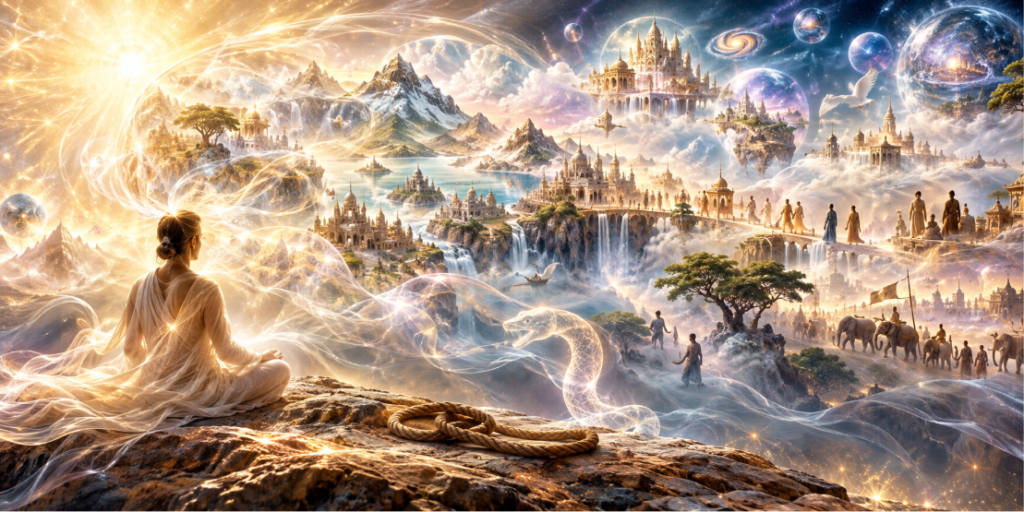
Equanimity Amidst Transience It is only that error of the mind which makes it mistake a rope for a snake; and it is the variety of the thoughts and pursuits of men that makes them roll about in the world. All the gross bodies that are seen here in this world are all the creatures of the working of the mind, like the building of aerial castles in our thought. Unrealities being all untrue, it is true that nothing is lost by their loss. Hence there is no cause for our joy or sorrow in this unreal world. Thus, everything being unreal and a mere cause of delusion, what is there that may be reckoned as the best boon for us that the wise man can desire? But he who considers the world as an unreality is never subject to joy or sorrow at his gain or loss of anything; it is only the ignorant who are elated or depressed at the one or the other.
The Immutability of the Self-Existent
“What was before and what will be in the end, the same is in being (in esse) even at present; therefore, what is always in esse—it is that entity alone that is seen everywhere and at all times.”
Children take a liking for light, empty, and gaudy baubles which are of no good or use to them nor anyone else, and are led to sorrow at their loss rather than derive any good from their gain.
Self-Control as the Path to Elevation
“It is self-control, or the government of one’s own mind, that is the only means of wading through all the troubles, distresses, dangers, and difficulties of this world.”
The goodly disposed mind ever teems with virtues opposed to wrong acts and vice, just as the ground of a good quality grows only good and useful trees in spite of weeds and bushes. The elevation of the mind in worldly affairs tends to its destruction, and its depression in these leads to its spiritual elevation. The wise always lower their minds (pride), but fools are for elevating them to their ruin.
The Mechanism of Rebirth and Desire
The soul is not the man of the world (i.e., no worldly being), nor is it the body or its blood. All material bodies are but gross and dull matter; but the soul in the body is empty air and intangible. Man stretches his own sphere of action by his own option only to entrap himself in it, as the silkworm weaves its cocoon for its own imprisonment.
“As is the desire or thought in the mind, so is it born in its next state of metempsychosis.”
“Hence, the newborn babe is given to sleeping because it thinks itself to be dead and lying in the night-time of its death. It is also given to dreaming of those things which had been the objects of its desire or thought in its previous state or birth.”
The Non-Dual Reality Beyond Appearances
“The perverted mind produces the fruits of its perversion in all its actions, while pure-mindedness is fraught with the effects of its purity everywhere.”
The world is a magical city and like a mirage appearing to sight; it is of the nature of a delusive panorama showing many moons of the one, whose unity admits of no duality. So the one Brahma is represented as many by delusion. “That I am not the infinite but an infinitesimal” is the misjudgment of the ignorant; but the certitude of my infinity and supremacy is the means of my absorption in the Infinite and Supreme.
Conditions for Realizing Brahma
“Perfect transparency of the soul, amounting to its nihility, its want of attachment to visible appearances, and its unmindfulness of all that is—these are the conditions for beholding Brahma in it; there is no other way to this.”
The visibles now present before us, being absent from our view either before or after our sight of them, must be considered as absent in the interim also. Therefore, one unacquainted with his mind is as insensible as the man that knows not what he holds in his hand.
The State of the Enlightened Soul The vanities of the world are fraught with sorrow; therefore, discard all its appendages from thee. The abandonment of superfluity will conduce to thy attainment of wisdom at last. Rely on that eternal Spirit, which is infinite knowledge and felicity, and which is between the viewer and the view (i.e., betwixt the noumenon and the phenomenon).
“The mind being fixed to that truth will adhere to it as clay after the swiftness of its flight is at an end.”
When the channel of our thirst is dried up, when the drinking pots are sucked up and emptied, when the forest of the heart is cleared and its brambles are rooted out, and when the frost of false knowledge has disappeared—then the rivulets of our desires do not run down the rock of the body, nor do the peacocks of our fleeting wishes fly and sport on its top. It sheds its clear lustre all over the world, showing the depths of the hills, forests, and everything on earth in their clearest light. The man whose investigation has made him acquainted with all things, whose soul is enlightened with truth, whose mind is melted down from his high-mindedness, who is calm and quiet in his understanding, and who looks at the unpleasant course of the births and deaths of men with pity—he verily lives happily in the realm of his body without feverish anxieties about anything.
Detached Living and the Wise Hero What pleasure or pain can one derive either from the grandeur or destruction of his aerial castle, and what cause of joy can he have in his ignorant children, or of sorrow upon their death? There is an increase of care with the increase of wealth and family, and there is no happiness in the increase of worldly possessions and affections.
“The abundance of carnal enjoyments, which are delightsome to the ignorant voluptuary, is quite distasteful and disgusting to the abstemious, wise, and learned.“
Therefore, O Rāma, be truly wise in thy conduct in this world; shun the transient as they are transitory, and lay hold on whatever offers of itself unto thee. Placed between the unreality and reality of this and next life, you must have the good sense of sticking to the Truth, and neither wholly reject nor stick to this or the next.
The Mastery of Life-Liberated Beings He who has nothing to desire or leave, but lives as he is obliged to live, has his intellect as unsullied as the lotus-leaf, to which the laving waters never stick. They that have not been swept away by the waves of their desires to the midst of the ocean of this world are said to have got over it; but the others are no doubt drowned and lost in it. In conducting yourself in this world, you should imitate them that are liberated in their lifetime—who are great in their souls and understandings, and who are ever satisfied with themselves—and not follow the examples of the greedy and wicked.
“Great men knowing the truth are never proud of their power, good qualities, honor, or prosperity like vulgar people.”
Great minds like warriors ride in the chariots of their bodies, clad in the armor of their knowledge; they have no desire of their own, but conduct themselves according to the course of time.
Infinite Creations and Cycles of Worlds “I am never satiate with hearing your speech, which is equally copious, clear, and elegant.” There have been various kinds of beings also in many other worlds, having their manners and customs widely differing from one another. Among these, the births of Brahmā and the other gods in different worlds are as wonderful as the productions of many things in a magic show. One Brahmā was lotus-born, another was produced from water, a third was born of an egg, and a fourth was produced in the air. There are some wondrous worlds in the universe, and others more wondrous still; some are luminous and bright, and others whose light has never reached unto us. It may be possible to count the particles of solar rays, but not the number of worlds abounding in the Supreme Spirit. They have been rolling without beginning like the billows of the sea; those that are past and gone had their previous ones, and they their prior ones also.
The Evanescent Nature of Existence There are series of mundane worlds like the egg of Brahmā, which pass away by thousands like hours in the course of a year.
“There will grow many more mundane worlds in the infinity of the divine mind, and they will also vanish away in course of time like evanescent sounds in the air.”
All things are of the manner of sea waves, which vanish no sooner than they appear to view, and they are all of the nature of paintings impressed in the mind.
“The learned in divine knowledge consider the creations proceeding from the Spirit of God as showers of rain falling from the waters contained in the clouds.”
Sometimes the subtle air is solidified in the form of the atmosphere, and therefrom is produced the great Brahmā, thence called the air-borne lord of creatures. At another time it is light that is thickened to a luminous body, and thence is born another Brahmā, bearing the appellation of the luminous lord of all creatures.
“It is by extraction of the essences of these four Brahmās that a fifth is formed under the name of the quintuple Brahmā, who is the creator of the present world.”
The Fancied Manifestations of Divine Will. All these theories of creation in the different śāstras are idle dreams and as false as dreams in our sleeping state; they are the reveries of fancy like the eddies of water. The first divine Male, casts his seed in the waters, which grows up to a lotus-flower which they call the great world. This lotus is the great womb of the birth of Brahmā, and at another time of the sun also; sometimes the gods Varuṇa and Vāyu also are born of it, and are thence called oviparous. It is agreed by all that creation is but the development of the divine mind, although I have related for your acquaintance the various processes of its production. The production and destruction of all bodies are like those of Brahmā and lamps: they assume their forms in their time, but become an undistinguishable mass after death. All things once manifest are next concealed in the divine mind, just as seasonal fruits and flowers disappear after their appearance in season.
The Endless Cycles of Time and Manifestation It is never as it appears to you, but quite a different thing from what it seems to be; it is a show depending on the power of the Omnipotent. All this is Brahma to the intelligent, and there is no such thing as the world, which is a mere theory (upapādya) of the unintelligent. There can be nothing whatever which does not reside in the wide expanse of the Divine mind; but as these are but the conceptions of the mind, they can never have any visible or separate form of existence. The gods and demigods appear again and again, and all people come and depart by turns; bondage and liberation are ever recurrent, and Indras and Somas ever reappear to view. Again, the holy arbour of heaven sheds its heap of flowers on the deserts of meritorious men as rewards for their virtuous acts. Again, the wicked age of Kali appears to soil the holy Satya Yuga, as the black body of Nārāyaṇa fills the clear waters of the deep, or as a blast of wind sweeps the dust of the earth on its pellucid surface. Again, the Pushkara and Āvartaka clouds pour down their rainwater, deluging the tops of boundary mountains and filling the face of the earth with foaming froth, swimming on the surface of one sheet of water. The world appearing so extensive and thickly peopled is but a fancied unreality, like the erroneous appearance of two moons in the sky. It is made of unreality though appearing as real, and is not worth reliance in our ignorance of its nature.
The Solitary Reality of the Sovereign Will Prosperity fades away like a plant encircled by a poisonous viper, and our consorts die away as soon as anything born of blood and flesh. Forsake therefore your desire of enjoyment, and seek to be united with your spiritual essence; because the thought of your materiality (or being a material body), has taken possession of your mind (and separated you from yourself and the spirit of God). Rāma asked:—How does the world become a solid substance, from its having been of a visionary form in the spirit or mind of God? Brahmā conceived at first luminous idea of light, which having assumed a visible form spread on all sides, as a creeping plant is outstretched all about in autumn. The rays of this light pierced all sides like threads of gold; they shone and spread themselves both above and below.
“He held the locks of his flaming hair on his head, which flashed as fire all around him, and filled the sphere of heaven with heat and light.”
Then did Brahmā bring to his recollection the eternal Vedas and the many ceremonial rites which he established as laws in his house of this world. It was he who ordained happiness and misery, birth and death, disease and decay; and he created the passions and feelings of living beings under their threefold divisions of sattva, rajas, and tamas.
Conclusion: The Divine State (Brāhmī Sthiti) The acts of all things in the world are produced by their conception and wishes; and it is the concept or thought that binds the gods also to their destiny. Brahmā then thought in himself: “I have thus stretched out at large the network of my desire; I will now cease from extending the objects of my desire any further.” He beholds the world as a vale of misery with very little happiness in it, where the soul is fast bound to its alternate passions and led by the changes of its hopes and fears. He remains sometimes entirely devoid of all his desires, and at others he takes upon him his cares for mankind from his great kindness to them. I have thus expounded to you concerning the existence of Brahmā (Brāhmī Sthiti), and his real states of Sātvika, Vidhyanika, and Suranika creation. In this manner, O Rāma, has the world come into existence. Its creation is evidently a work of labor, as it is brought into being by various acts of motion and exertion of body and mind; and all these products of the god’s will are sustained also by continuous force and effort on his part.