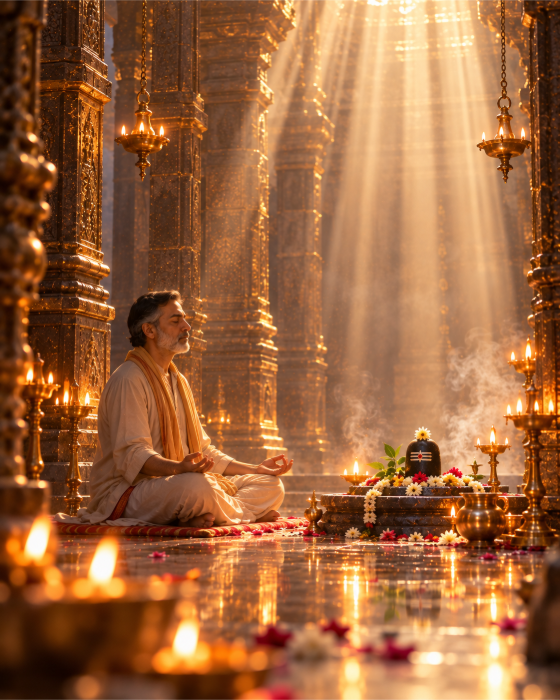
Leaving behind the shores of Saṁsāra to realize the undivided Self
on an Advaita Pilgrimage.
Awakening Beyond Saṁsāra
Advaita Pilgrimage
Step beyond transmigration into the Absolute Reality.
Unfolding into Dvādaśānta: Unveiling the Self
Advaita Pilgrimage
The Sacred Crossing
“A yatra is not measured in the distance covered. It is measured in what falls away.”
The Arc of Jñāna
The Yoga Vāsiṣṭha does not speak of liberation as something granted by a place. It speaks of seven stages by which the jīva moves from bondage to Brahman — a lived structure that forms the arc of this pilgrimage:
Subhecchā: The first stirring toward good.
Vichāranā: Discretion born of right guidance.
Tanumānasā: The thinning of the mind.
Sattā-patti: The turn toward the Self as one’s only true refuge.
Asaṅga: The falling away of clinging.
Padārtha-bhāvanā: The dissolving of the very sense of “thing.”
Turya-gati: The stage that opens into the fourth state itself.
Our pilgrimage is built to walk the seeker through exactly this arc — not as a metaphor, but as a lived structure.
Setting Out and Inquiring
Subhecchā — The setting out itself — the will to leave what is known, because staying has stopped feeling sufficient.
What follows in the presence of the master who has seen it all — who has already stood where truth stands, and returned to point the way.
Vichāranā — This discretion, as the Śāstras say, cannot arise alone, only in the company of one who knows. Here the inquiry begins in earnest:
What is this world I have taken to be so solid? What is this “I” I have taken to be so real?
Thinning and Turning
Tanumānasā — This inquiry is what thins the mind. Not the wearing down of the body, but the direct recognition that the mind itself is not what it claims to be. Mind is only a movement of thought; when action comes to an end, mind comes to an end with it.
Sattā-patti — The fourth is self-reliance, and dependence upon the Divine spirit as the true refuge of this soul. This is attainable by means of the three qualities described above.
The Opening of Turīya
This is where turīya opens. The Vāsiṣṭha calls it “deep sleep in wakefulness” — a state where the outward movement of thought has ceased, where all attachment has been snapped, and only peace remains.
Not the peace of rest after effort, but the peace of the jīva that has stopped being jīva at all — freed from the pull toward objects, freed even from the memory of having sought. This is the sacredness a pilgrimage can offer that no ordinary journey can: not a teaching read about turīya, but a moment lived inside it.
The Invitation
This is why we do not call it a yatra. We call it a sacred pilgrimage — a movement through the seven stages, undertaken in the body, so that what the Śāstras describe as a ladder of knowledge becomes, for a few days, a ladder you actually climb.
The dates of the next Sacred Pilgrimage will be shared here soon.
If you have long wished to experience turīya, not just read of it, register your name today. We will write to you personally on WhatsApp as soon as the Crossing is announced, with the details, the preparation, and your place to confirm.